The nurse is caring for an infant with the below tracing on the electrocardiogram (ECG).
The nurse should plan to take which initial action? See the image below.
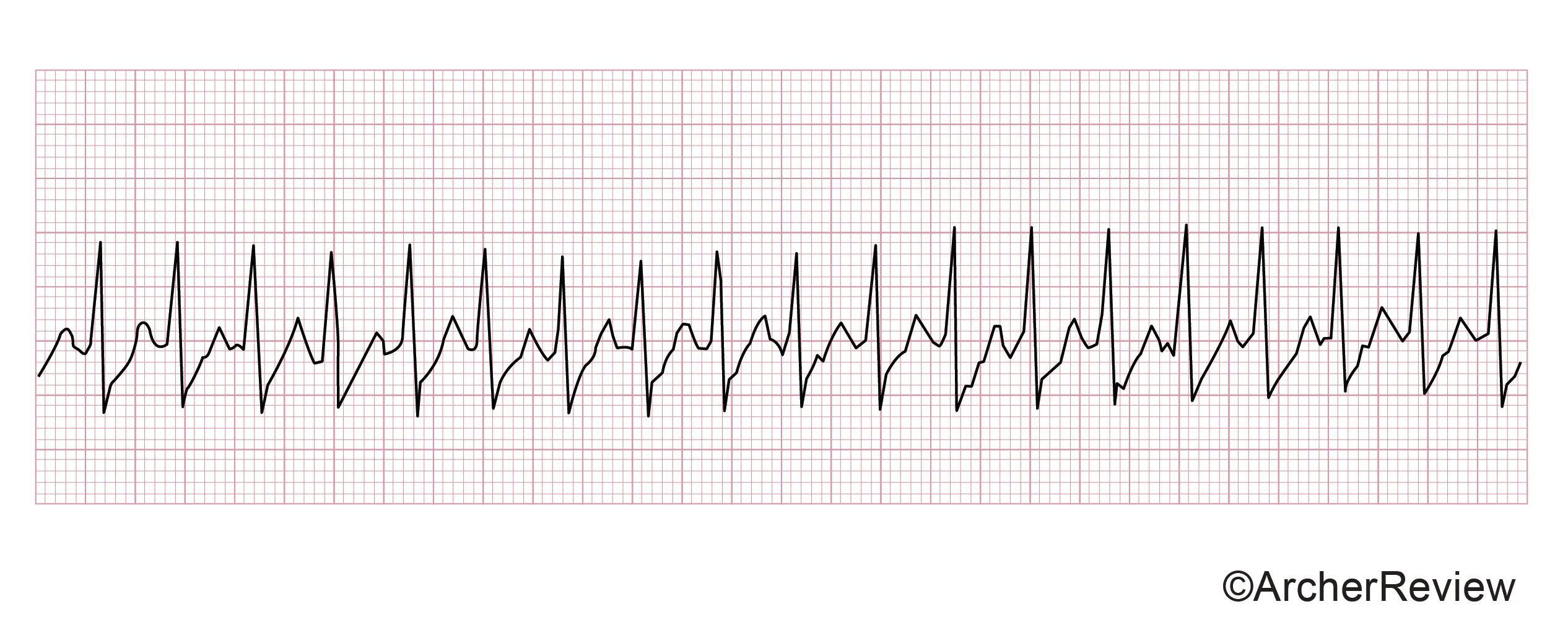
The nurse is caring for an infant with the below tracing on the electrocardiogram (ECG).
The nurse should plan to take which initial action? See the image below.
A. Instruct the infant to bear down.
[14%]
B. Prepare a bag filled with ice and water.
[26%]
C. Assess the infant's axillary temperature.
[24%]
D. Obtain the infant's carotid pulse.
[36%]
Statistics
Subject/Lesson
Subject
Child Health
Lesson
Cardiovascular
Client Need
Test Plan
Physiological Adaptation
Related Topic
Alterations in Body Systems
Item Type
Item Type
Analysis
Explanation
Choice B is correct. This tracing reflects supraventricular tachycardia (SVT), which is concerning because of the very high rate. The rate may be as high as 180 to 280 beats/min in infants. Characteristically, SVT does not have P-waves as they are buried in the T-waves. Preparing a bag filled with ice and water is essential because this may be applied to the face above the nose and mouth for 15 to 30 seconds. If that is ineffective, another vagal maneuver would be pressing the infant's knees to the chest for 15-30 seconds.
Choice A is incorrect. Instructing an infant to bear down would be futile because the infant does not have the cognitive ability to follow this instruction. This is the instruction that could be provided to a child or adult.
Choice C is incorrect. Assessing the infant's axillary temperature would not have clinical significance because of the necessity to break the SVT. While SVT may be caused by severe febrile illness, the infant's rhythm must be corrected.
Choice D is incorrect. An infant's pulse should be obtained via the brachial artery, not the carotid artery.
Related Videos
2 Key Topics
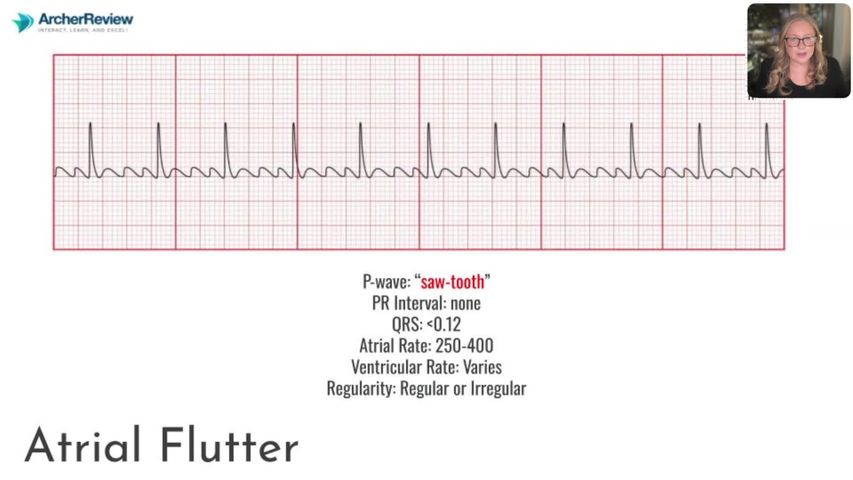
Supraventricular Tachycardia
7.5 Atrial Dysrhythmias
Additional Info
✓ During SVT, P waves may not be visible because the P waves are embedded in the preceding T wave
✓ A client with SVT may be asymptomatic. If the client is symptomatic, they may exhibit manifestations such as palpitations, dizziness, dyspnea, and nervousness
✓ Treatment includes vagal maneuvers. Vagal maneuvers include having the beardown, blowing through a straw, having the primary healthcare provider (PHCP) perform a carotid massage, and, if the client is an infant, applying a bag filled with ice and water to the face above the nose and mouth for 15 to 30 seconds. If that is ineffective, another vagal maneuver would be pressing the infant's knees to the chest for 15-30 seconds.
✓ If these measures are ineffective, the nurse should prepare to administer the prescribed adenosine by rapid intravenous push (IVP) that is followed by a flush of 0.9% saline.
✓ When adenosine is administered, the emergency (code) cart should be nearby, and the nurse should always have additional personnel in the room.
