The nurse is assessing a client receiving intravenous (IV) fluids via a peripheral vascular access device (PVAD). Assessment findings show swelling and tenderness at the infusion site. The nurse should perform which action?
The nurse is assessing a client receiving intravenous (IV) fluids via a peripheral vascular access device (PVAD). Assessment findings show swelling and tenderness at the infusion site. The nurse should perform which action?
A. stop the infusion and remove the PVAD
[95%]
B. remove the dressing and reposition the PVAD
[2%]
C. instruct the client to perform range of motion activities in the affected arm
[1%]
D. place the arm in a dependent position
[2%]
Statistics
Subject/Lesson
Subject
Pharmacology
Lesson
Medication Administration
Client Need
Test Plan
Pharmacological and Parenteral Therapies
Related Topic
Parenteral/IV Therapies
Item Type
Item Type
Application
Explanation
Choice A is correct. This assessment findings indicate that the client is experiencing infiltration. Infiltration is when the catheter migrates out of the vein, and the fluid leaks into the surrounding tissue. The nurse must stop/pause the IV fluids and discontinue the PVAD.
Choice B is incorrect. The nurse must discontinue the PVAD and restart it on the opposite extremity. The nurse should elevate the affected extremity and apply a warm compress. The nurse should not remove the dressing and reposition the catheter as this will contaminate the PVAD.
Choice C is incorrect. The nurse must render care, such as removing the PVAD, elevating the affected extremity, and applying a compress. Performing range of motion activities is not appropriate in treating infiltration.
Choice D is incorrect. The nurse should elevate the client's affected extremity to reduce the edema. The nurse should not put the extremity in the dependent position (below the heart) as this would not assist in reducing swelling.
Related Videos
2 Key Topics
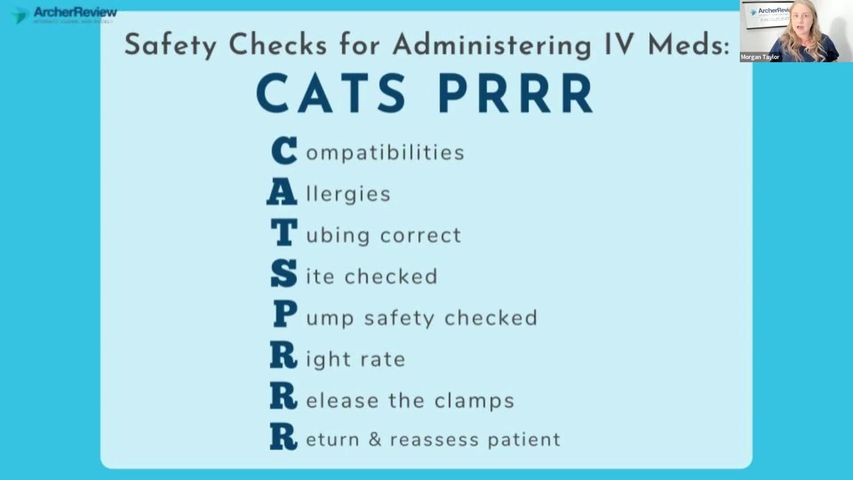
Intravenous Administration
10.3 Intravenous Medication Administration
Additional Info
✓ Infiltration occurs when the intravenous catheter migrates out of the vein.
✓ The intravenous catheter migration is often caused by the catheter not being secured to the client's skin.
✓ When infiltration occurs, the medication leaks into the tissues around the vein.
✓ Manifestations of infiltration include swelling, coolness, tingling, or redness at the IV site.
✓ Treatment for infiltration includes pausing the infusion, discontinuing the IV catheter, and elevating the extremity above the heart.
✓ Extravasation is significantly worse than infiltration because the medication leaks into the surrounding tissue, and the medication is a vesicant.
✓ A vesicant is a medication with a low pH or may cause significant irritation to the surrounding tissue.
✓ If extravasation occurs, the nurse should pause the infusion and aspirate any medication in the IV catheter.
✓ The nurse should not flush the IV catheter, which will further cause more damage. The catheter should be discontinued, and the physician should be notified.
