The nurse in the physician's office cares for a client looking to establish care
Item 1 of 1
- Nurses' Notes
1709: 58-year-old African American male presents to the office looking to establish primary care. The client has not had a primary healthcare provider in over eleven years. The client requests a physical examination. The client reports that two months ago, he started noticing changes in his bowel habits, which alternate between diarrhea and constipation. The symptoms are accompanied by occasional dark, tarry stools. This past week, he has had constant abdominal pain that has ranged from a 5/10 to a 7/10 on the Numerical Rating Scale. He describes the pain as 'dull.' He reports that his diet has not changed, and he primarily eats red meat and sandwiches made with luncheon meats and occasionally vegetables. Currently, the client takes a daily aspirin and a multivitamin. He reports a medical history of oral herpes simplex and high blood pressure. He is overweight. He smokes cigarettes daily. On assessment, the client is alert and fully oriented, skin is warm and dry. Lung sounds are clear; the apical pulse is regular. Bowel sounds are active in all quadrants, with no abdominal distention. Capillary refill less than 3 seconds. Peripheral pulses palpable, 2+. Vital signs: T 97.5° F (36.4° C), P 97, RR 18, BP 161/92, pulse oximetry reading 96% on room air.
- Laboratory Results
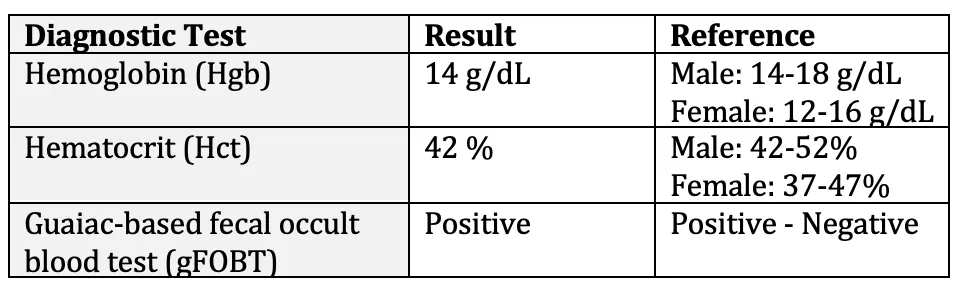
1741:
- Orders
1719:
- Point of care (POC) hemoglobin and hematocrit
- Guaiac-based fecal occult blood test (gFOBT)
The nurse is reviewing the client's assessment data to prepare the client's plan of care.
Complete the diagram by dragging from the choices below to specify what condition the client is most likely experiencing, two (2) actions the nurse should take to address that condition, and two (2) parameters the nurse should monitor to assess the client's progress.
The nurse is reviewing the client's assessment data to prepare the client's plan of care.
Complete the diagram by dragging from the choices below to specify what condition the client is most likely experiencing, two (2) actions the nurse should take to address that condition, and two (2) parameters the nurse should monitor to assess the client's progress.
Actions to Take
- obtain an order for serum type and screen
- educate the client on adopting a high fiber diet
Condition Most Likely Experiencing
- bowel obstruction
- colon cancer
- peptic ulcer disease
Parameter to Monitor
- pain level
- serum glucose level
Statistics
Subject/Lesson
Subject
Adult Health
Lesson
Gastrointestinal
Client Need
Test Plan
Reduction of Risk Potential
Related Topic
Potential for Alterations in Body Systems
Item Type
Item Type
NgnAll
Explanation
Condition Most Likely Experiencing
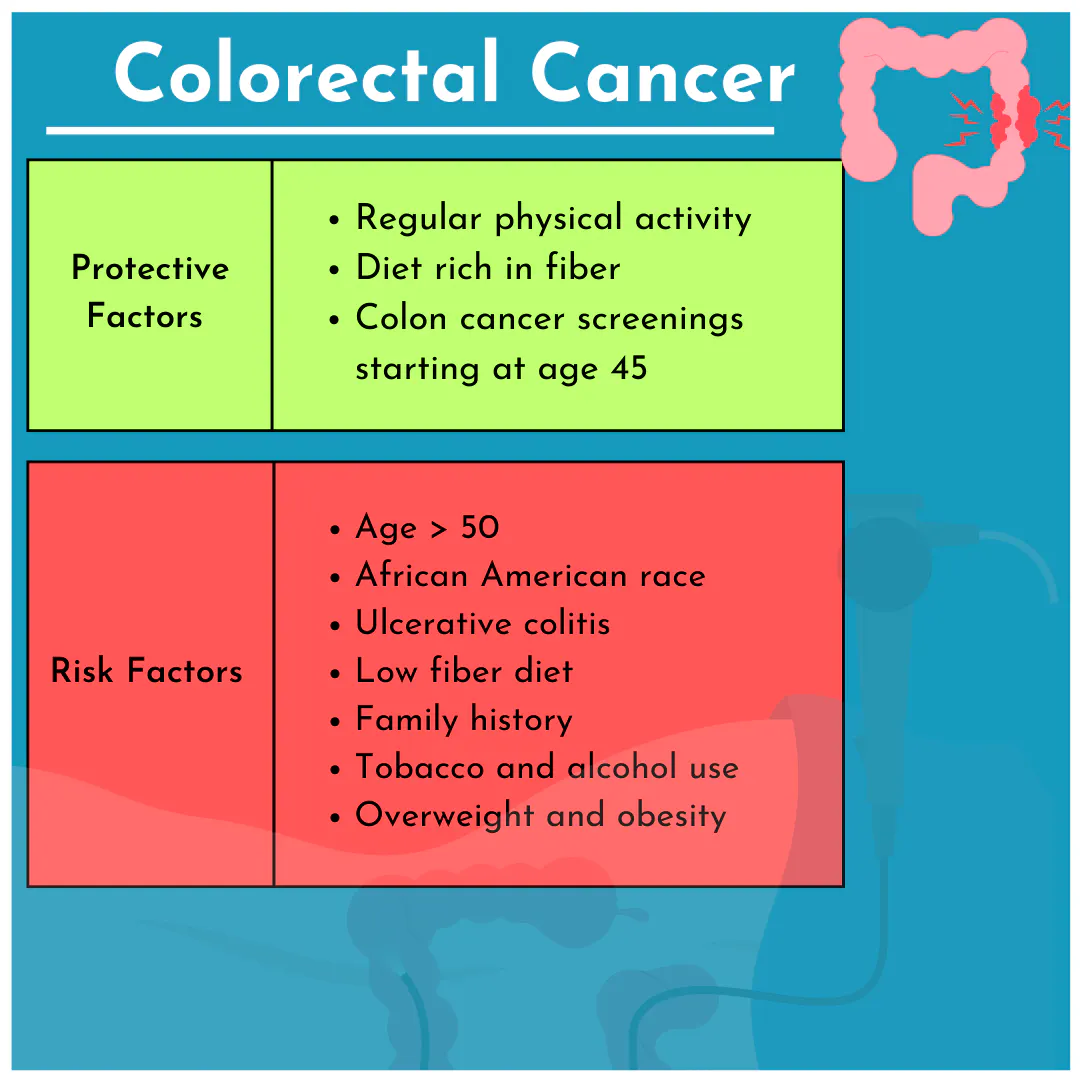
- The client is most likely experiencing colon cancer. While confirmation needs to be done with a biopsy via colonoscopy, the client's gastrointestinal bleeding, change in bowel habits, abdominal pain, and other risk factors of a low-fiber diet, cigarette smoking, and being overweight best support this potential condition.
- Bowel obstruction is unlikely because the client has bowel sounds in all quadrants and has not experienced any obstipation (obstipation is when an individual has no passage of stool). Additionally, the client does not experience any nausea or vomiting. All of which may be found in a bowel obstruction.
- Ulcerative colitis (UC) is unlikely because UC causes an individual to have tenesmus (an unpleasant and urgent sensation to defecate) and multiple bloody stools. The client does not endorse this.
- Peptic ulcer disease is unlikely because the client does not characterize his abdominal pain as worsening or abating with food. While he does smoke (a risk factor for peptic ulcer disease), the abdominal pain is constant and is accompanied by constipation and diarrhea. Constipation is not a finding associated with peptic ulcer disease.
Actions to Take
- To confirm colon cancer, a biopsy needs to be performed via a colonoscopy. This would be a definitive way to rule out this diagnosis and appropriately classify the cancer.
- The client should be instructed about a high-fiber diet. A high-fiber diet may help with his constipation and provide additional health benefits.
- The client's hemoglobin is within normal limits; a serum type and screening are unnecessary. Transfusion of packed red blood cells is usually recommended when the hemoglobin is 7 g/dL or less.
- Oral corticosteroids are not necessary. This would be helpful in the treatment of an exacerbation of ulcerative colitis. However, the client is not experiencing ulcerative colitis.
Parameters to Monitor
- The nurse should monitor the client's bowel elimination pattern or habits since they are altered. Additionally, the client has occult blood in their stool, which warrants further monitoring.
- The client endorses abdominal pain, and this should be monitored.
- Glucose level and WBC count do not need to be monitored. These parameters should be monitored if a client takes a steroid or is experiencing an infection, but not in this case.
Related Videos
2 Key Topics
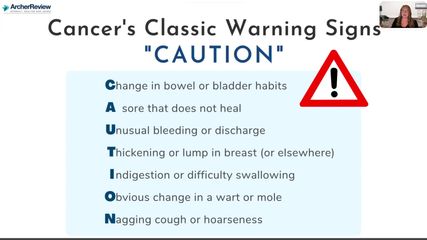
Cancer Warning Signs
33.2 General Cancer Signs & Treatment Precautions
Additional Info