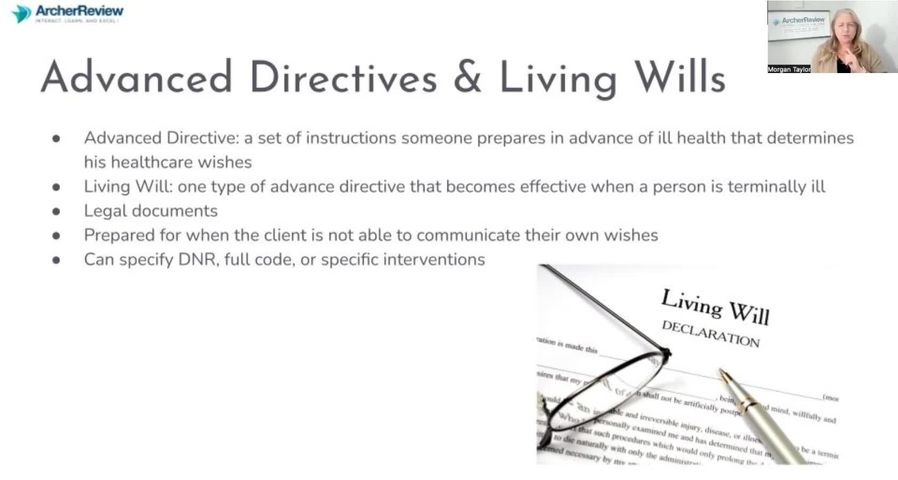
A patient has completed a living will stating that he does not want intubation, mechanical ventilation, or artificial nutrition/hydration should he become unable to communicate his preferences related to medical care. However, the patient’s adult children have expressed their opposition to the patient’s wishes. Which are appropriate nursing actions?
Select all that apply.
A patient has completed a living will stating that he does not want intubation, mechanical ventilation, or artificial nutrition/hydration should he become unable to communicate his preferences related to medical care. However, the patient’s adult children have expressed their opposition to the patient’s wishes. Which are appropriate nursing actions?
Select all that apply.
Statistics
Subject/Lesson
Subject
Leadership & Management
Lesson
Ethical/Legal
Client Need
Test Plan
Management of Care
Related Topic
Advance Directives
Item Type
Item Type
Application
Explanation
Choices A, C, and D are correct. Should such a conflict be observed, the nurse should notify the patient’s physician, the nursing supervisor, and the risk manager. It is also important to encourage the family to discuss the issue among themselves and with the above individuals, to resolve the conflict. A consult with the ethics committee may also be indicated.
Choice B is incorrect. The patient may revoke or change an advance directive at any time, either orally or in writing.
Choice E is incorrect. By law, the patient has a right to autonomy and self-determination, including the right to choose and refuse treatment.
Bloom’s Taxonomy – Analyzing
Related Videos
2 Key Topics
Advanced Directives & Living Wills
