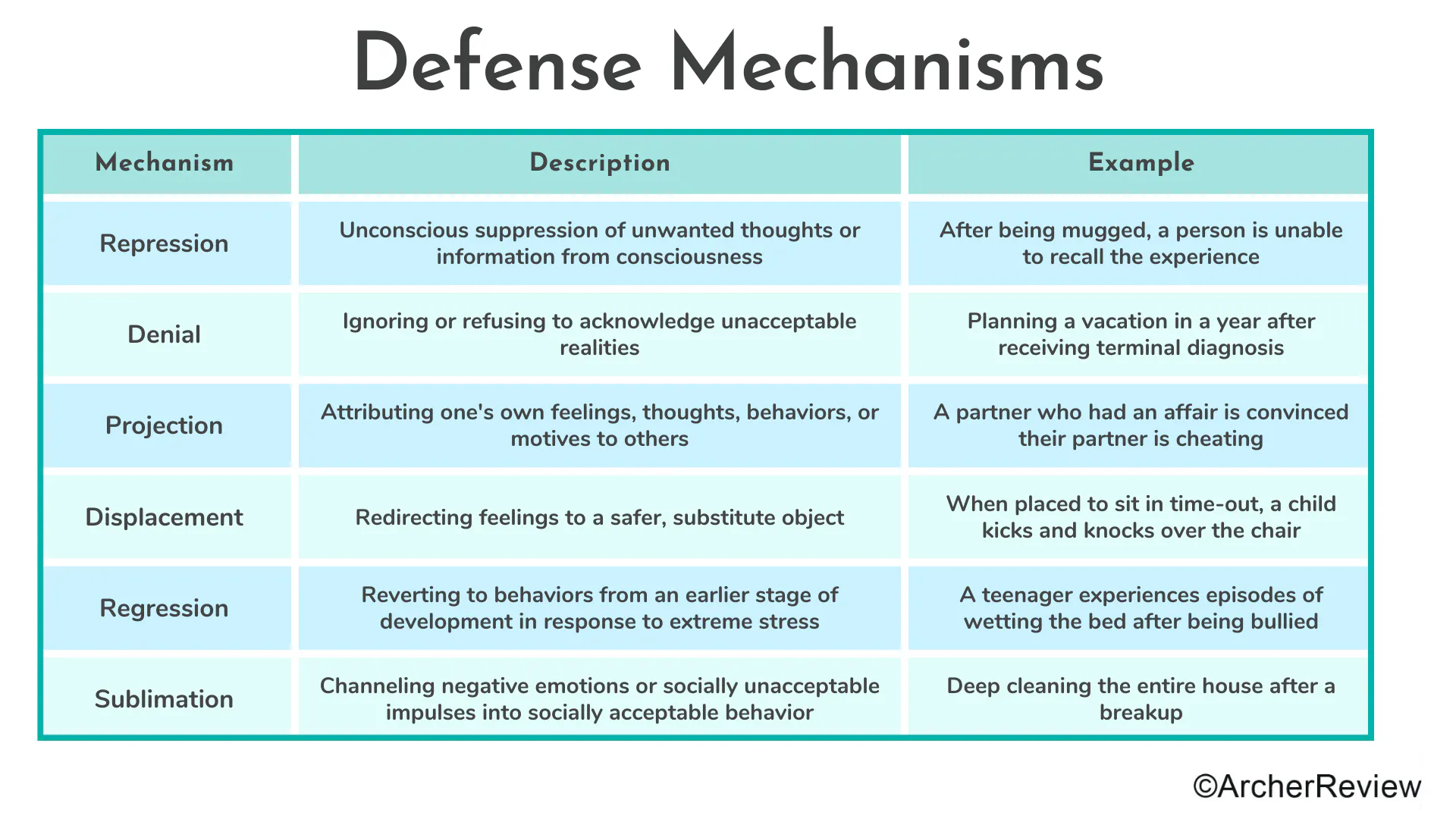
The nurse is performing an admission assessment on a client admitted to the behavioral health unit. The client is reporting new-onset blindness after witnessing a traumatic motor vehicle accident. The nurse suspects that this client is using which defense mechanism?
The nurse is performing an admission assessment on a client admitted to the behavioral health unit. The client is reporting new-onset blindness after witnessing a traumatic motor vehicle accident. The nurse suspects that this client is using which defense mechanism?
A. suppression
[22%]
B. conversion
[42%]
C. displacement
[16%]
D. dissociation
[20%]
Statistics
Subject/Lesson
Subject
Mental Health
Lesson
Mental Health
Client Need
Test Plan
Psychosocial Integrity
Related Topic
Coping Mechanisms
Item Type
Item Type
Analysis
Explanation
Choice B is correct. Converting anxiety into physical symptoms with no organic cause best explains this defense mechanism this client is experiencing. Conversion is a pathological defense that may manifest as a disorder if it continues to recur. The accident traumatized this client and converted his anxiety into a physical symptom (blindness). His new-onset blindness has no organic origin; thus, this exemplifies conversion.
Choices A, C, and D are incorrect. Suppression is defined as the conscious decision to delay addressing a disturbing situation. The client does not exhibit this avoidance because they have taken their anxiety and manifested it as a physical ailment that cannot be explained. Displacement is the transference of emotions associated with a particular person, object, or situation to another non-threatening person, object, or situation. This client has not transferred their anxiety to someone (or something). Finally, dissociation is a disruption in consciousness, memory, identity, or perception of the environment that results in compartmentalizing uncomfortable or unpleasant aspects of oneself. This client has no evidence of a disruption in their consciousness, memory, or identity.
Related Videos
4 Key Topics
Defense Mechanisms in Mental Health
32.2 Psychological Concepts & Safety
Defense Mechanisms
13.1 Psychosocial Stressors & Coping
Additional Info
✓ Adaptive use of defense mechanisms helps people lower their anxiety levels and achieve their goals in acceptable ways.
✓ Maladaptive use of defense mechanisms occurs when one or several are used to excess, particularly immature defenses.
✓ Most defense mechanisms can be used in both healthy and unhealthy ways. People generally use a variety of defense mechanisms but not always to the same degree.
✓ Defenses range from immature (e.g., projection, denial, and splitting) to mature (e.g., altruism, sublimation, and humor).