The nurse is performing an assessment for a client who is pregnant in her third trimester. The nurse assessed several bruises in various stages of healing on her arms and upper back. The nurse plans on assessing the client for
The nurse is performing an assessment for a client who is pregnant in her third trimester. The nurse assessed several bruises in various stages of healing on her arms and upper back. The nurse plans on assessing the client for
A. major depressive disorder.
[2%]
B. iron-deficiency anemia.
[7%]
C. intimate partner violence (IPV).
[89%]
D. polycythemia vera.
[2%]
Statistics
Subject/Lesson
Subject
Maternal & Newborn Health
Lesson
Antepartum
Client Need
Test Plan
Psychosocial Integrity
Related Topic
Abuse/Neglect
Item Type
Item Type
Application
Explanation
Choice C is correct. The incidence of IPV intensifies while a woman is pregnant. Signs of IPV while pregnant include the late onset of prenatal care, unexplained bruising, and depression. Other symptoms include problems adhering to prenatal care, missed appointments, and drug or alcohol abuse.
Choice A is incorrect. Depression may occur during pregnancy; however, unexplained bruising is not an anticipated finding in a depressed patient. If the client were engaging in self-injurious behavior, this would be commonly found on the wrists and forearms. It is difficult to connect self-injurious behavior to the bruises found on the client's upper back.
Choice B is incorrect. Anemia may cause a client to develop pallor, fatigue, yellowing of the eyes, and palpitations. Bruising is not an expected finding of this type of anemia.
Choice D is incorrect. Polycythemia vera is a condition in which the client has an overproduction of red blood cells. While this may cause a client to have bruising, the bruises are generalized, and the manifestations do not abruptly start in the third trimester.
Related Videos
3 Key Topics
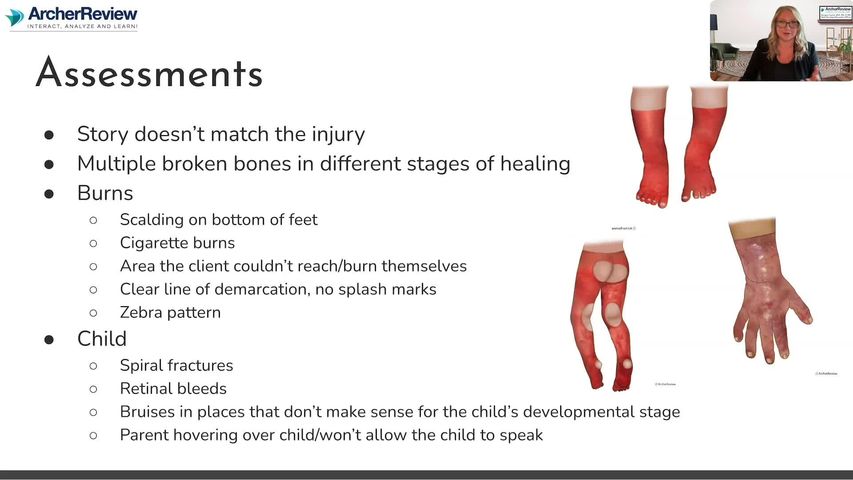
Abuse
13.1 Psychosocial Stressors & Coping
Additional Info
✓ Intimate partner violence (IPV) could be a current or previous partner or spouse
✓ IPV occurs in heterosexual and same-sex relationships where intimacy may not be present
✓ Nurses should assess all clients for IPV
✓ IPV may be physical, psychological (emotional), sexual, financial, stalking, neglect, or abandonment
✓ Nurses should inform clients that information regarding IPV will be kept confidential and shared with the treating physician
✓ The nurse should also inform the client that most jurisdictions require reporting of IPV; the nurse should inform the client that any IPV will be reported
✓ Interactions between the victim and the perpetrator may demonstrate the victim seeking approval from the perpetrator, the perpetrator is reluctant to leave the victim alone, or frequent interruptions during the assessment
✓ Cases of IPV reported by the nurse are kept anonymous, and that should not dissuade the nurse from reporting
✓ It is not enough for the nurse to report suspicions of abuse to the supervisor; that does not absolve the nurses' legal and ethical responsibility to report the IPV
