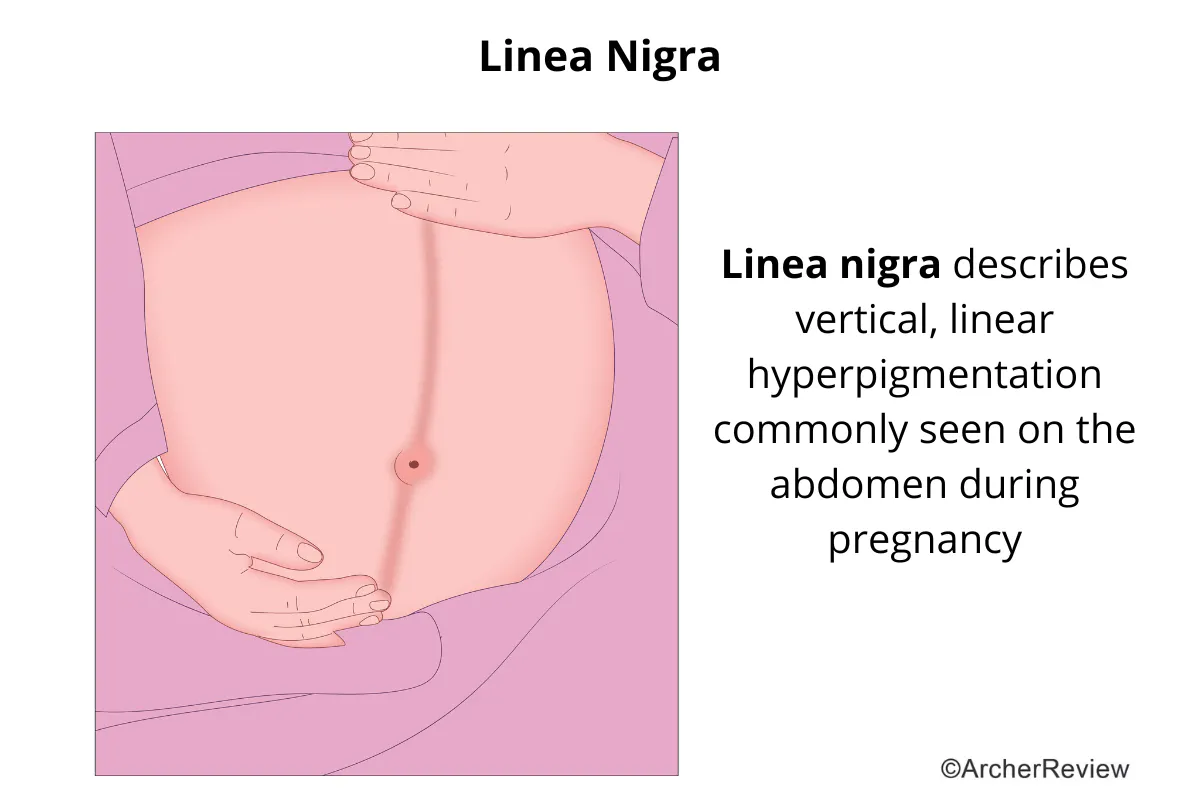
The nurse is caring for a client in the first trimester of pregnancy who reports having a darkened vertical line present on the midline of the abdomen.
The nurse should document this finding as
The nurse is caring for a client in the first trimester of pregnancy who reports having a darkened vertical line present on the midline of the abdomen.
The nurse should document this finding as
A. melasma
[1%]
B. linea nigra
[93%]
C. varicose veins
[0%]
D. striae gravidarum
[6%]
Statistics
Subject/Lesson
Subject
Maternal & Newborn Health
Lesson
Antepartum
Client Need
Test Plan
Health Promotion and Maintenance
Related Topic
Ante/Intra/Postpartum and Newborn Care
Item Type
Item Type
Knowledge/Comprehension
Explanation
Choice B is correct. The linea alba is the line that marks the longitudinal division of the midline of the abdomen—darkens to become the linea nigra due to hormone changes during pregnancy. This dark pigmentation may extend from the symphysis pubis to the top of the fundus and becomes darker as pregnancy progresses. This hyperpigmentation is temporary and typically disappears after childbirth due to hormonal changes during pregnancy.
Choice A is incorrect. Melasma are brownish patches on the forehead, cheeks, and bridge of the nose. Melasma increases with sunlight and can be reduced with the client applying sunscreen.
Choice C is incorrect. Varicose veins develop during pregnancy because of the pooling of blood in deep and superficial veins, which causes distention.
Choice D is incorrect. Striae gravidarum (stretch marks) develops during pregnancy when connective tissues in the abdomen and breasts are stretched.
Learning Objective
Recognize that a linea nigra is a temporary hyperpigmentation that appears vertically down the abdomen due to hormone changes during pregnancy.
Related Videos
2 Key Topics
Skin Changes & Rashes
28.4 Pregnancy Documentation & Physical Changes
Additional Info
✓ Those with darker complexions tend to have a more pronounced linea nigra than those with fair complexions.
✓ In most individuals, the linea nigra darkens enough to be visible in the second trimester.
✓ Following delivery, fading is gradual, occurring over several weeks or months.
✓ The exact cause of linea nigra is unknown, but the hypothesis is that the melanocyte-stimulating hormone created by the placenta causes melanin to rise during pregnancy.