A G1P0 client currently in the 28th week of gestation whose blood type is A negative was advised to receive a Rho(D) immune globulin intramuscular injection today. Which statement by the client indicates the need for further teaching about this therapy by the nurse?
A G1P0 client currently in the 28th week of gestation whose blood type is A negative was advised to receive a Rho(D) immune globulin intramuscular injection today. Which statement by the client indicates the need for further teaching about this therapy by the nurse?
A. "This shot is meant to prevent my baby from developing antibodies against my blood, right?"
[43%]
B. "I understand that if we find out my baby is Rh-positive, I'll need another one of these injections after delivery."
[15%]
C. "This shot should help to protect future pregnancies if this baby comes out Rh positive, although each future pregnancy will require a repeat dose."
[21%]
D. "This shot will prevent me from making Rh antibodies."
[21%]
Statistics
Subject/Lesson
Subject
Maternal & Newborn Health
Lesson
Antepartum
Client Need
Test Plan
Pharmacological and Parenteral Therapies
Related Topic
Expected Actions/Outcomes
Item Type
Item Type
Application
Explanation
Choice A is correct. Rho(D) immune globulin is administered to Rh-negative mothers to prevent them from producing antibodies against any Rh-positive fetus. "This shot is meant to prevent my baby from developing antibodies against my blood, right?" indicates that the client needs further teaching, as the client is incorrectly summarizing what occurs during Rh incompatibility. During a pregnancy, Rh antibodies produced in the woman's body can cross the placenta and attack fetal blood cells. This can lead to serious health problems, even death, for a fetus or a newborn.
Choice B is incorrect. The greatest chance that the blood of an Rh-positive fetus will enter the bloodstream of an Rh-negative client occurs during delivery. In these cases, the client will require a second Rho(D) immune globulin intramuscular injection.
Choice C is incorrect. Rho(D) immune globulin intramuscular injection prevents an Rh-negative client from making antibodies that could affect future pregnancies. Each treatment is good only for the pregnancy for which it is given. Each subsequent pregnancy and delivery of an Rh-positive baby will require a repeat dose of Rho(D) immune globulin.
Choice D is incorrect. Rho(D) immune globulin prevents maternal sensitization of Rh-positive blood by stopping the body from making Rh antibodies. This can prevent serious health problems, even death, for a fetus or a newborn in current or future pregnancies.
Learning Objective
In a client requiring a Rho(D) immune globulin intramuscular injection, identify the client's statement, "This shot is meant to prevent my baby from developing antibodies against my blood, right?" indicates the need for further teaching by the nurse.
Related Videos
2 Key Topics
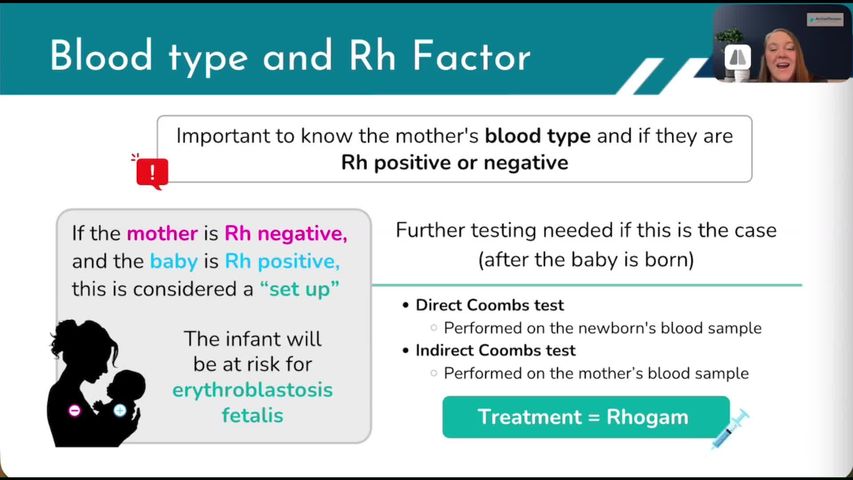
Blood Type & Rh Factor
28.3 Routine Prenatal Screening
Additional Info
- During pregnancy, a single dose of Rho(D) immune globulin should be given prophylactically at weeks 26 to 28 and again within 72 hours of delivery of an Rh-positive infant.
- Rh factor is an inherited protein (passed down from parent to child) that is attached to one's red blood cells.
- Health problems usually do not occur during an Rh-negative client's initial pregnancy with an Rh-positive fetus, as the client's body has not had the opportunity to develop many antibodies.
- An Rh-negative client can also make antibodies following a miscarriage, ectopic pregnancy, and/or an induced abortion. If an Rh-negative client becomes pregnant after one of these events and has not received Rho(D) immune globulin treatment, any future fetus will be at risk of complications if it is Rh-positive.
