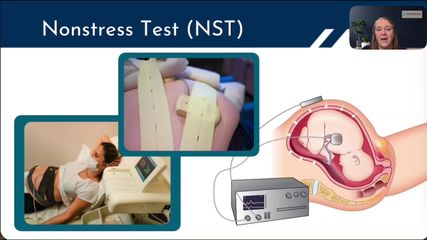
A nurse is performing a nonstress test (NST) on a client at 37 weeks gestation.
Which of the following findings indicates a reactive result?
A nurse is performing a nonstress test (NST) on a client at 37 weeks gestation.
Which of the following findings indicates a reactive result?
A. no fetal heart rate accelerations noted in 40 minutes
[5%]
B. two fetal heart rate accelerations of 15 bpm lasting 15 seconds within 20 minutes
[76%]
C. one acceleration with fetal movement in 20 minutes
[5%]
D. fetal heart rate baseline of 160 bpm with moderate variability
[14%]
Statistics
Subject/Lesson
Subject
Maternal & Newborn Health
Lesson
Antepartum
Client Need
Test Plan
Health Promotion and Maintenance
Related Topic
Ante/Intra/Postpartum and Newborn Care
Item Type
Item Type
Application
Explanation
Choice B is correct. A reactive NST result is defined as two accelerations of 15 beats/min lasting at least 15 seconds within 20 minutes for a fetus ≥32 weeks gestation.
Choice A is incorrect. This is a nonreactive result and may warrant further testing.
Choice C is incorrect. One acceleration is not sufficient to qualify the test as reactive.
Choice D is incorrect. Although the baseline and variability are normal, they do not alone determine NST reactivity.
Learning Objective
Interpret results of nonstress testing to determine fetal well-being and reduce perinatal risk.
Related Videos
3 Key Topics
Nonstress Test
29.3 Fetal Assessment Tests
Additional Info
✓ NST is a noninvasive way to assess fetal well-being and oxygenation.
✓ A nonreactive result may lead to a biophysical profile or contraction stress test.
