A 28-week pregnant client is advised by her provider to receive an Rh immune globulin (RhoGAM) injection.
The client asks the nurse the reason for the medication. The nurse should inform the client that this medication
A 28-week pregnant client is advised by her provider to receive an Rh immune globulin (RhoGAM) injection.
The client asks the nurse the reason for the medication. The nurse should inform the client that this medication
A. prevents measles during pregnancy.
[1%]
B. prevents you from forming antibodies against your baby.
[95%]
C. prevents jaundice in your baby.
[1%]
D. prevents autosomal abnormalities.
[3%]
Statistics
Subject/Lesson
Subject
Maternal & Newborn Health
Lesson
Antepartum
Client Need
Test Plan
Pharmacological and Parenteral Therapies
Related Topic
Expected Actions/Outcomes
Item Type
Item Type
Knowledge/Comprehension
Explanation
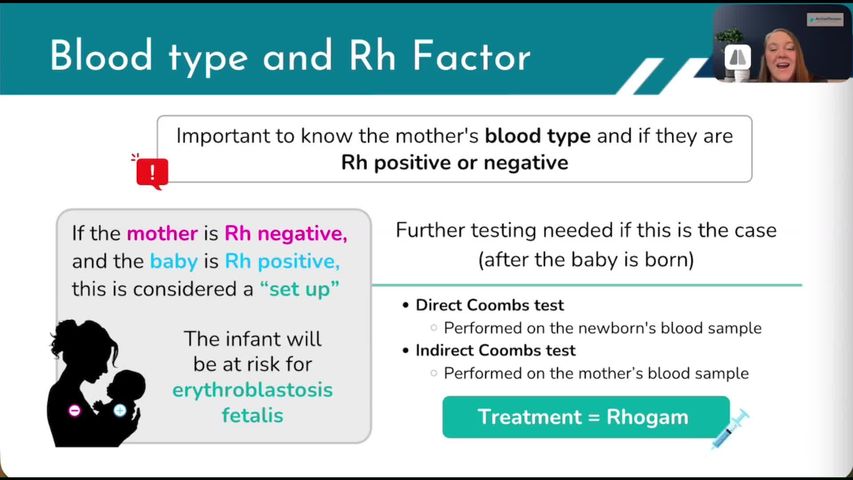
Choice B is correct. In Rh-negative clients, exposure to Rh-positive fetal blood can trigger an immune response, leading to the production of antibodies against the Rh antigen. These antibodies can cross the placenta, attacking the red blood cells of an Rh-positive fetus, resulting in hemolytic disease of the newborn (HDN), characterized by severe anemia, jaundice, or even hydrops fetalis. RhoGAM is a passive immunization that binds to any fetal Rh-positive cells in the maternal bloodstream and prevents the maternal immune system from recognizing them as foreign. The administration of RhoGAM is repeated after birth if the woman delivers an Rh-positive infant.
Choice A is incorrect. RhoGAM is not a vaccine and has no role in preventing viral infections such as measles. Measles immunity is typically achieved via the MMR (measles, mumps, rubella) vaccine, which is contraindicated in pregnancy due to it being a live virus vaccine.
Choice C is incorrect. Neonatal jaundice can result from many causes, including blood incompatibility, but RhoGAM does not directly prevent jaundice. Instead, it prevents maternal sensitization; if sensitization were to occur and the fetus were affected, jaundice could be one downstream effect, but this is not the primary action of RhoGAM.
Choice D is incorrect. RhoGAM has no effect on autosomal abnormalities, which are genetic conditions involving non-sex chromosomes (e.g., cystic fibrosis, Down syndrome). It is an immunologic intervention, not a genetic therapy.
Learning Objective
Correlate the administration of Rh immune globulin (RhoGAM) injections to pregnant women to prevent the formation of antibodies against the fetus.
Related Videos
2 Key Topics
Blood Type & Rh Factor
28.3 Routine Prenatal Screening
Additional Info
✓ As a precaution, women who have Rh-negative blood are given an injection of Rh antibodies at each of the following times:
- At 28 weeks of pregnancy
- Within 72 hours after delivery of a baby who has Rh-positive blood, even after a miscarriage or an abortion
- After any episode of vaginal bleeding during pregnancy
- After amniocentesis or chorionic villus sampling
✓Monitoring for signs of Rh sensitization is vital for Rh-negative clients, which can include indirect Coombs tests to detect antibodies in the mother's blood during pregnancy and direct Coombs tests in the newborn to identify antibody-coated red blood cells.
✓ Sometimes, when large amounts of the fetus's blood enter the woman's bloodstream, additional injections are needed.
