During a prenatal visit, a pregnant client is found to have Rh-negative blood type. The nurse knows that Rh-negative clients are at risk for Rh isoimmunization. What intervention is essential for preventing Rh isoimmunization in this client?
During a prenatal visit, a pregnant client is found to have Rh-negative blood type. The nurse knows that Rh-negative clients are at risk for Rh isoimmunization. What intervention is essential for preventing Rh isoimmunization in this client?
A. Administer Rh immunoglobulin (RhoGAM) at 28 weeks
[97%]
B. Initiate early induction of labor
[1%]
C. Administer folic acid supplementation
[2%]
D. Recommend avoiding travel during the third trimester
[1%]
Statistics
Subject/Lesson
Subject
Maternal & Newborn Health
Lesson
Antepartum
Client Need
Test Plan
Physiological Adaptation
Related Topic
Alterations in Body Systems
Item Type
Item Type
Application
Explanation
Choice A is correct. Rh-negative pregnant clients are at risk for Rh isoimmunization if they are exposed to Rh-positive blood, such as during childbirth. Administering Rh immunoglobulin (RhoGAM) at 28 weeks and again within 72 hours after childbirth helps prevent the development of antibodies against Rh-positive blood.
Choice B is incorrect. Initiating early induction of labor is not a standard intervention for preventing Rh isoimmunization.
Choice C is incorrect. Administering folic acid supplementation is important for preventing neural tube defects, but it is not specifically related to preventing Rh isoimmunization.
Choice D is incorrect. Recommending avoiding travel during the third trimester is not a standard intervention for preventing Rh isoimmunization. Travel restrictions are generally based on other considerations, such as the risk of preterm labor or other complications.
Related Videos
2 Key Topics
Blood Type & Rh Factor
28.3 Routine Prenatal Screening
Additional Info
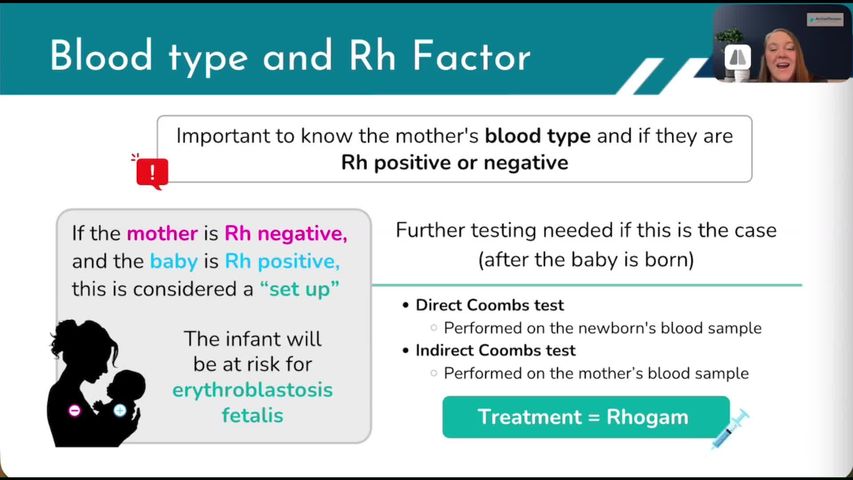
✓ Rh isoimmunization, also known as Rh incompatibility or Rh disease, is a condition that occurs when there is a mismatch in the Rh factor between the blood of a pregnant woman and her developing fetus. The Rh factor is a protein that can be present on the surface of red blood cells, and individuals are classified as Rh-positive or Rh-negative based on the presence or absence of this protein.
✓ The most significant risk is the development of Hemolytic Disease in the Newborn. If an Rh-negative mother produces antibodies against Rh-positive blood cells and these antibodies cross the placenta, they can attack and destroy the red blood cells of an Rh-positive fetus.
✓ Educate the client about the importance of Rh immunoglobulin administration and the potential risks associated with Rh isoimmunization. Discuss the timing of RhoGAM injections, emphasizing the significance of receiving it around 28 weeks of gestation and within 72 hours after childbirth if the baby is Rh-positive.
