The nurse is caring for a pregnant client who is 37 weeks gestation and has come to the emergency department. The client reports severe abdominal pain and significant vaginal bleeding.
Which assessment by the nurse would be contraindicated at this time?
The nurse is caring for a pregnant client who is 37 weeks gestation and has come to the emergency department. The client reports severe abdominal pain and significant vaginal bleeding.
Which assessment by the nurse would be contraindicated at this time?
A. External fetal heart rate monitoring
[7%]
B. Abdominal palpation
[13%]
C. Measurement of vital signs
[2%]
D. Internal vaginal examination
[77%]
Statistics
Subject/Lesson
Subject
Maternal & Newborn Health
Lesson
Antepartum
Client Need
Test Plan
Reduction of Risk Potential
Related Topic
Potential for Complications from Surgical Procedures and Health Alterations
Item Type
Item Type
Analysis
Explanation
Choice D is correct. An internal vaginal examination is contraindicated In the presence of vaginal bleeding unless it is performed in an environment prepared for an emergent vaginal delivery or cesarean section, such as a labor and delivery unit. Additionally, this emergency room nurse is likely not permitted under hospital or emergency department policy to perform an internal vaginal examination on a full-term pregnant woman with vaginal bleeding and severe abdominal pain. Moreover, the emergency department nurse is likely not trained for this procedure, as it is not routinely performed or practiced in an emergency department.
Choice A is incorrect. This is an appropriate action taken by the nurse. External fetal heart rate monitoring should be performed to determine the current status of the fetus. Continuous fetal monitoring should persist to observe for any signs and symptoms, allowing for early intervention.
Choice B is incorrect. This is an appropriate action taken by the nurse. Abdominal palpation should be performed, providing the nurse with valuable information about uterine contractions and abdominal tenderness, potentially assisting in determining the cause of the vaginal bleeding.
Choice C is incorrect. This is an appropriate action taken by the nurse. The nurse should assess a complete set of vital signs on the client to ascertain the current physiological functioning.
Related Videos
4 Key Topics
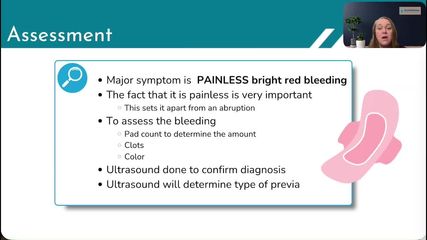
Placenta Previa
30.4 Intrapartum Complications
Abruptio Placentae
30.4 Intrapartum Complications
Additional Info
✓ While many emergency departments are capable of performing emergent vaginal and/or cesarean section deliveries, emergency department staff will notify obstetrics staff who specializes in this type of care to provide care for these clients.
✓ Maintain clear and effective communication with the healthcare team, especially the healthcare provider overseeing the case. Promptly convey the client's symptoms, vital signs, and any other relevant information for timely decision-making.
✓ Prioritize the need for emergent intervention over diagnostic procedures. Immediate actions may include notifying the healthcare provider, preparing for possible emergent delivery or cesarean section, and initiating measures to stabilize the mother and fetus.
