A nurse is caring for a client in the ICU who is intubated and receiving mechanical ventilation. The most recent arterial blood gas (ABG) results are:
pH: 7.30 (7.35-7.45)
PaCO₂: 52 mm Hg (35-45 mm Hg)
PaO₂: 78 mm Hg (80-100 mm Hg)
HCO₃⁻: 24 mEq/L (22-28 mEq/L, 22-28 mmol/L)
The client is sedated and ventilated on the following settings:
Mode: Assist-control (AC)
Rate: 12 breaths/min T
Tidal volume: 500 mL
FiO₂: 40%
Which adjustment to the ventilator settings should the nurse anticipate based on these findings?
A nurse is caring for a client in the ICU who is intubated and receiving mechanical ventilation. The most recent arterial blood gas (ABG) results are:
pH: 7.30 (7.35-7.45)
PaCO₂: 52 mm Hg (35-45 mm Hg)
PaO₂: 78 mm Hg (80-100 mm Hg)
HCO₃⁻: 24 mEq/L (22-28 mEq/L, 22-28 mmol/L)
The client is sedated and ventilated on the following settings:
Mode: Assist-control (AC)
Rate: 12 breaths/min T
Tidal volume: 500 mL
FiO₂: 40%
Which adjustment to the ventilator settings should the nurse anticipate based on these findings?
A. increase the FiO₂
[44%]
B. decrease the tidal volume
[9%]
C. increase the respiratory rate
[42%]
D. switch to SIMV mode
[4%]
Statistics
Subject/Lesson
Subject
Critical Care
Lesson
Critical Care Concepts
Client Need
Test Plan
Physiological Adaptation
Related Topic
Illness Management
Item Type
Item Type
Analysis
Explanation
Choice C is correct. The ABG shows respiratory acidosis, indicated by a low pH and elevated PaCO₂, meaning the client is not effectively clearing carbon dioxide. Increasing the respiratory rate will enhance minute ventilation and promote CO₂ elimination, making this the most appropriate intervention.
Choice A is incorrect. Although oxygenation is important, the client's PaO₂ of 78 mm Hg on 40% FiO₂ is within acceptable limits. Increasing the FiO₂ would not address the underlying issue of CO₂ retention and is not the priority at this time.
Choice B is incorrect. Decreasing the tidal volume would reduce minute ventilation and could worsen CO₂ retention unless offset by a significant increase in respiratory rate, which is not suggested here. This intervention would likely exacerbate the acidosis.
Choice D is incorrect. Switching to SIMV mode is typically used during weaning from mechanical ventilation, not for managing acute respiratory acidosis. SIMV allows for spontaneous breathing, which may be inadequate in a client with elevated CO₂ levels.
Learning Objective
Analyze arterial blood gas (ABG) results and mechanical ventilation settings in a critically ill client to determine the most appropriate adjustment needed to correct respiratory acidosis.
Related Videos
5 Key Topics

Ventilators- Critical Care
27.1 Critical Care Respiratory System
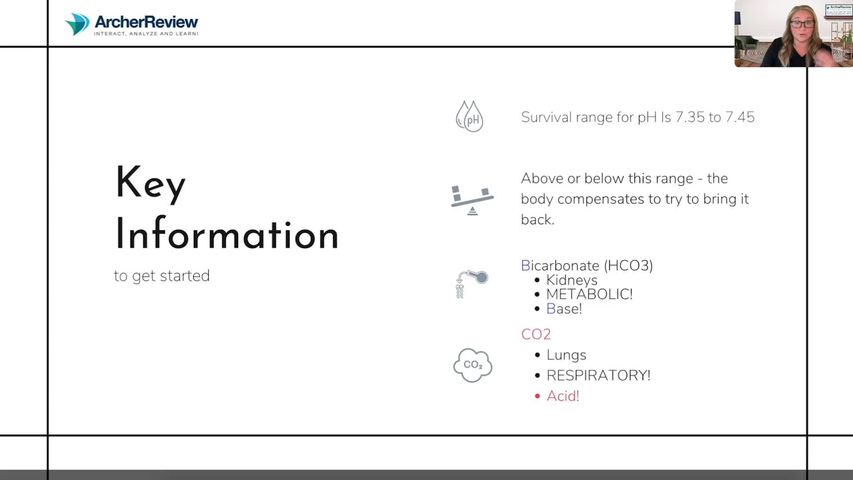
ABG Interpretation
2.6 ABG Interpretation
Additional Info
✓ Elevated PaCO₂ with a low pH = respiratory acidosis, often due to hypoventilation in ventilated clients.
✓ Increasing the respiratory rate improves CO₂ elimination, which is the primary treatment for respiratory acidosis on mechanical ventilation.
✓ ABG interpretation guides ventilator management, especially in critical care—recognizing when oxygenation vs ventilation is the problem is essential.
