The nurse is caring for a client with a pneumothorax who is connected to a water-seal chest drainage system. Which action should the nurse take to prevent an air leak?
The nurse is caring for a client with a pneumothorax who is connected to a water-seal chest drainage system. Which action should the nurse take to prevent an air leak?
A. clean the insertion site daily with chlorhexidine
[0%]
B. keep the drainage system below the insertion site
[16%]
C. encourage the client to perform incentive spirometry
[1%]
D. secure all of the connections of the chest tube
[82%]
Statistics
Subject/Lesson
Subject
Critical Care
Lesson
Critical Care Concepts
Client Need
Test Plan
Reduction of Risk Potential
Related Topic
Potential for Complications of Diagnostic Tests/Treatments/Procedures
Item Type
Item Type
Application
Explanation
Choice D is correct. The nurse can prevent air leaks by ensuring the connections to the chest tube are secure. An air leak in the chest tube system may be determined by the water seal chamber having continuous bubbling. The source of the air leak could be damage to the drainage system or its connections.
Choice A is incorrect. The nurse cleaning the insertion site with chlorhexidine is the clinical standard to prevent infection. The tubing is secured in the client with sutures, and the sutures may allow pathogens to enter the insertion site and cause infection. This action would prevent infection, not an air leak.
Choice B is incorrect. Keeping the device below the insertion site would encourage adequate drainage but would not prevent an air leak. The nurse should keep the device below the insertion site and upright.
Choice C is incorrect. Incentive spirometry would prevent atelectasis and respiratory acidosis. This would not be a method to prevent an air leak in the chest tube system.
Related Videos
6 Key Topics
Chest Tubes- Respiratory System
17.4 Chest Tubes

Chest Tubes
4.2 Thoracic Drainage
Pneumothorax
17.8 Respiratory Emergencies
Additional Info
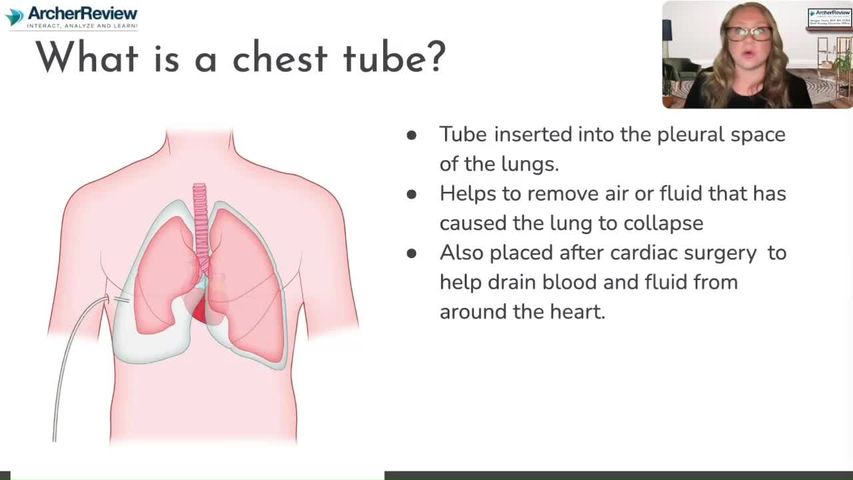
✓ A chest tube is placed to remove air and fluid so the lung can reinflate.
✓ Stationary chest tube drainage systems, such as the Pleur-evac system, use a water-seal mechanism that acts as a one-way valve to prevent air or liquid from moving back into the chest cavity.
✓ The drainage system should be kept upright and below the insertion site.
✓ The nurse should avoid kinks and dependent loops in the tubing. Extra tubing can be loosely coiled on the bed.
✓ The emergency equipment kept at the bedside includes an occlusive dressing, a bottle of sterile water (or normal saline), and a clamp.
