The nurse preceptor supervises a new nurse caring for a child with epiglottitis.
Which action by the new nurse would require the nurse preceptor to intervene? The new nurse
The nurse preceptor supervises a new nurse caring for a child with epiglottitis.
Which action by the new nurse would require the nurse preceptor to intervene? The new nurse
A. obtains a throat culture.
[82%]
B. positions the client high-Fowlers.
[7%]
C. initiates peripheral vascular access.
[4%]
D. places a bag-valve mask at the bedside.
[8%]
Statistics
Subject/Lesson
Subject
Child Health
Lesson
Respiratory
Client Need
Test Plan
Reduction of Risk Potential
Related Topic
Potential for Complications from Surgical Procedures and Health Alterations
Item Type
Item Type
Application
Explanation
Choice A is correct. Obtaining a throat culture would require immediate follow-up because this may cause acute laryngospasm leading to respiratory obstruction. Obtaining a throat culture can trigger severe airway obstruction. Epiglottitis involves inflammation and swelling of the epiglottis, which can rapidly progress to airway occlusion. Inserting any object into the throat can exacerbate the condition and lead to a life-threatening situation. The culture may be obtained once an artificial airway has been established.
Choice B is incorrect. Positioning the child in high Fowler is appropriate as it helps to improve airway patency by allowing gravity to assist in opening the airway. This position can help the child breathe more comfortably and effectively by reducing the work of breathing.
Choice C is incorrect. Initiating peripheral vascular access is necessary in a child with epiglottitis to ensure that immediate access to the bloodstream is available for administering medications and fluids if needed. This action is a standard part of the management of epiglottitis.
Choice D is incorrect. Placing a bag-valve mask at the bedside is a prudent action because it ensures that emergency resuscitation equipment is readily available if the child's airway becomes compromised. Rapid access to a bag-valve mask can be life-saving in the event of acute respiratory failure.
Related Videos
3 Key Topics
Epiglottitis
31.8 Pediatric Respiratory Conditions
Additional Info
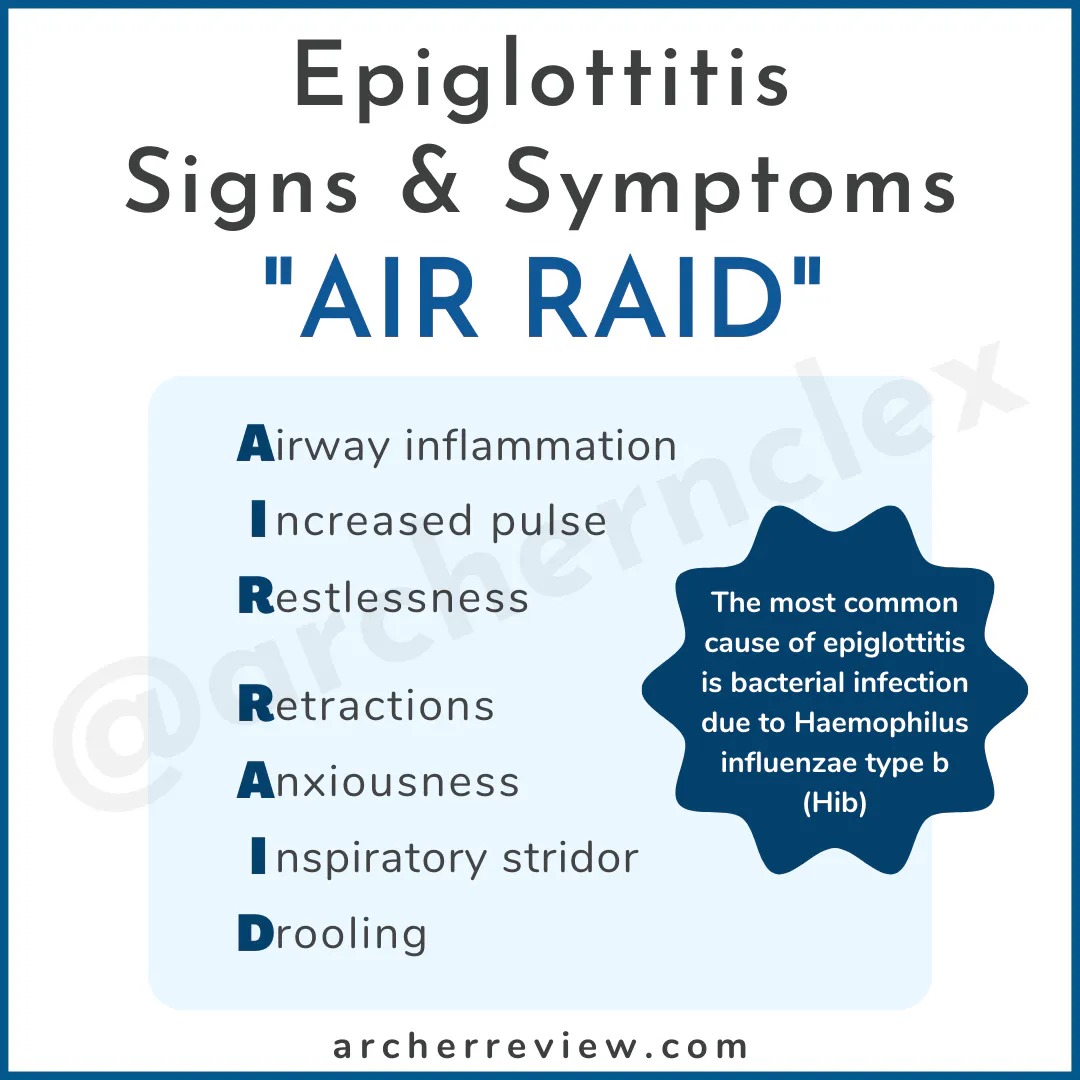
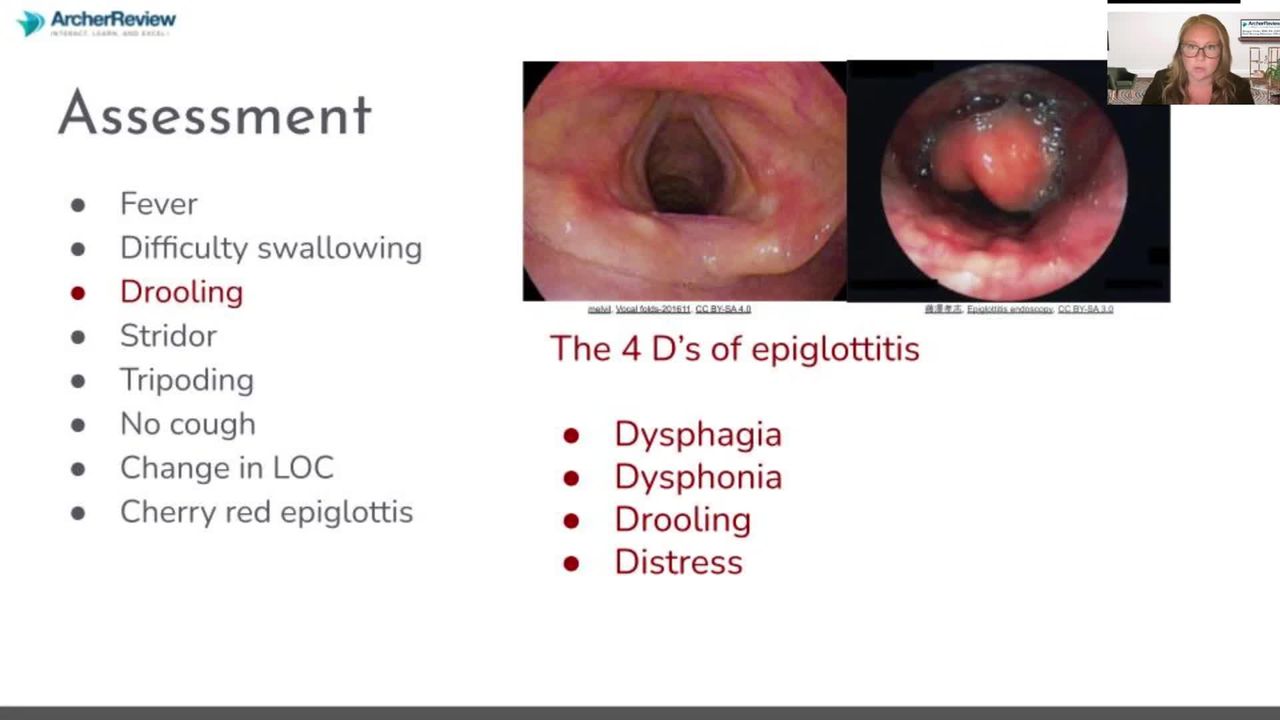
✓ Epiglottis is a cartilaginous flap present at the back of the throat. Its primary function is to close over the airway during swallowing so that the food does not enter the airway. Acute epiglottitis is a medical emergency that has an abrupt onset. In epiglottitis, the epiglottis becomes inflamed and swollen and obstructs the airway. Classic symptoms of epiglottis include -
- Sore throat and pain in swallowing
- Fever
- The child insists on sitting upright and leaning forward (tripod position), with the chin thrust out, mouth open, and tongue protruding.
- Drooling of saliva
- Red and inflamed mucous membranes
- Large, cherry red, edematous epiglottis
✓ Prevention: The key prevention for epiglottitis is immunization with H. influenzae type B conjugate beginning at two months of age.