The nurse is assessing a 4-year-old client in the emergency department (ED). The assessment reveals tripod positioning, blue lips, mottled skin, inspiratory stridor, and excessive drooling.
What is the priority action for the nurse at this time?
The nurse is assessing a 4-year-old client in the emergency department (ED). The assessment reveals tripod positioning, blue lips, mottled skin, inspiratory stridor, and excessive drooling.
What is the priority action for the nurse at this time?
A. Notify the provider and prepare the client for intubation.
[81%]
B. Keep the client calm in a supine position and administer humidified oxygen.
[10%]
C. Encourage the client to cough and suction the client's oral secretions.
[7%]
D. Obtain a nasopharyngeal swab and blood specimens for testing.
[1%]
Statistics
Subject/Lesson
Subject
Child Health
Lesson
Respiratory
Client Need
Test Plan
Physiological Adaptation
Related Topic
Medical Emergencies
Item Type
Item Type
Analysis
Explanation
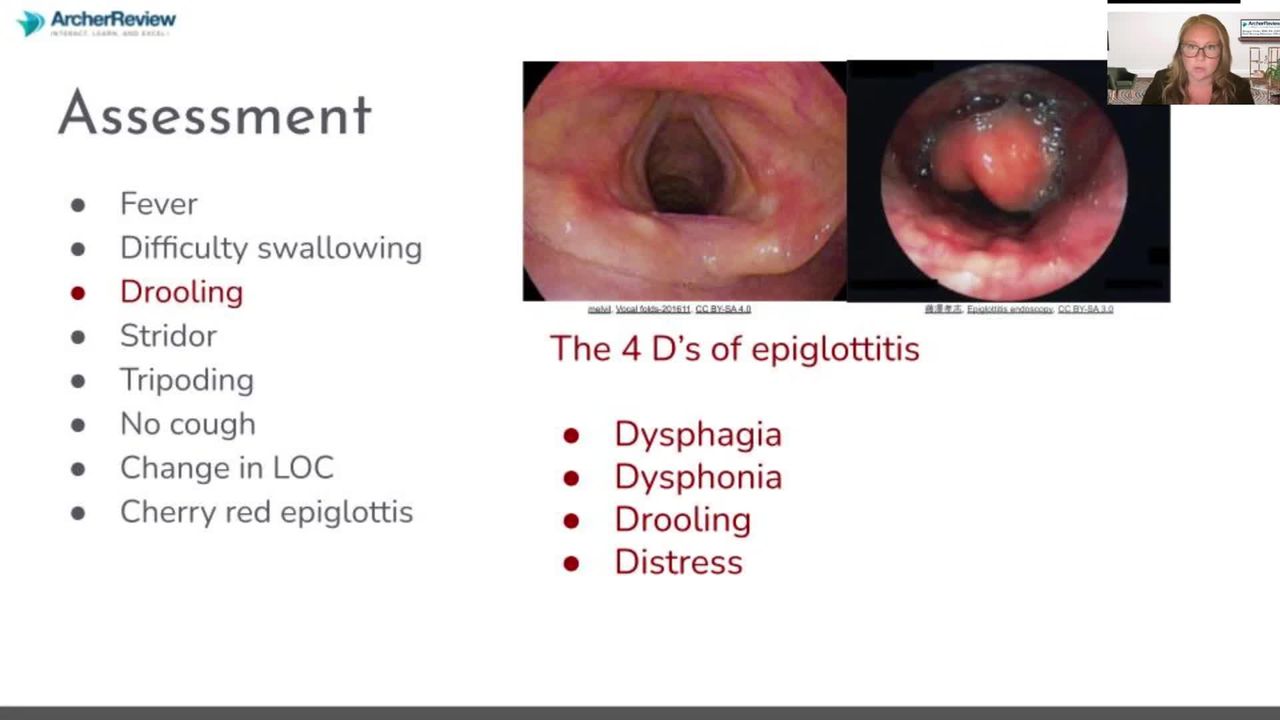
Choice A is correct. This client presents with hallmark signs of acute epiglottitis, a life-threatening upper airway obstruction. The priority is to maintain airway patency. Notifying the provider and preparing for intubation ensures that the airway can be secured promptly in a controlled environment, reducing the risk of sudden respiratory collapse.
Choice B is incorrect. Although minimizing agitation is appropriate, placing a child with suspected epiglottitis in a supine position can cause the epiglottitis to obstruct the airway further. These children often tripod to optimize airflow, and they should not be repositioned or forced to lie down. Oxygen may be given only if tolerated without distress.
Choice C is incorrect. Encouraging coughing or attempting suction can irritate the inflamed epiglottis, potentially triggering laryngospasm and complete airway obstruction. In suspected epiglottitis, airway manipulation should be avoided until personnel and equipment for advanced airway management are available.
Choice D is incorrect. While diagnostic confirmation is useful, it is not the priority in an airway emergency. Attempting to collect a nasopharyngeal swab may cause trauma and provoke laryngospasm, further endangering the client. Stabilization of the airway always comes before diagnostic tests.
Related Videos
3 Key Topics
Epiglottitis
31.8 Pediatric Respiratory Conditions
Additional Info
✓ Epiglottitis is an airway emergency!
✓ Classic signs: Tripod position, drooling, stridor, muffled voice, and cyanosis.
✓ Do NOT attempt to visualize the throat or insert anything orally unless in a controlled setting with intubation-ready personnel.
✓ Leave the child in the position they adopt (usually sitting forward), and avoid procedures that could provoke crying or distress.
✓ Do not delay airway stabilization for labs or imaging. Blood work, swabs, and cultures are secondary to securing the airway.
