The nurse is preparing to care for a child admitted with impetigo.
The nurse should plan to implement which disease transmission precautions?
The nurse is preparing to care for a child admitted with impetigo.
The nurse should plan to implement which disease transmission precautions?
A. Standard precautions
[22%]
B. Contact precautions
[72%]
C. Droplet precautions
[5%]
D. Airborne precautions
[1%]
Statistics
Subject/Lesson
Subject
Child Health
Lesson
Integumentary
Client Need
Test Plan
Safety & Infection Control
Related Topic
Standard Precautions/Transmission- Based Precautions/Surgical Asepsis
Item Type
Item Type
Application
Explanation
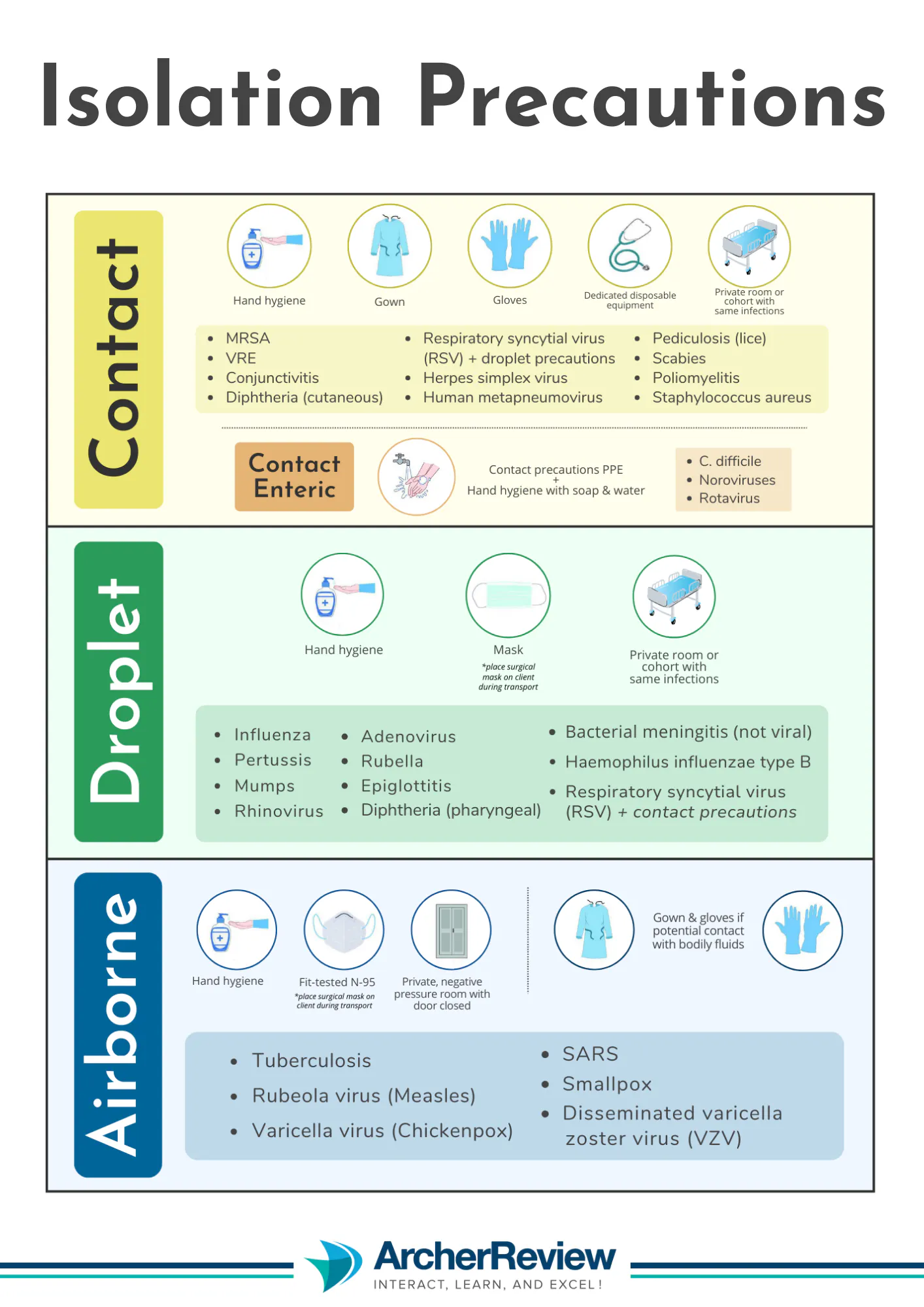
Choice B is correct. Clients with impetigo need to be placed on contact precautions to prevent spreading this highly contagious disease. According to the CDC, these precautions are “for clients who may be infected or colonized with specific infectious agents for which additional precautions are needed to prevent infection transmission. Contact precautions will be used for any disease in which direct contact with the infectious organism can cause illness. This includes impetigo and other conditions such as viral gastroenteritis, MRSA, and scabies. Contact precautions will require a gown and gloves before entering the room.
Choice A is incorrect. According to the CDC, standard precautions are used for all client care. They’re based on a risk assessment and make use of common-sense practices and personal protective equipment (PPE) use that protect healthcare providers from infection and prevent the spread of infection from client to client. Standard precautions include performing hand hygiene, using PPE when there is possible exposure to infectious material, properly cleaning equipment and instruments, and following safe injection practices. For impetigo, standard precautions are not enough. This is a highly contagious disease that will require more precautions.
Choice C is incorrect. Droplet precautions are not the appropriate type of precautions for a client with impetigo. Droplet precautions should be initiated for any client with an illness that may be spread through droplet particles. This includes influenza, pertussis, rubella, and many others. Impetigo is transmitted through direct contact with the bacteria on the skin, not through droplet particles. In droplet precautions, a face mask and gloves must be worn to prevent transmission.
Choice D is incorrect. Airborne precautions are not the appropriate type of precautions for a client with impetigo. Airborne precautions should be initiated for any client with an illness that may be spread through particles that survive in the air. This type of transmission occurs with diseases such as TB, varicella, and measles. Particular kinds of respirators must be used to prevent transfers, such as an N95 or a PAPR.
Related Videos
4 Key Topics

Bacterial Infections
25.5 Infectious Skin Conditions
Transmission based precautions- Immune System
23.3 Infection Control & Infectious Diseases
Additional Info