A 3-year-old client arrives in the emergency department with sudden fever, drooling, and tripod positioning. The primary health care provider enters several orders.
Which order should the nurse question immediately?
A 3-year-old client arrives in the emergency department with sudden fever, drooling, and tripod positioning. The primary health care provider enters several orders.
Which order should the nurse question immediately?
A. Keep the client upright with the caregiver.
[2%]
B. Offer humidified oxygen near the client’s face.
[3%]
C. Prepare equipment for controlled airway management.
[5%]
D. Obtain a throat swab for culture and sensitivity.
[90%]
Statistics
Subject/Lesson
Subject
Child Health
Lesson
Infectious Disease
Client Need
Test Plan
Reduction of Risk Potential
Related Topic
Potential for Complications of Diagnostic Tests/Treatments/Procedures
Item Type
Item Type
Application
Explanation
Choice D is correct. Collecting a throat culture with a swab can stimulate the inflamed epiglottis, increase agitation, and precipitate complete airway obstruction. Examination of the pharynx should be deferred until the airway can be managed in a controlled setting with immediate respiratory support available.
Choice A is incorrect. Keeping the client upright with the caregiver helps maintain the position that provides the best airway patency and decreases distress. Forcing the client into another position can worsen upper-airway obstruction.
Choice B is incorrect. Oxygen may be offered near the client’s face when it can be provided without increasing agitation. The nurse should use the least distressing delivery method and should not force a mask or nasal cannula onto the client.
Choice C is incorrect. Epiglottic swelling can progress rapidly, so preparation for controlled airway management is appropriate. Airway equipment should be immediately available before procedures that could worsen obstruction.
Learning Objective
The learner will be able to recognize suspected pediatric epiglottitis and prioritize interventions that prevent acute airway obstruction.
Related Videos
3 Key Topics
Epiglottitis
31.8 Pediatric Respiratory Conditions
Additional Info
✓ Hypoxemia is often a late finding in acute upper-airway obstruction; a normal oxygen saturation does not eliminate the risk of rapid deterioration.
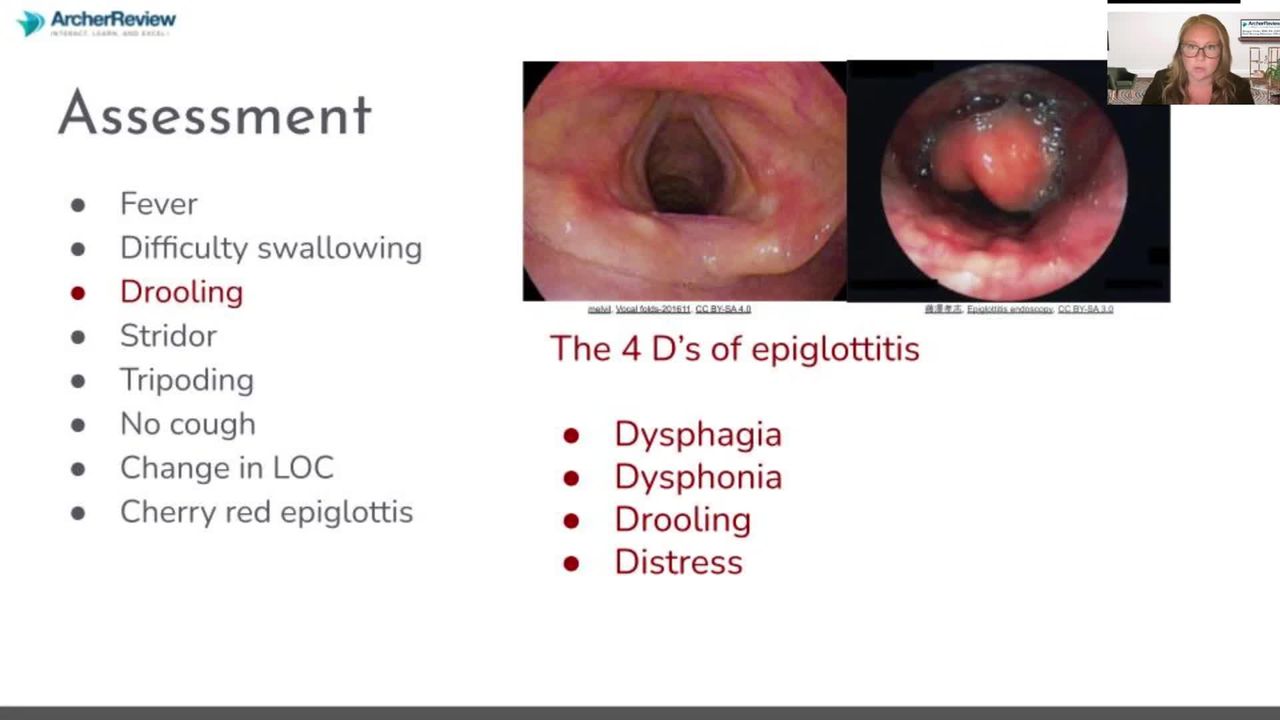
✓ Epiglottitis commonly presents with abrupt fever, dysphagia, drooling, muffled speech, stridor, and tripod positioning; a barking cough is more characteristic of croup.
✓ Lateral neck radiography may show a “thumb sign,” but transporting an unstable client for imaging can delay airway management and provoke deterioration.
✓ Direct visualization of the epiglottis is performed only in a controlled environment where immediate intubation or another advanced airway intervention is available.
✓ After the airway is stabilized, cultures may be obtained and prescribed intravenous antibiotics, such as ceftriaxone, can be initiated.
✓ Routine Haemophilus influenzae type b vaccination has greatly reduced Hib disease, but other organisms can still cause epiglottitis.
