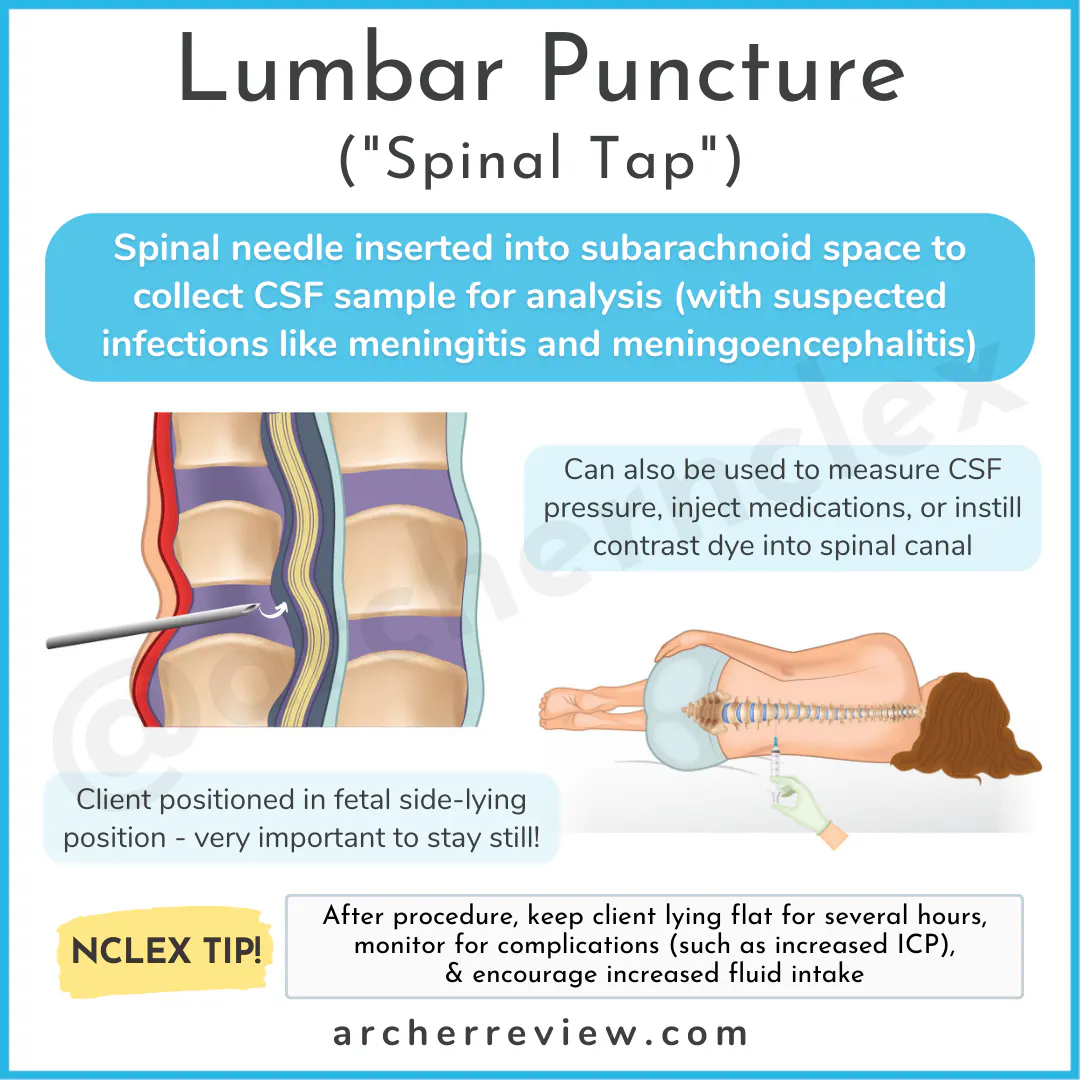
The nurse is taking care of a 9-year-old boy undergoing testing for acute myeloid leukemia (AML). She is assisting with the client's positioning for a lumbar puncture. Which of the following positions is appropriate?
The nurse is taking care of a 9-year-old boy undergoing testing for acute myeloid leukemia (AML). She is assisting with the client's positioning for a lumbar puncture. Which of the following positions is appropriate?
A. Prone
[7%]
B. Trendelenburg
[1%]
C. Supine
[2%]
D. Side lying
[89%]
Statistics
Subject/Lesson
Subject
Child Health
Lesson
Hematological/Oncological
Client Need
Test Plan
Reduction of Risk Potential
Related Topic
Potential for Complications of Diagnostic Tests/Treatments/Procedures
Item Type
Item Type
Application
Explanation
Choice D is correct. Side-lying (lateral recumbent) is the most appropriate lumbar puncture (LP) position. The client's legs are flexed at the knee and pulled towards the chest, while the upper thorax is curved forward in an almost fetal position. A pillow may be placed under the client's head and/or between the legs. This position will allow the healthcare provider to identify the lumbar vertebrae and insert the needle into the subarachnoid space at the L3-4 or L4-5 interspace. The lateral recumbent position is preferred over the upright one because it allows for accurate cerebrospinal fluid (CSF) opening pressure measurement. An upright or sitting position may be used for the LP when the client's lateral position is not feasible.
Choice A is incorrect. Placing the client in the prone position for a bedside lumbar puncture is not appropriate. The prone position is generally preferred for LPs performed under fluoroscopic guidance with the client lying face down. Prone positioning is also used to increase ventilation and lung perfusion in acute respiratory distress syndrome (ARDS) and in some infants with congenital anomalies such as tracheoesophageal fistula (TEF) at risk for aspiration.
Choice B is incorrect. Placing the client in a Trendelenburg position for a lumbar puncture is not appropriate. Trendelenburg refers to a position where the client is placed supine and then reclined so that the feet are 15-30 degrees above the head. Trendelenburg is used in preterm labor or placing a central venous catheter in the internal jugular or subclavian vein.
Choice C is incorrect. The supine position is not appropriate for a lumbar puncture. With a client lying on the back, the healthcare provider could not access the intrathecal space to perform the LP. However, the client is instructed to lie supine following the LP since headache is a common complaint after the LP. Post-LP headache occurs due to CSF pressure changes, and sitting up soon after the LP can worsen the headache.