You are reinforcing counseling for two parents who are preparing for the birth of their first child. The father has sickle cell anemia, and the mother is a carrier. You tell them that their baby has what chance of having sickle cell anemia?
You are reinforcing counseling for two parents who are preparing for the birth of their first child. The father has sickle cell anemia, and the mother is a carrier. You tell them that their baby has what chance of having sickle cell anemia?
A. 25%
[14%]
B. 50%
[46%]
C. 75%
[28%]
D. 100%
[11%]
Statistics
Subject/Lesson
Subject
Child Health
Lesson
Hematological/Oncological
Client Need
Test Plan
Physiological Adaptation
Related Topic
Pathophysiology
Item Type
Item Type
Analysis
Explanation
Choice B is correct. Sickle cell anemia is an autosomal recessive disease. The normal chromosome is represented as S, and the sickle cell gene-containing chromosome is expressed as s. Therefore, ss characterizes sickle cell anemia, Ss defines the carrier, and SS is the normal phenotype. The baby has a 50% chance of having sickle cell anemia (ss). From the information presented in the question, the father is ss because he has the disease, and the mother is Ss since she is a carrier. The disease is referred to as sickle cell anemia or sickle cell disease, whereas the carrier state is referred to as sickle cell trait.
Sickle cell anemia is inherited in an autosomal recessive pattern, which means that both copies of the gene in each cell should have the mutations necessary to have that disease (ss). The parents of an individual with an autosomal recessive condition such as sickle cell disease must each carry one copy of the mutated gene. The odds or chances of the offspring having the disease or carrier state are determined by the Punnett square. Based on the combinations, the baby has a 50% chance of having sickle cell disease (ss).
The Punnett square in this case, is as follows:
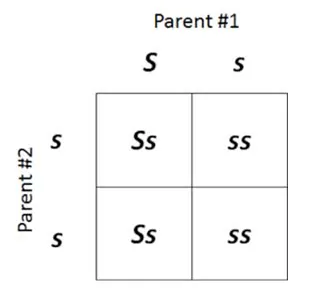
Choice A is incorrect. The baby does not have a 25% chance of having sickle cell anemia. Should the mother and father each have the carrier state alone (Ss), the baby would have a 25% chance of having sickle cell anemia/disease.
Choice C is incorrect. The baby does not have a 75% chance of having sickle cell anemia. This odds possibility does not happen in an autosomal recessive inheritance with any kind of parental combinations.
Choice D is incorrect. The baby does not have a 100% chance of having sickle cell anemia. This can only happen if both parents have sickle cell anemia (ss) but not when one of the parents is a carrier.
Related Videos
4 Key Topics
Sickle Cell
24.5 Hematologic Disorders
Sickle Cell Anemia
