The nurse is caring for a client with a peripherally inserted central catheter (PICC) in the left upper extremity. It would indicate correct nursing care if the nurse
The nurse is caring for a client with a peripherally inserted central catheter (PICC) in the left upper extremity. It would indicate correct nursing care if the nurse
A. pulsatile flushes each lumen with 0.9% sodium chloride (normal saline) in a 5 mL syringe.
[9%]
B. slowly flushes each lumen with 0.9% sodium chloride (normal saline) in a 10 mL syringe.
[40%]
C. pulsatile flushes each lumen with sterile water in a 10 mL syringe.
[7%]
D. pulsatile flushes each lumen with 0.9% sodium chloride (normal saline) in a 10 mL syringe.
[43%]
Statistics
Subject/Lesson
Subject
Pharmacology
Lesson
Medication Administration
Client Need
Test Plan
Pharmacological and Parenteral Therapies
Related Topic
Central Venous Access Devices
Item Type
Item Type
Application
Explanation
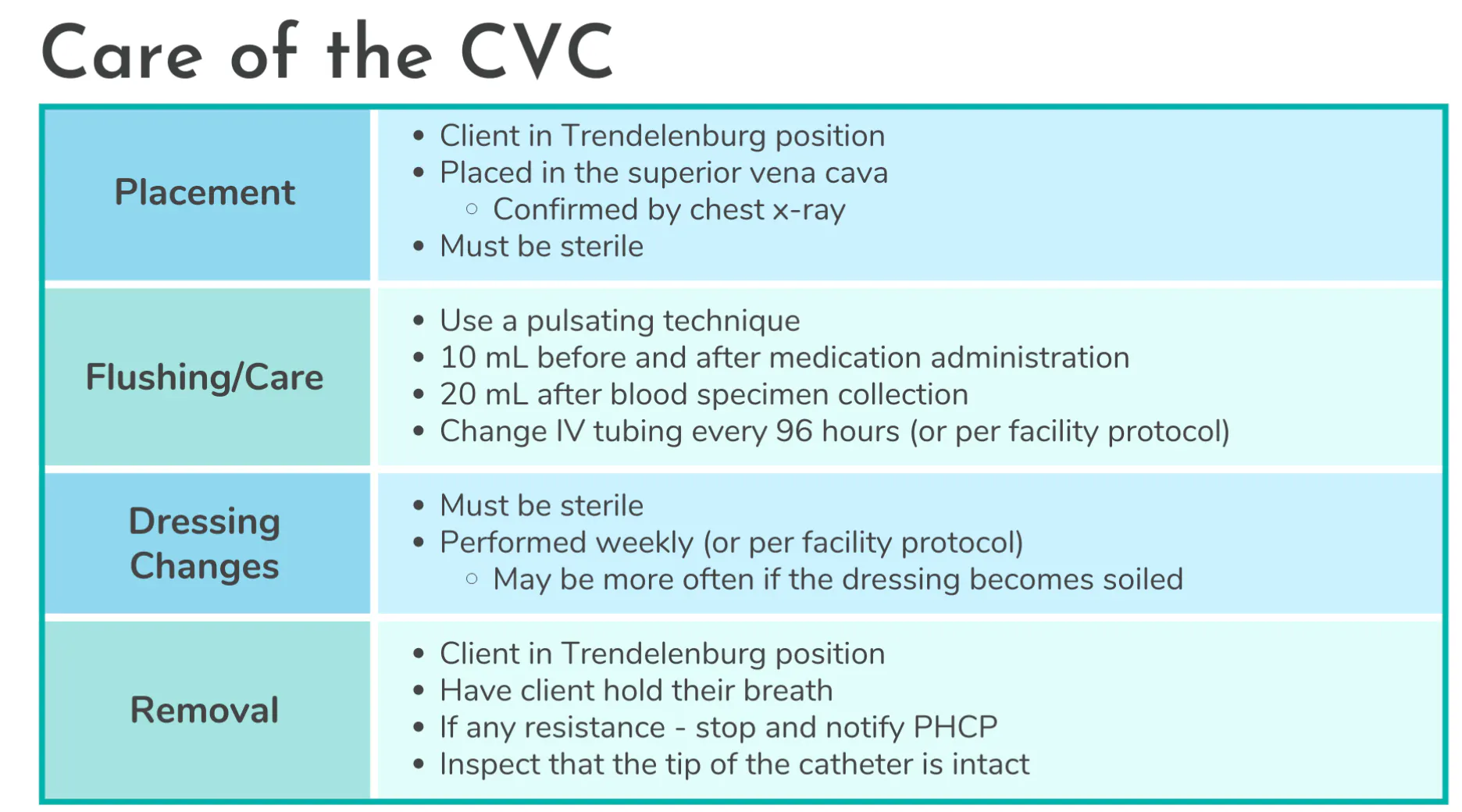
Choice D is correct. When flushing a central vascular access device, such as a PICC line, the nurse should flush each lumen with 0.9% sodium chloride (normal saline) in a 10 mL syringe. This 10 mL volume of the syringe is necessary because of its pressure to remove adequate debris and any fibrin clots that could form on the tip of the catheter. A pulsatile flushing technique removes any fibrin debris on the end of the catheter, which protects the lumen from becoming occluded. Because of its isotonicity, only 0.9% saline should be used to flush vascular access devices.
Choice A is incorrect. A 10 mL syringe should be used to administer medications and flush or aspirate blood from a central vascular access device. A 5 mL syringe would be an inadequate volume size.
Choice B is incorrect. The flushing technique for all central vascular access devices is the pulsatile method. The pulsatile method is a guideline because it removes debris that may cause catheter occlusion. Flushing slowly would be less effective in eliminating fibrin debris, and this method is not recommended.
Choice C is incorrect. Sterile water should not be used when flushing central vascular access devices. Sterile water is hypotonic, and the clinical guide for flushing all vascular access devices is normal saline (sodium chloride).
Related Videos
3 Key Topics
Intravenous Access (PIV/CVC)
4.4 Intravenous Access
Additional Info
✓ The Infusion Nurses Society has established clinical guidelines for nursing care-related vascular access devices
✓ Additional guidelines may be obtained from the Centers for Disease Control and Prevention
✓ A PICC line is a central vascular access device that may be used to administer fluids, vasoactive medications, antibiotics, and parenteral nutrition
✓ Strategies to prevent infections include meticulous hand hygiene, disinfection caps, dressing changes every seven days (or sooner if necessary), and appropriate spiking and priming techniques of medications and fluids that avoid contamination
✓ 0.9% sodium chloride (normal saline) is the only fluid that should be flushed through a central vascular access device using a pulsatile method
https://app.archerreview.com/test-screen/MjQyNzUxNDE=/MTMxMTM=
