The nurse is reviewing newly prescribed medications for assigned clients. Which of the following prescribed medications should the nurse question?
The nurse is reviewing newly prescribed medications for assigned clients. Which of the following prescribed medications should the nurse question?
A. captopril for a client with congestive heart failure
[10%]
B. metoprolol for a client with multiple premature ventricular contractions (PVCs)
[16%]
C. verapamil for a client with atrial fibrillation
[12%]
D. spironolactone for a client with end-stage renal disease
[62%]
Statistics
Subject/Lesson
Subject
Pharmacology
Lesson
Cardiovascular
Client Need
Test Plan
Pharmacological and Parenteral Therapies
Related Topic
Adverse Effects/Contraindications/Side Effects/Interactions
Item Type
Item Type
Analysis
Explanation
Choice D is correct. Spironolactone is a potassium-sparing diuretic and is primarily indicated in treating essential hypertension. The potential (significant) issue is that clients with end-stage renal disease commonly have hyperkalemia because of the significantly reduced glomerular filtration rate and rely on dialysis to remove nitrogenous waste, water, and electrolytes. It would be detrimental for a client with ESRD to receive spironolactone because this medication will raise serum potassium levels that are already high. This prescription requires follow-up.
Choice A is incorrect. Captopril is an ACE inhibitor. ACE inhibitors are highly recommended in managing heart failure because they decrease the complication of cardiomegaly, which may cause a further reduction in cardiac output.
Choice B is incorrect. Metoprolol for a client with multiple premature ventricular contractions (PVCs) is appropriate. PVCs are generally benign and cause the ventricles to empty before they are filled. This may give the client a palpitation or flutter sensation. The nurse should identify the underlying cause for multiple PVCs, such as hypokalemia, hypomagnesemia, or central nervous stimulants. If the cause cannot be identified, beta-blockers may slow the heart rate to prevent premature firing.
Choice C is incorrect. Atrial fibrillation is an irregularly irregular arrhythmia with two treatment goals: 1. prevention of stroke 2. rate control between 60-100 beats per minute. Verapamil is a calcium channel blocker that may be used for an individual with atrial fibrillation; this will help maintain rate control. Another medication that may be used instead of verapamil would be diltiazem or amiodarone.
Related Videos
2 Key Topics
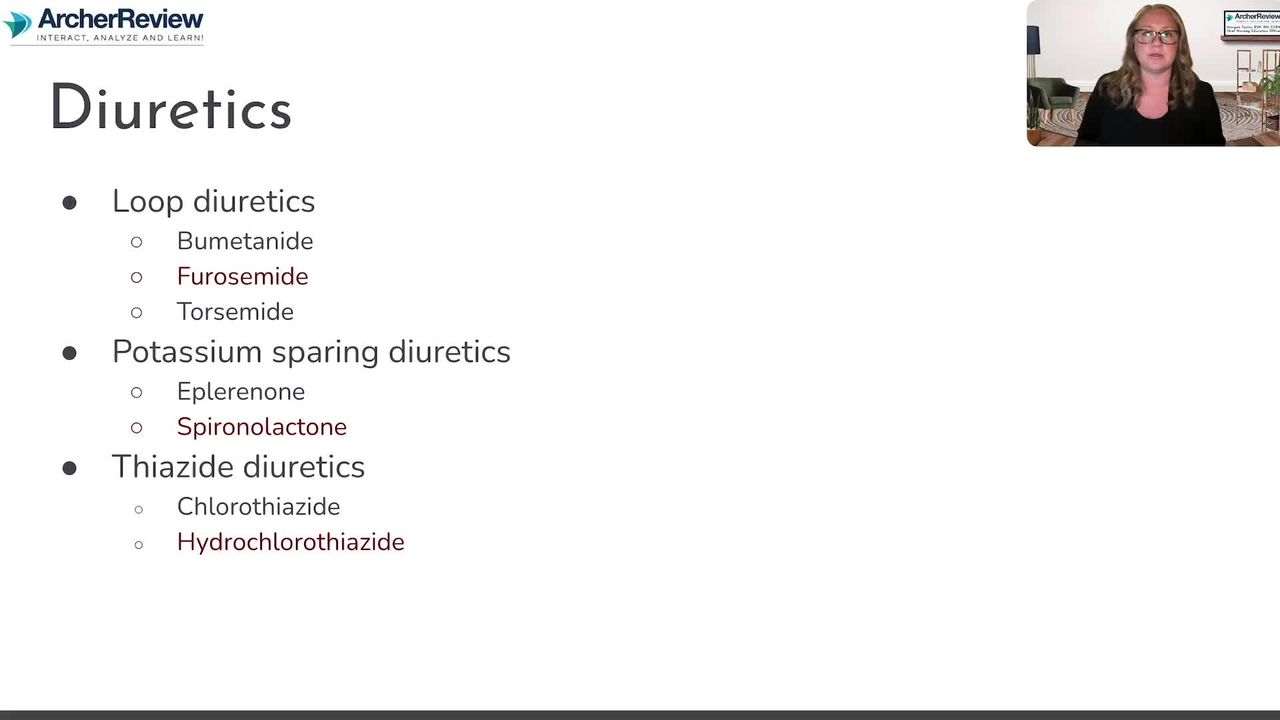
Diuretics- Renal System
21.2 Renal & Blood Pressure Pharmacology
Additional Info
✓ Spironolactone is an aldosterone antagonist indicated in the treatment of heart failure and hypertension
✓ Prior to administration, the nurse should review the client's electrolytes to ensure that the client is not hyperkalemic (this medication reduces fluid volume while holding onto potassium)
✓ Blood pressure should be obtained prior to administering any diuretic, such as spironolactone
✓ Fall precautions should be implemented for any client receiving a diuretic
