The nurse has instructed a client newly diagnosed with the human immunodeficiency virus (HIV).
Which of the following statements by the client would indicate effective understanding? This disease is caused by a retrovirus leading to
The nurse has instructed a client newly diagnosed with the human immunodeficiency virus (HIV).
Which of the following statements by the client would indicate effective understanding? This disease is caused by a retrovirus leading to
A. encapsulation of CD4+ T-cells.
[10%]
B. inflammation of the CD4+ T-cells.
[5%]
C. abnormal proliferation of CD4+ T-cells.
[32%]
D. viral integration into the CD4+ T-cells.
[52%]
Statistics
Subject/Lesson
Subject
Adult Health
Lesson
Infectious Disease
Client Need
Test Plan
Physiological Adaptation
Related Topic
Pathophysiology
Item Type
Item Type
Knowledge/Comprehension
Explanation
Choice D is correct: HIV is a retrovirus because of its ability to insert itself into a cell's DNA via its viral RNA. This process causes the CD4/T-cell to be hijacked. HIV infection causes a virion to dock with a CD4/T-cell, which causes it to seize its nucleus. This hijacking alters the cell's DNA by inserting its viral RNA, which the DNA then converts by the enzyme reverse transcriptase. This integrative process completes the process, making the CD4/T-cell able to create more HIV viral particles to infect other healthy CD4/T-cells.
Choice A is incorrect: This virus does not encapsulate CD4/T-cells; instead, it integrates itself into the cell's nucleus with the goal of viral replication. This virus leads to the reduction of healthy CD4/T-cells, not an abnormal proliferation.
Choice B is incorrect: HIV is not an inflammatory disease. Its underlying pathophysiology is to cause the hijacking of an existing CD4/T-cell. While inflammation may occur with secondary infections, the primary pathophysiology involves no direct inflammation.
Choice C is incorrect: During acute infection, immune activity increases, but this increase in activity is not abnormal; instead, it is an expected response.
Related Videos
4 Key Topics
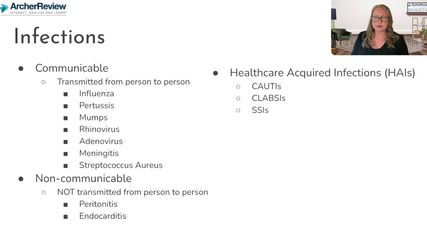
Transmission based precautions- Immune System
23.3 Infection Control & Infectious Diseases
Infections by system
23.3 Infection Control & Infectious Diseases
Additional Info
✓ Human immunodeficiency virus (HIV) is a retrovirus that may lead to Acquire Immunodeficiency Syndrome (AIDS) if untreated
✓ Modes of transmitting HIV include -
• Sexual: genital, anal, or oral (low risk) sexual contact with exposure of mucous membranes to infected semen or vaginal secretions
• Parenteral: sharing of needles ("sharps”) or equipment contaminated with infected blood or receiving contaminated blood products
• Perinatal: from the placenta, from contact with maternal blood and body fluids during birth, or from breast milk from an infected mother to child. Pregnancy is a risk factor for HIV as the pregnant individual has engaged in unprotected copulation. HIV testing is routinely done in the third trimester
✓ HIV is not transmitted by
- Casual contact in the home, school, or workplace
- Sharing household utensils, towels, linens, and toilet facilities
- Mosquitos or other insects do not spread HIV
✓ HIV and AIDS treatment goals include increasing the CD4 count and reducing the viral load (VL) to undetectable
- ✓ PrEP (pre-exposure prophylaxis) is prescribed to clients with risk factors of contracting HIV
