The nurse is providing discharge teaching to a client with a substance use disorder.
Which of the following statements would be appropriate for the nurse to make?
The nurse is providing discharge teaching to a client with a substance use disorder.
Which of the following statements would be appropriate for the nurse to make?
A. "If you relapse, this could indicate that your illness will not get better."
[2%]
B. "Participate in family, group, and individual therapy."
[68%]
C. "Make a list of whom to call, what to do, and where to seek help. Keep it at home."
[28%]
D. "Minimize your social interactions and isolate yourself during stressful periods."
[2%]
Statistics
Subject/Lesson
Subject
Mental Health
Lesson
Substance Abuse and other dependencies
Client Need
Test Plan
Psychosocial Integrity
Related Topic
Support Systems
Item Type
Item Type
Application
Explanation
Choice B is correct. Regular psychotherapy and healthy socialization are key to recovery. Therapy may be provided individually or in a group setting. Regular socialization with sober individuals is healthy and encouraged.
Choice A is incorrect. This statement is stigmatizing and fails to reflect current evidence-based, nonjudgmental approaches to addiction treatment. Relapse is a recognized part of the recovery process and should be addressed as an opportunity for learning, not failure.
Choice C is incorrect. While creating a crisis plan is helpful, limiting it to home storage may reduce its utility. Clients should be advised to keep this information accessible—such as on their phone or wallet—and use it when away from home.
Choice D is incorrect. Social isolation is a risk factor for relapse. Stress should be addressed with positive coping strategies, not avoidance or isolation. Encouraging social support is essential in recovery.
Related Videos
4 Key Topics
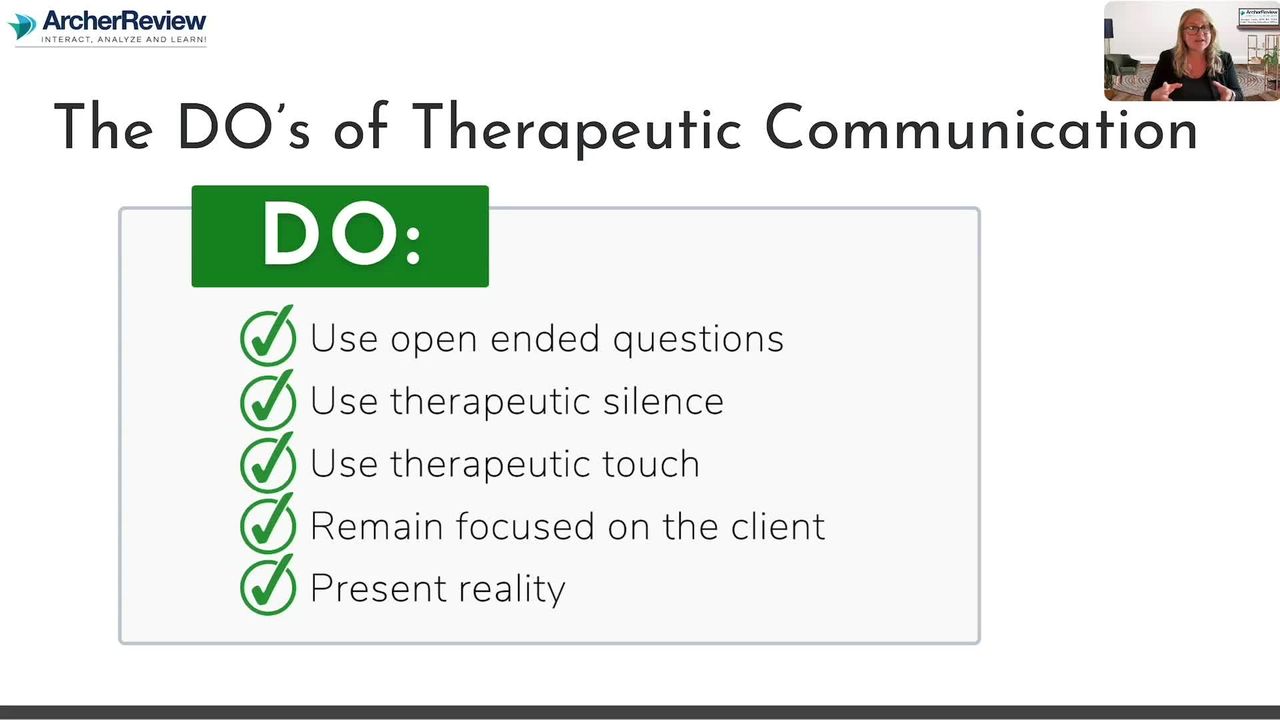
Therapeutic communication
13.3 Therapeutic Communication & Environment
Therapeutic environment
13.3 Therapeutic Communication & Environment
Additional Info
✓ Substance use disorders can be effectively managed with regular psychiatric care. Regular psychotherapy with potentially pharmacotherapy is a winning combination.
✓ The client with a substance use disorder develops a relapse prevention plan that includes recognizing early signs of a relapse.
✓ Regular socialization with others who are sober is strongly encouraged.
