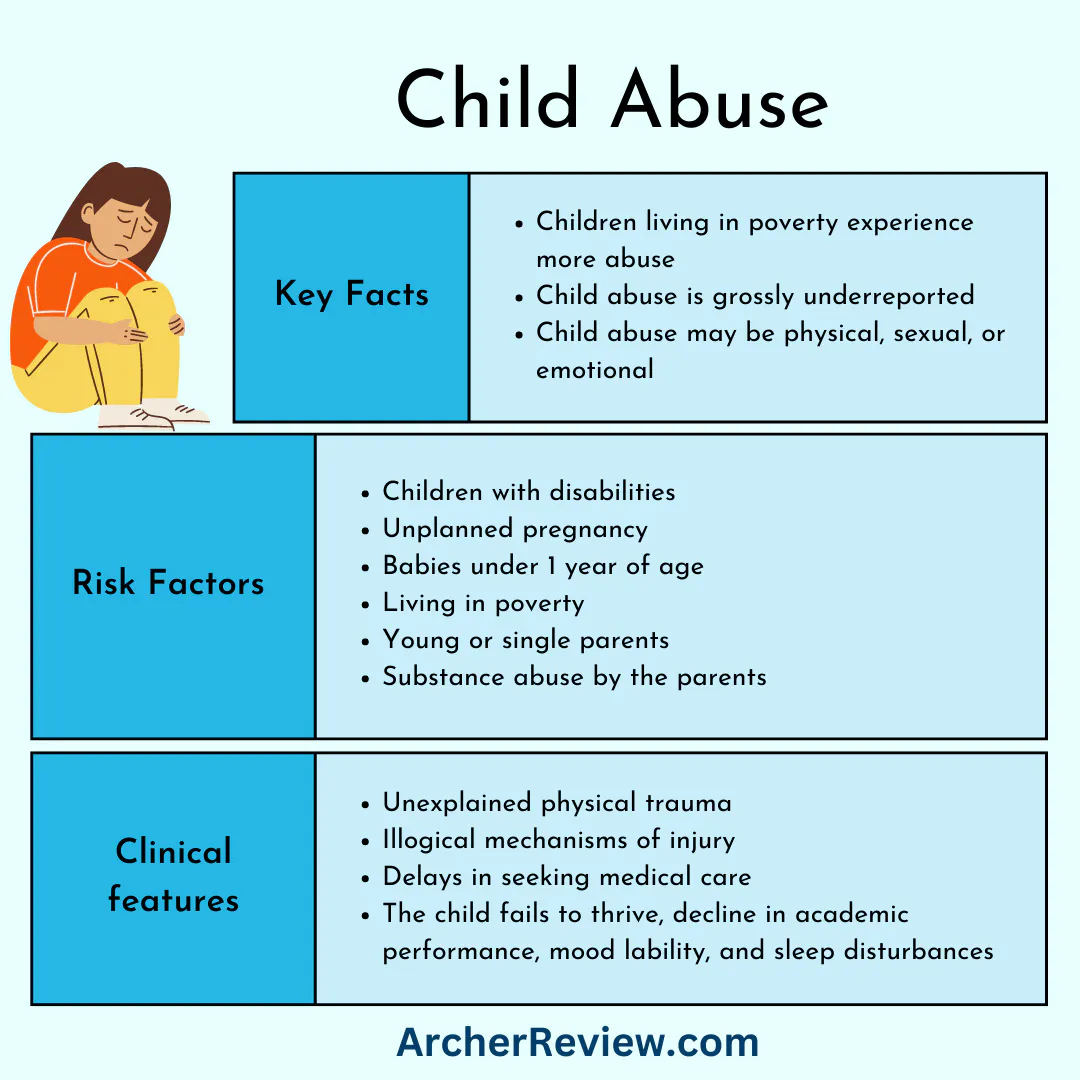
The home health nurse is performing a follow-up visit on a child recently relocated to a new home following child abuse.
The nurse anticipates that the child will likely demonstrate
The home health nurse is performing a follow-up visit on a child recently relocated to a new home following child abuse.
The nurse anticipates that the child will likely demonstrate
A. a willingness to explore new places.
[5%]
B. rapid social engagement with others.
[4%]
C. increased scholastic performance.
[3%]
D. reluctance or avoidance in social interactions.
[88%]
Statistics
Subject/Lesson
Subject
Mental Health
Lesson
Abuse/Neglect
Client Need
Test Plan
Psychosocial Integrity
Related Topic
Abuse/Neglect
Item Type
Item Type
Knowledge/Comprehension
Explanation
Choice D is correct. Children subjected to abuse often have immediate psychosocial adverse effects such as acting aloof, being withdrawn, guarded, distrustful, and having difficulty engaging and maintaining social relationships.
Choice A is incorrect. Children who have been abused are distrustful, resulting in their inability to explore new places. Children may prefer a predictable routine and not cope well with exploring new places.
Choice B is incorrect. Social withdrawal and aloofness do not cause an individual who has been abused to develop rapid social engagement. These individuals appear guarded and may have minimal social interactions.
Choice C is incorrect. An abused child will often appear fearful and withdrawn, which may result in a negative academic performance.
Learning Objective
Recognize that a nurse would anticipate a child exhibiting aloofness and isolation from peers following hospital discharge after an episode of child abuse
Related Videos
2 Key Topics
Abuse
13.1 Psychosocial Stressors & Coping
Additional Info