The nurse is reviewing eating disorders with a group of students. It would be correct for the nurse to identify that the primary differential between anorexia nervosa and bulimia nervosa is a client's
The nurse is reviewing eating disorders with a group of students. It would be correct for the nurse to identify that the primary differential between anorexia nervosa and bulimia nervosa is a client's
A. dentition.
[9%]
B. body mass index (BMI).
[34%]
C. binging and purging patterns.
[46%]
D. distorted perception of body weight.
[11%]
Statistics
Subject/Lesson
Subject
Mental Health
Lesson
Mental Health
Client Need
Test Plan
Psychosocial Integrity
Related Topic
Mental Health Concepts
Item Type
Item Type
Analysis
Explanation
Choice B is correct. Clients with anorexia nervosa often present with a body mass index (BMI) of < 18.5 (i.e., underweight). This is due to the severe caloric restriction anorexia nervosa clients implement on themselves. Conversely, the body weight of clients with bulimia nervosa tends to fluctuate around normal, periodically going above this range (i.e., the majority of bulimia nervosa clients have a BMI between 18.5 and 30). This higher BMI is due to the binging and purging of high-calorie foods by clients with bulimia nervosa. Binging and purging are clinical features of both bulimia and anorexia nervosa. It cannot be used to determine the client's condition. The key distinguishing feature of anorexia nervosa is abnormally low body weight, as indicated by a body mass index <18.5 kg/m2.
Choice A is incorrect. Both anorexia nervosa and bulimia nervosa can have dental issues due to malnutrition and repeated vomiting, therefore, it is not the primary differential between the two disorders.
Choice C is incorrect. Binging and purging patterns are common features of bulimia nervosa. However, while this behavior is present in bulimia nervosa, it is not the primary differential.
Choice D is incorrect. A distorted perception of body weight is a shared characteristic in both anorexia nervosa and bulimia nervosa. Individuals with anorexia nervosa often perceive themselves as overweight despite being underweight. Similarly, individuals with bulimia nervosa may have a distorted body image.
Learning Objective
Identify differences in body mass indexes (BMIs) as the most efficient way to distinguish clients affected with bulimic nervosa from those with anorexia nervosa.
Related Videos
4 Key Topics
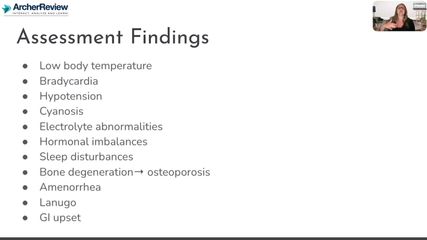
Anorexia Nervosa
32.4 Eating Disorders
Bulimia Nervosa
32.4 Eating Disorders
Additional Info
✓ Significant overlap occurs between bulimia nervosa and anorexia nervosa
✓ Physically, the client with anorexia nervosa is significantly underweight with a BMI < 18.5
✓ Fluoxetine has proven efficacy in the treatment of bulimia nervosa
✓ Commonalities Between Anorexia Nervosa and Bulimia Nervosa:
- Both eating disorders can cause binging and purging behaviors, where individuals may engage in episodes of excessive eating followed by compensatory actions such as vomiting or excessive exercise.
- Both eating disorders cause a client to have a distorted view of food and themselves. Individuals with these disorders often perceive themselves as overweight or have an intense fear of gaining weight, even when underweight.
- Both eating disorders may have other psychiatric co-morbidities such as obsessive-compulsive personality disorder or depression. Individuals with anorexia nervosa and bulimia nervosa may experience additional mental health challenges, contributing to the complexity of their conditions.
