The nurse is caring for a client scheduled for electroconvulsive therapy (ECT) for the first time. The client's spouse asks about visiting the client after the procedure. It would be appropriate for the nurse to inform the visitor that
The nurse is caring for a client scheduled for electroconvulsive therapy (ECT) for the first time. The client's spouse asks about visiting the client after the procedure. It would be appropriate for the nurse to inform the visitor that
A. "You may visit as long as you wear the required surgical mask while visiting to prevent infection."
[1%]
B. "You may visit, but your spouse may have a few seizures after this procedure."
[3%]
C. "You may visit, but you will have to wear a lead apron and stay six feet from the client."
[3%]
D. "You may visit but may notice that your spouse may have some memory problems immediately after this procedure."
[92%]
Statistics
Subject/Lesson
Subject
Mental Health
Lesson
Mental Health
Client Need
Test Plan
Psychosocial Integrity
Related Topic
Therapeutic Communication
Item Type
Item Type
Application
Explanation
Choice D is correct. For clients undergoing electroconvulsive therapy (ECT) treatments, visitors, especially family members, are allowed and encouraged. Some of the most common side effects of electroconvulsive therapy sessions include nausea, headache, drowsiness, confusion, and slight memory loss, which may last minutes to hours.
Choice A is incorrect. Visitors after this procedure are not prohibited, nor are they asked to wear personal protective equipment (PPE) such as a surgical mask. Standard precautions are utilized while caring for the client after ECT.
Choice B is incorrect. This is an incorrect statement because the client does not have seizures after this procedure. ECT is a procedure requiring general anesthesia that causes the administration of electrical currents to specific regions of the brain. This procedure is effective and may even be used during pregnancy.
Choice C is incorrect. This statement is incorrect because it does not reflect an appropriate understanding of ECT. Wearing a lead apron and staying six feet away from the client are interventions that may be implemented for a client receiving brachytherapy.
Learning Objective
When speaking with the spouse of a client due to undergo electroconvulsive therapy (ECT) for the first time who is asking about visiting the client on ECT treatment days and expressing concern regarding what to expect after the initial treatment, recognize the best response by the nurse is one which encourages the spouse to visit while also informing the spouse that certain side effects (drowsiness, confusion, and/or memory loss) may occur but are typically temporary in nature.
Related Videos
3 Key Topics

Electroconvulsive Therapy
32.1 Psychopharmacology (Medications & Treatments)
Additional Info
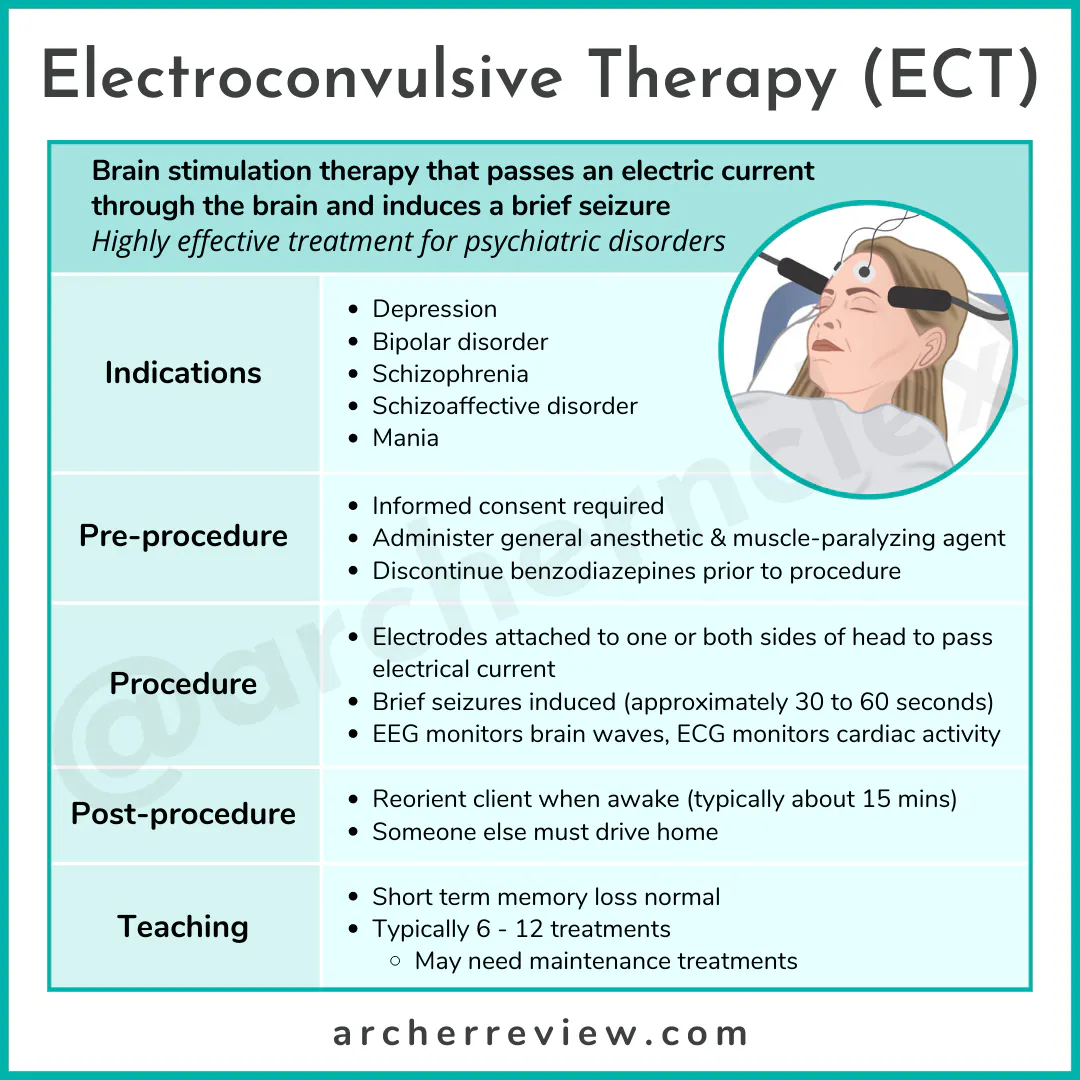 Source : Source: Archer Review
✓ Electroconvulsive therapy (ECT) involves the electrical induction of a seizure under controlled conditions. The mechanism of action for ECT is uncertain, but the production of seizure activity appears to be integral to its antidepressant effects.
✓ ECT treatments are generally given two to three times weekly for three to four weeks, for a total of six to 12 treatments.
✓ Clients who have stopped eating may need ECT to prevent death.
✓ ECT is particularly effective for psychotic depression.
✓ Relapse after ECT is common, and drug therapy is often maintained after ECT is stopped.
