A nurse is caring for a client who has experienced a recent traumatic event. The client reports sudden paralysis of the right arm, but diagnostic testing reveals no neurological or physical cause.
Which defense mechanism is the client most likely exhibiting?
A nurse is caring for a client who has experienced a recent traumatic event. The client reports sudden paralysis of the right arm, but diagnostic testing reveals no neurological or physical cause.
Which defense mechanism is the client most likely exhibiting?
A. dissociation
[18%]
B. conversion
[63%]
C. regression
[11%]
D. suppression
[8%]
Statistics
Subject/Lesson
Subject
Mental Health
Lesson
Mental Health
Client Need
Test Plan
Psychosocial Integrity
Related Topic
Coping Mechanisms
Item Type
Item Type
Application
Explanation
Choice B is correct. Conversion is a defense mechanism where psychological stress or trauma is unconsciously transformed into a sensory or motor deficit (e.g., paralysis, blindness) with no identifiable medical cause. It is a hallmark of conversion disorder.
Choice A is incorrect. Dissociation involves a disruption in consciousness, memory, identity, or perception of the environment. It may occur during or after trauma, but does not typically cause localized motor or sensory deficits like conversion does.
Choice C is incorrect. Regression is an unconscious return to an earlier stage of development in response to stress. For example, a previously continent adult is beginning to soil themselves under extreme stress, not losing physical function without an organic cause.
Choice D is incorrect. Suppression is a conscious, voluntary decision to avoid thinking about disturbing feelings or thoughts. It differs from conversion, which is unconscious and manifests physically.
Related Videos
2 Key Topics
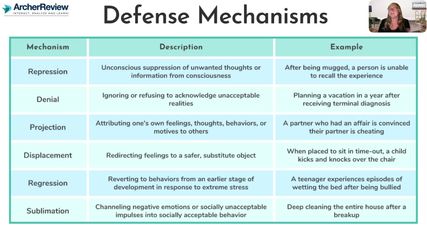
Defense Mechanisms in Mental Health
32.2 Psychological Concepts & Safety
Additional Info
✓ Conversion is a type of unconscious defense mechanism in which psychological stress is expressed as neurological or somatic symptoms, such as paralysis, blindness, or seizures, without a physiological basis.
✓ Symptoms mimic neurologic conditions, such as:
- Paralysis
- Blindness
- Aphonia (loss of voice)
- Non-epileptic seizures
- Loss of sensation
✓ Symptoms are not intentionally produced (unlike factitious disorder or malingering).
✓ No medical cause can be found, yet the symptoms are real to the client.
