The nurse is caring for a client experiencing auditory hallucinations.
Which of the following statements would be most appropriate for the nurse to make to the client?
The nurse is caring for a client experiencing auditory hallucinations.
Which of the following statements would be most appropriate for the nurse to make to the client?
A. “What are you hearing?”
[31%]
B. "What are the voices saying to you?"
[57%]
C. "When did you start hearing voices?"
[6%]
D. "Would you like to go watch some television?"
[5%]
Statistics
Subject/Lesson
Subject
Mental Health
Lesson
Mental Health
Client Need
Test Plan
Psychosocial Integrity
Related Topic
Sensory/Perceptual Alterations
Item Type
Item Type
Application
Explanation
Choice A is correct. This is the most appropriate and therapeutic statement. It uses nonjudgmental, open-ended language that encourages the client to share their experience without reinforcing or validating the hallucination's content. It helps the nurse recognize cues and assess risk while building trust.
Choice B is incorrect. This implies acceptance that the voices are real, which may reinforce the hallucination. It also analyzes content before establishing rapport or assessing client readiness to discuss.
Choice C is incorrect. While potentially useful information, this is less therapeutic in the moment, as it focuses on timing over the client's current experience and emotions.
Choice D is incorrect. This is a distraction technique, which may be appropriate later, but not as an initial response. It does not allow assessment of the hallucination's nature, potential danger, or impact on behavior.
Related Videos
2 Key Topics
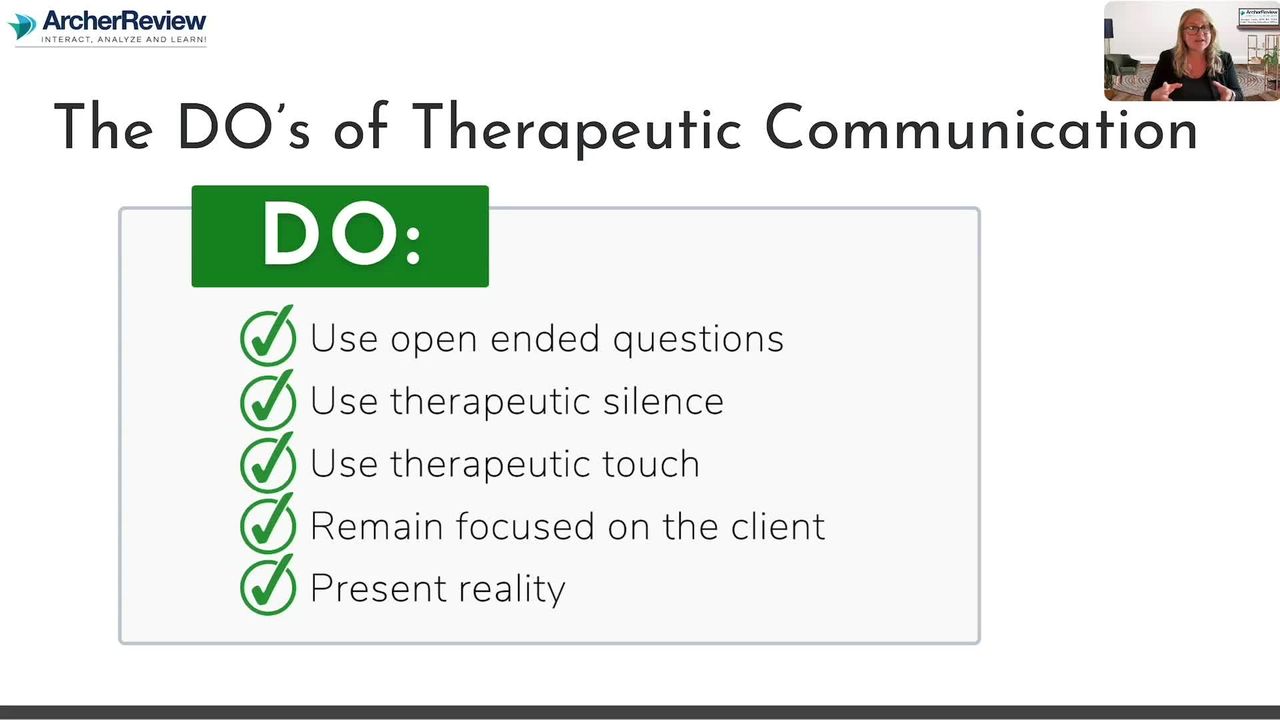
Therapeutic communication
13.3 Therapeutic Communication & Environment
Additional Info
For the client experiencing hallucinations
✓ Ask about the content of the hallucinations and how the reaction.
✓ Assess for command hallucinations and if the hallucinations are causing fear or distress.
✓ Avoid referring to hallucinations as if they are real. Do not ask, “What are the voices saying to you?” Ask, “What are you hearing?”
✓ Be alert to signs of anxiety, which may indicate that hallucinations are intensifying or that they are of a command type.
✓ Do not negate the client's experience; offer your perceptions and convey empathy. “I don’t hear angry voices that you hear, but that must be very frightening for you.”
✓ Focus on reality-based “here-and-now” activities such as conversations or simple projects. Tell the client, “The things you are hearing are part of your illness, and it cannot hurt you. Try to listen to me and the others you can see around you."
