The nurse is planning a staff education program about restraints.
When discussing the documentation of restraints, the nurse should remind the participants of what needs to be documented when a client is initially placed in restraints?
The nurse is planning a staff education program about restraints.
When discussing the documentation of restraints, the nurse should remind the participants of what needs to be documented when a client is initially placed in restraints?
A. Least-restrictive measures used before restraint
[59%]
B. Admission status (voluntary or involuntary)
[5%]
C. Previous time spent in restraints
[5%]
D. Vital signs
[31%]
Statistics
Subject/Lesson
Subject
Mental Health
Lesson
Mental Health
Client Need
Test Plan
Safety & Infection Control
Related Topic
Use of Restraints/Safety Devices
Item Type
Item Type
Application
Explanation
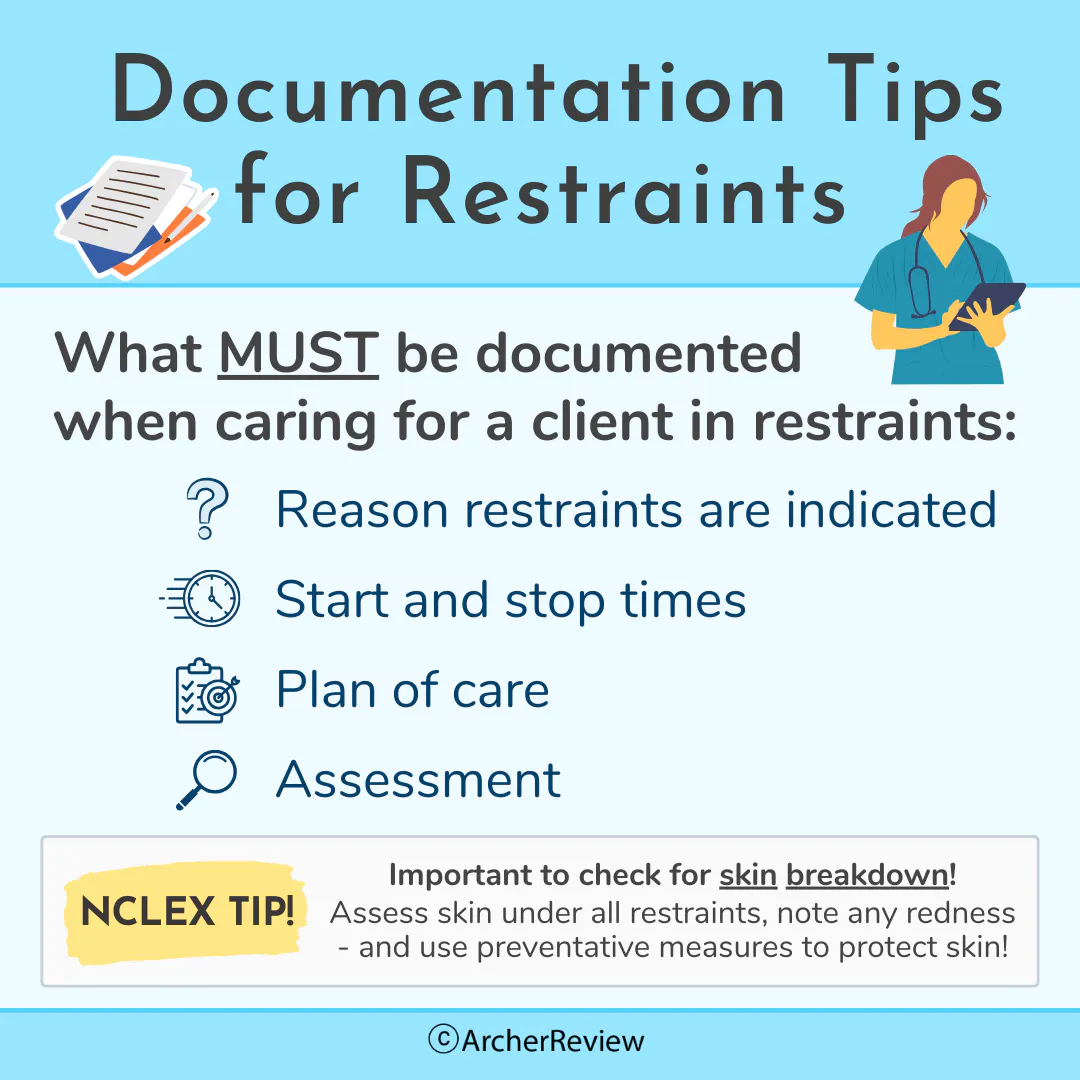
Choice A is correct. The use of restraints should always be a last resort, so it’s essential to document the least-restrictive measures that were tried first (such as verbal de-escalation, offering a quiet space, or using other non-physical interventions). This ensures that restraints were only applied after all other efforts to manage the client's behavior had been exhausted.
Choice B is incorrect. While admission status (voluntary or involuntary) is important for overall client care, it is not specifically required to be documented in relation to the use of restraints. Admission status generally informs care plans and the legal considerations around client rights, but it does not directly pertain to the restraint procedure or the reasons for their use.
Choice C is incorrect. Previous time spent in restraints may be useful information for assessing trends in behavior or restraint use, but it is not required for the documentation of a current restraint episode. Each use of restraint should be documented independently, including the measures taken and the time of application and release for the current episode. The history of restraint use may be reviewed for broader care planning but isn't a specific documentation requirement for a given restraint event.
Choice D is incorrect. While monitoring vital signs is important for ongoing care and safety during restraint use, it is not required to document the vital signs specifically before restraints are applied. It is not necessary for the nurse to obtain vital signs prior to restraining a client; rather, it is essential for the nurse to obtain and monitor these vital signs while the client is restrained.
Related Videos
4 Key Topics
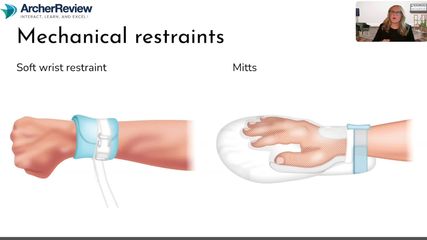
Restraints
8.2 Risk Management & Environment Safety
Additional Info
✓ The nurse should always use non-pharmacological and non-mechanical measures to de-escalate client behavior.
✓ Documentation of the restraint should include the alternatives used prior to restraining the client, type of restraint applied, the client's behavior while they were being restrained, and the ongoing evaluation.
✓ If restraints are necessary, the nurse should inform the client of the reason for the restraint and the expected behavior for them to demonstrate so they can be discontinued.
✓ Mechanical restraints should be applied if the client is physically violent.
✓ The nurse should position the client semi-Fowler's while mechanically restrained to ease respirations and reduce the client feeling vulnerable.