A client is scheduled to undergo electroconvulsive therapy (ECT). The nurse understands which of the following actions must be performed before the client's electroconvulsive therapy (ECT) procedure?
A client is scheduled to undergo electroconvulsive therapy (ECT). The nurse understands which of the following actions must be performed before the client's electroconvulsive therapy (ECT) procedure?
A. Assess the client for contrast dye allergy
[10%]
B. Administer an anticonvulsant medication
[23%]
C. Apply a blood pressure cuff to the client
[47%]
D. Check if the client is currently on metformin
[21%]
Statistics
Subject/Lesson
Subject
Mental Health
Lesson
Mental Health
Client Need
Test Plan
Reduction of Risk Potential
Related Topic
Therapeutic Procedures
Item Type
Item Type
Analysis
Explanation
Choice C is correct. Standard American Society of Anesthesiologists (ASA) recommends monitoring the client's heart rate, blood pressure, ECG, capnography, and temperature during any electroconvulsive therapy (ECT) procedure, as clients undergoing an ECT procedure often experience a temporary rise in blood pressure during treatment.
Choice A is incorrect. The nurse does not need to assess the client for allergies to contrast dye, as iodinated contrast agents are not used during an electroconvulsive therapy (ECT) procedure.
Choice B is incorrect. Electroconvulsive therapy (ECT) involves the induction of an electrically generated therapeutic seizure while the client is under general anesthesia. Administration of an anticonvulsant medication would be counter-effective towards the goal of this procedure.
Choice D is incorrect. While the medication list needs to be verified with the client, there is no particular reason to be alarmed by a client currently taking metformin before the client's scheduled electroconvulsive therapy (ECT) procedure. The nurse does not need to instruct the client to discontinue the metformin before the procedure.
Learning Objective
While preparing a client scheduled to undergo electroconvulsive therapy (ECT), the nurse should understand that applying a blood pressure cuff to the client must be performed before the client's ECT procedure.
Related Videos
3 Key Topics
Electroconvulsive Therapy
32.1 Psychopharmacology (Medications & Treatments)
Additional Info
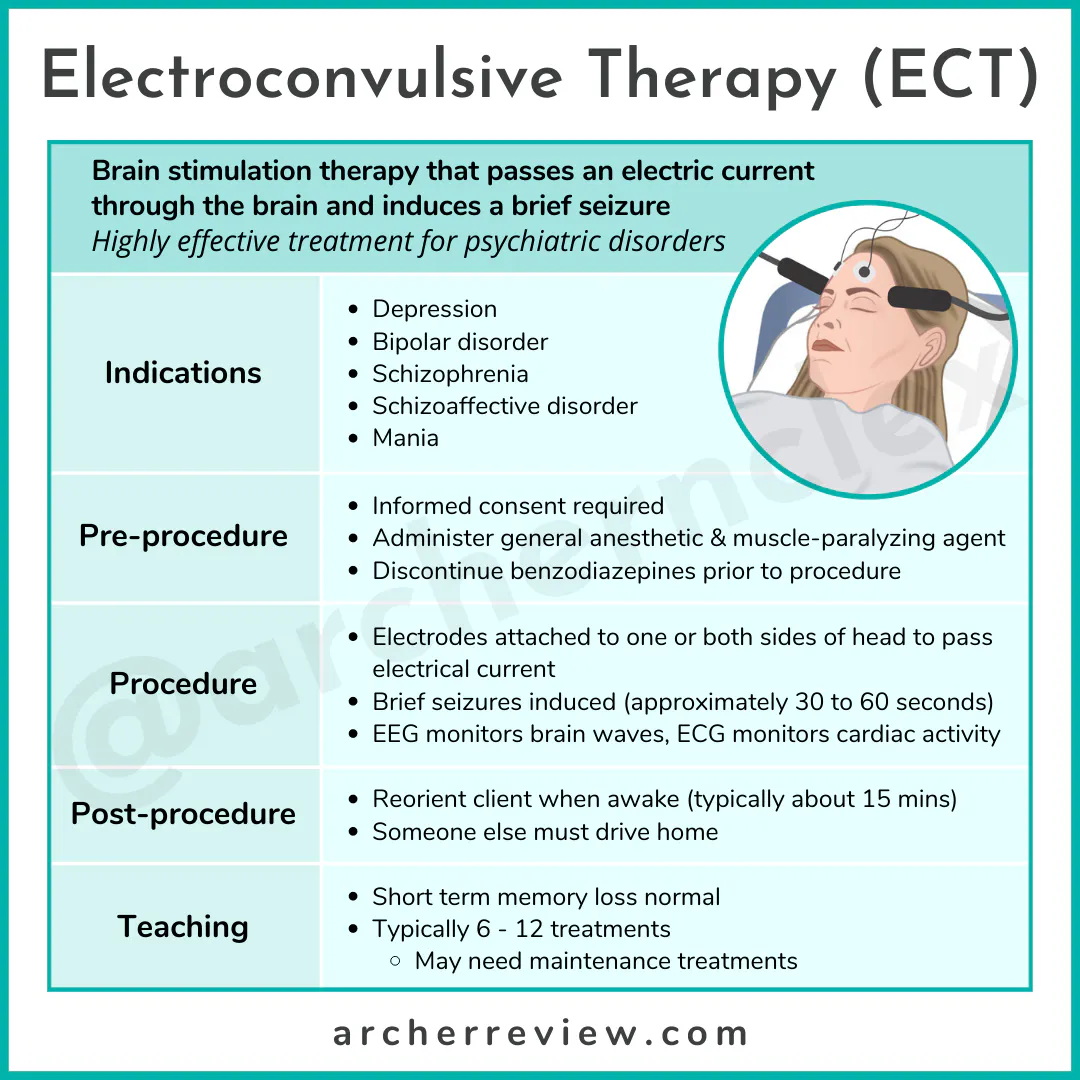
✓ Electroconvulsive therapy (ECT) is indicated for the treatment of severe or treatment-resistant depression, psychosis, bipolar disorder, and catatonia.
✓ Modern electroconvulsive therapy (ECT), delivered under heavy sedation/general anesthesia, is typically well tolerated, although confusion and memory impairment may occur acutely.
✓ Response to six to ten electroconvulsive therapy (ECT) treatments is usually dramatic and, at times, life-saving.
