The nurse is performing discharge teaching to a client who is alert and fully oriented but appears unable to comprehend the teaching. The client presents with signs of forehead sweating, tachycardia, and reports of impending doom.
The nurse suspects that the client is experiencing
The nurse is performing discharge teaching to a client who is alert and fully oriented but appears unable to comprehend the teaching. The client presents with signs of forehead sweating, tachycardia, and reports of impending doom.
The nurse suspects that the client is experiencing
A. moderate anxiety.
[18%]
B. psychosis.
[8%]
C. severe anxiety.
[65%]
D. mild anxiety.
[8%]
Statistics
Subject/Lesson
Subject
Mental Health
Lesson
Mental Health
Client Need
Test Plan
Psychosocial Integrity
Related Topic
Mental Health Concepts
Item Type
Item Type
Analysis
Explanation
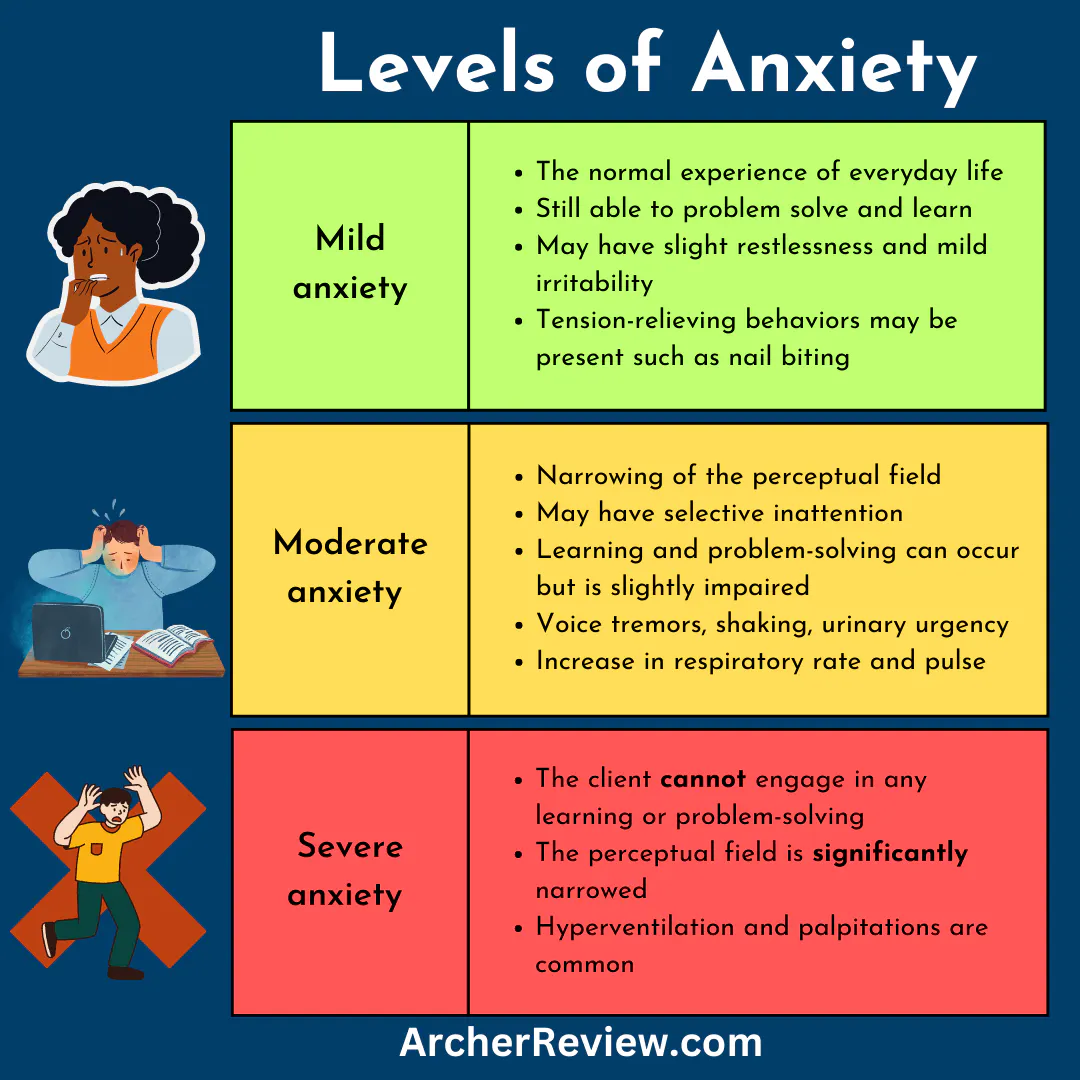
Choice C is correct. The client's inability to comprehend any information signals that the client is experiencing severe anxiety. A critical difference between moderate and severe anxiety is that the client with severe anxiety has such a narrow perceptual field that the thought process is grossly impaired, and learning and problem-solving cannot occur. When a client has moderate anxiety, the thought process is slightly scattered, but can still engage in learning and problem-solving. The increase in pulse and beads of sweat support both moderate and severe anxiety.
Choice A is incorrect. This client is not experiencing moderate anxiety because the client cannot comprehend teaching. Gross impairment of comprehension and problem-solving is associated with severe anxiety. At a moderate level, the client can still engage in some degree of problem-solving and learning.
Choice B is incorrect. Nothing in the client's symptomatology suggests psychosis. Further, most individuals with psychosis experience cognitive impairment, impacting their ability to recognize the situation, place, and time. This client was assessed as being fully alert and oriented.
Choice D is incorrect. Mild anxiety is excluded because the client has an increased pulse, inability to comprehend information, and is reporting a feeling of impending doom. All of which are associated with severe anxiety. Mild anxiety is part of everyday life and can be a motivating factor to relieve the stressor.
Learning Objective
Related Videos
2 Key Topics
Anxiety
32.2 Psychological Concepts & Safety
Additional Info
Source: ArcherReview.com
