The nurse reviews the clinical data of a term newborn one hour following birth
Click to highlight the body systems in the assessment that require follow-up
Please hover over (and click, if appropriate) the selected answer(s) under the system column.
The nurse reviews the clinical data of a term newborn one hour following birth
Click to highlight the body systems in the assessment that require follow-up
Please hover over (and click, if appropriate) the selected answer(s) under the system column.
| System | Finding |
|---|---|
Vital signs | Pulse 184/minute; Temperature of 95.7°F (35.3°C); Respiratory rate 65/minute |
Head | 33 cm head circumference; flat and soft fontanels; symmetrical in shape |
Eyes | Positive corneal and pupillary reflex; negative red reflex |
Cardiovascular | S1 and S2 heart tones present; regular rhythm; femoral pulses palpable |
Lungs | Abdominal respirations; clear lung sounds bilaterally; absent cough reflex |
Neuromuscular | Floppy, poor head control, hypotonic movements in all extremities |
Abdomen | Cylindric in shape; no meconium stool; normoactive bowel sounds |
Skin | Generalized cyanosis; vernix caseosa present in skin folds; lanugo present on back |
Cry | Weak, jittery cry |
Statistics
Subject/Lesson
Subject
Maternal & Newborn Health
Lesson
Newborn
Client Need
Test Plan
Health Promotion and Maintenance
Related Topic
Ante/Intra/Postpartum and Newborn Care
Item Type
Item Type
RecognizeCues
Explanation
Assessment findings requiring follow-up
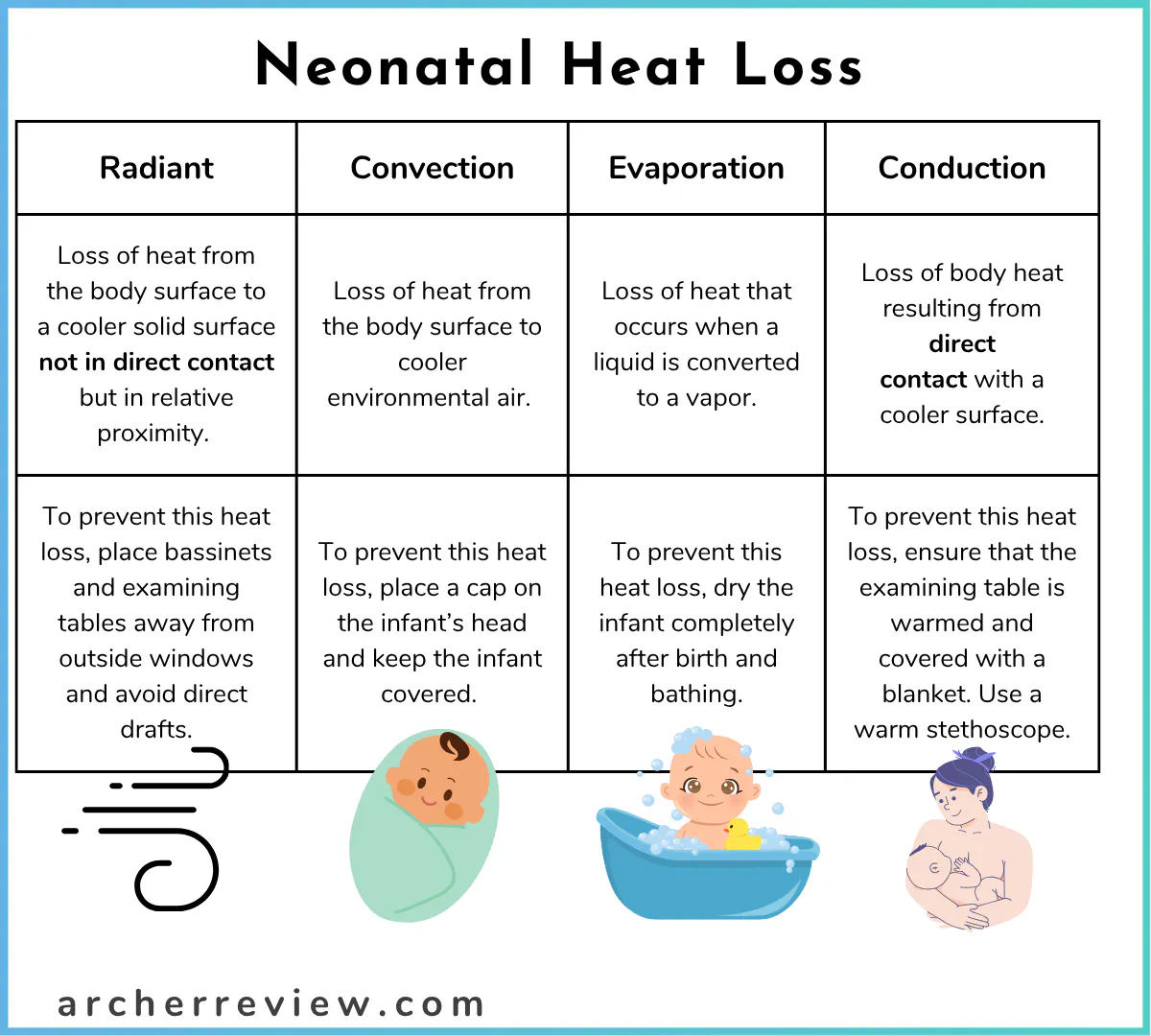
- Vital signs: the pulse is high (normal 110-160/minute; may go to 180/minute when crying). The temperature of 95.7°F (35.3°C) is low (normal 36.5°-37°C [97.7°-98°F]). The infant has tachypnea (normal respiratory rate 40-60/minute). These findings strongly suggest cold stress.
- Neuromuscular: floppy, poor head control; hypotonic movement in all extremities is abnormal. The expected finding would be the extremities in some degree flexion with good muscle tone. The infant should be able to turn their head from side to side when prone. Hypotonia may suggest hypoglycemia which could be potentially caused by cold stress.
- Eyes: the eyes should have a positive pupillary and corneal reflex. It is normal for the lids to be edematous for 2 days after birth. The red reflex should be positive. The red reflex is the reflection of light on the vascular retina. The absence of the red reflex may indicate glaucoma, retinal abnormality, retinoblastoma, or cataracts.
- Skin: generalized cyanosis is a concerning finding for cold stress. The expected integument finding is bright red, puffy, smooth, and some facial edema. The presence of vernix caseosa (a white, oily substance that coats the term infant's body and is often found in the creases of the axillae and groin) and lanugo (fine, downy hair found especially on the forehead, cheeks, shoulders, and back) is a benign finding.
- Cry: the cry should be vigorous. A weak, jittery cry is concerning for hypoglycemia.
Assessment findings within normal limits
- Head: the head circumference should be between 33-35 cm - the head circumference should be approximately 2 to 3 cm more than the chest circumference. The fontanels should be soft and flat.
- Cardiovascular: S1 and S2 heart tones should be auscultated without any murmur. The rhythm should be regular. Femoral pulses should be palpable.
- Lungs: respirations are chiefly abdominal. The breath sounds should be clear without any adventitious sounds. Respirations that are chiefly abdominal are expected. The cough reflex is absent at birth and will be present in 1-2 days.
- Abdomen: The abdomen should be cylindric in shape. The umbilical cord should have two arteries and one vein. The bowel sounds should be normoactive bowel sounds in all quadrants. Passage of meconium should occur within the first 24 hours after birth.
Related Videos
6 Key Topics
Newborn Assessment
31.1 Immediate Newborn Evaluation
Additional Info