The nurse is caring for a newborn immediately following birth.
Which of the following actions by the nurse will prevent radiant heat loss in the newborn?
The nurse is caring for a newborn immediately following birth.
Which of the following actions by the nurse will prevent radiant heat loss in the newborn?
A. Drying the newborns skin with a towel
[37%]
B. Placing the newborn on a padded, covered surface
[21%]
C. Using warmed, humidified oxygen
[6%]
D. Positioning the bassinet away from outside windows
[36%]
Statistics
Subject/Lesson
Subject
Maternal & Newborn Health
Lesson
Newborn
Client Need
Test Plan
Reduction of Risk Potential
Related Topic
Potential for Alterations in Body Systems
Item Type
Item Type
Application
Explanation
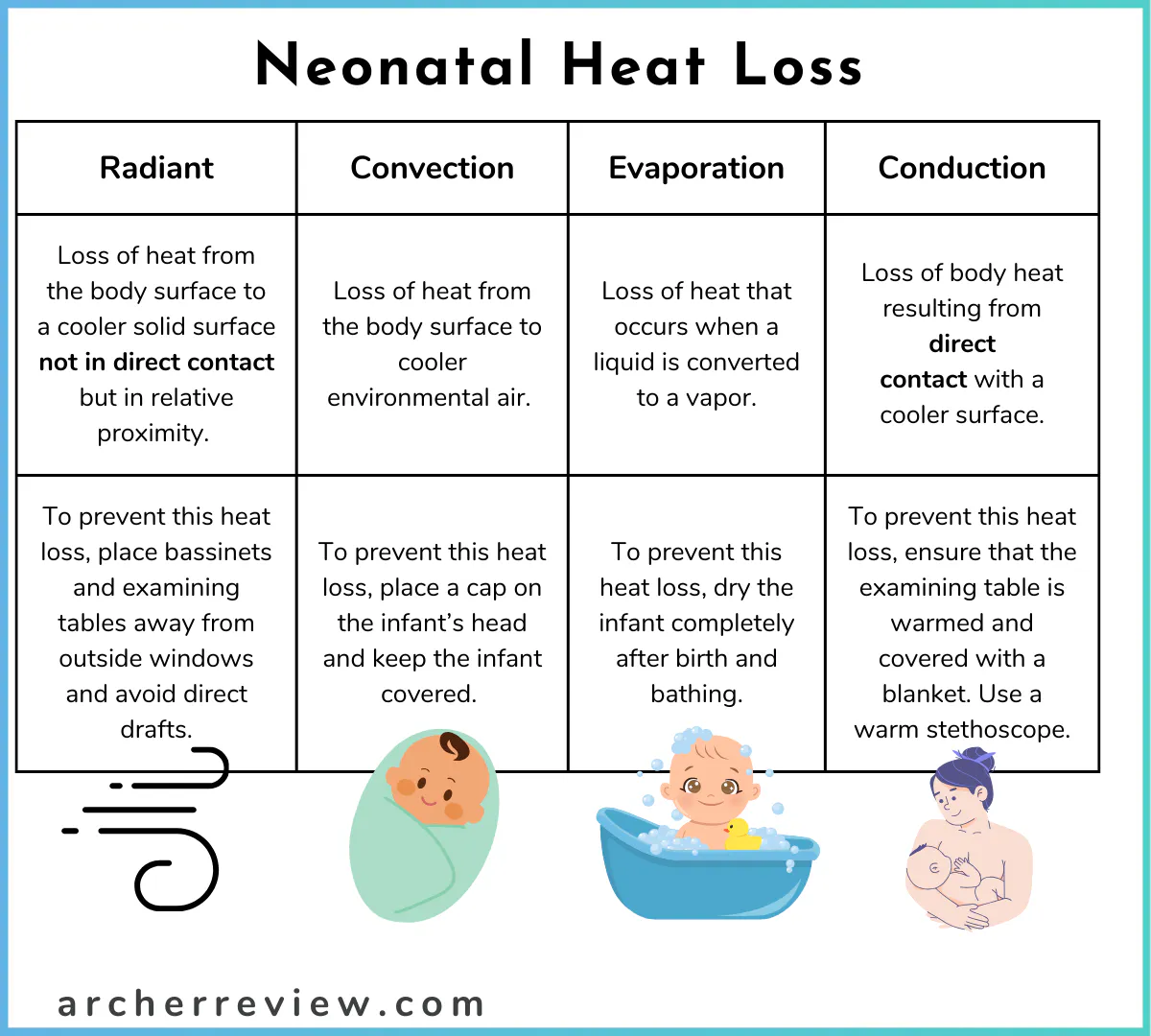
Choice D is correct. This prevents radiant heat loss, which occurs when heat is transferred from a warmer object (like a newborn’s body) to a cooler object nearby, without direct contact. The key is indirect heat transfer via infrared radiation. Even if the surrounding air feels warm, nearby cooler surfaces—like window glass—can “pull” warmth away from the baby. Glass, especially when exposed to the outside environment, remains much cooler than room temperature and can absorb radiant heat from the infant. By positioning the bassinet away from cold surfaces like windows, the nurse reduces the baby’s exposure to cooler objects that would otherwise draw heat away through radiation.
Choice A is incorrect. Drying the infant helps prevent evaporative heat loss, not radiant heat loss. Evaporation occurs when moisture on the infant’s skin turns into vapor, removing body heat in the process.
Choice B is incorrect. Placing the infant on a padded, covered surface prevents conductive heat loss, which happens through direct contact with cold surfaces.
Choice C is incorrect. Administering warmed, humidified oxygen prevents convective heat loss, which occurs when the air surrounding the infant carries away body heat—especially if air currents or drafts are present. Radiation = heat transfer to a cooler object without touching it, such as feeling cold when standing near a large window. Convection = heat transfer to air. It happens when the baby’s warm body heats up the surrounding air, which then moves away and is replaced by cooler air. A draft, open window, or air vent would cause convective heat loss.
Learning Objective
Understand different types of neonatal heat loss and preventive measures.
Related Videos
2 Key Topics
Newborn Assessment