The nurse is monitoring a newborn infant who was just delivered.
Which finding indicates successful transition to extrauterine respiration in a newborn 10 minutes after delivery?
The nurse is monitoring a newborn infant who was just delivered.
Which finding indicates successful transition to extrauterine respiration in a newborn 10 minutes after delivery?
A. Grunting and nasal flaring
[7%]
B. Respiratory rate of 70 breaths per minute with seesaw breathing
[13%]
C. Pink trunk and acrocyanosis of the hands and feet
[74%]
D. Heart rate of 90 bpm and intercostal retractions
[5%]
Statistics
Subject/Lesson
Subject
Maternal & Newborn Health
Lesson
Newborn
Client Need
Test Plan
Health Promotion and Maintenance
Related Topic
Ante/Intra/Postpartum and Newborn Care
Item Type
Item Type
Analysis
Explanation
Choice C is correct. A pink trunk indicates adequate oxygenation and successful lung function. Acrocyanosis is normal in the first 24–48 hours due to immature peripheral circulation and is not considered a sign of respiratory distress.
Choice A is incorrect. Grunting and nasal flaring are signs of respiratory distress. Grunting helps keep alveoli open, but it signals that the baby is working too hard to breathe.
Choice B is incorrect. A respiratory rate of 70 is on the high end of normal, but combined with seesaw breathing (inward movement of the chest with outward movement of the abdomen), it indicates abnormal respiratory effort and should be evaluated further.
Choice D is incorrect. A heart rate of 90 bpm is too low for a newborn, whose normal heart rate is 110–160 bpm. Intercostal retractions further suggest respiratory distress requiring prompt intervention.
Learning Objective
Recognize signs of normal respiratory adaptation versus distress in the immediate newborn period.
Related Videos
4 Key Topics
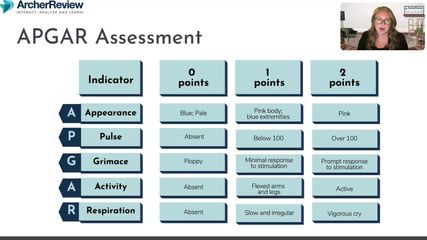
APGAR
31.1 Immediate Newborn Evaluation
Work of Breathing
31.1 Immediate Newborn Evaluation
Additional Info
✓Newborns must clear lung fluid and establish functional residual capacity with their first breath.
✓Surfactant, produced from 32–34 weeks gestation, reduces alveolar surface tension and prevents collapse.
✓Normal signs in the first hours include irregular breathing, acrocyanosis, and periodic breathing (<20 seconds).
✓Abnormal signs include grunting, nasal flaring, retractions, central cyanosis, and tachypnea (>60 breaths/min).
✓Failure to adapt may require interventions such as oxygen support, CPAP, or NICU transfer.
