The nurse is performing a continuing education course on newborn care and thermoregulation.
Which of the following actions by the nurse will prevent evaporative heat loss in the newborn?
The nurse is performing a continuing education course on newborn care and thermoregulation.
Which of the following actions by the nurse will prevent evaporative heat loss in the newborn?
A. Drying the newborn's skin with a towel after a bath
[57%]
B. Placing the infant skin-to-skin with the parent.
[30%]
C. Warm the stethoscope before auscultating heart and lung sounds
[4%]
D. Keeping the temperature in the newborn care area between 22°C and 26°C (72°F and 78°F)
[9%]
Statistics
Subject/Lesson
Subject
Maternal & Newborn Health
Lesson
Newborn
Client Need
Test Plan
Reduction of Risk Potential
Related Topic
Potential for Alterations in Body Systems
Item Type
Item Type
Application
Explanation
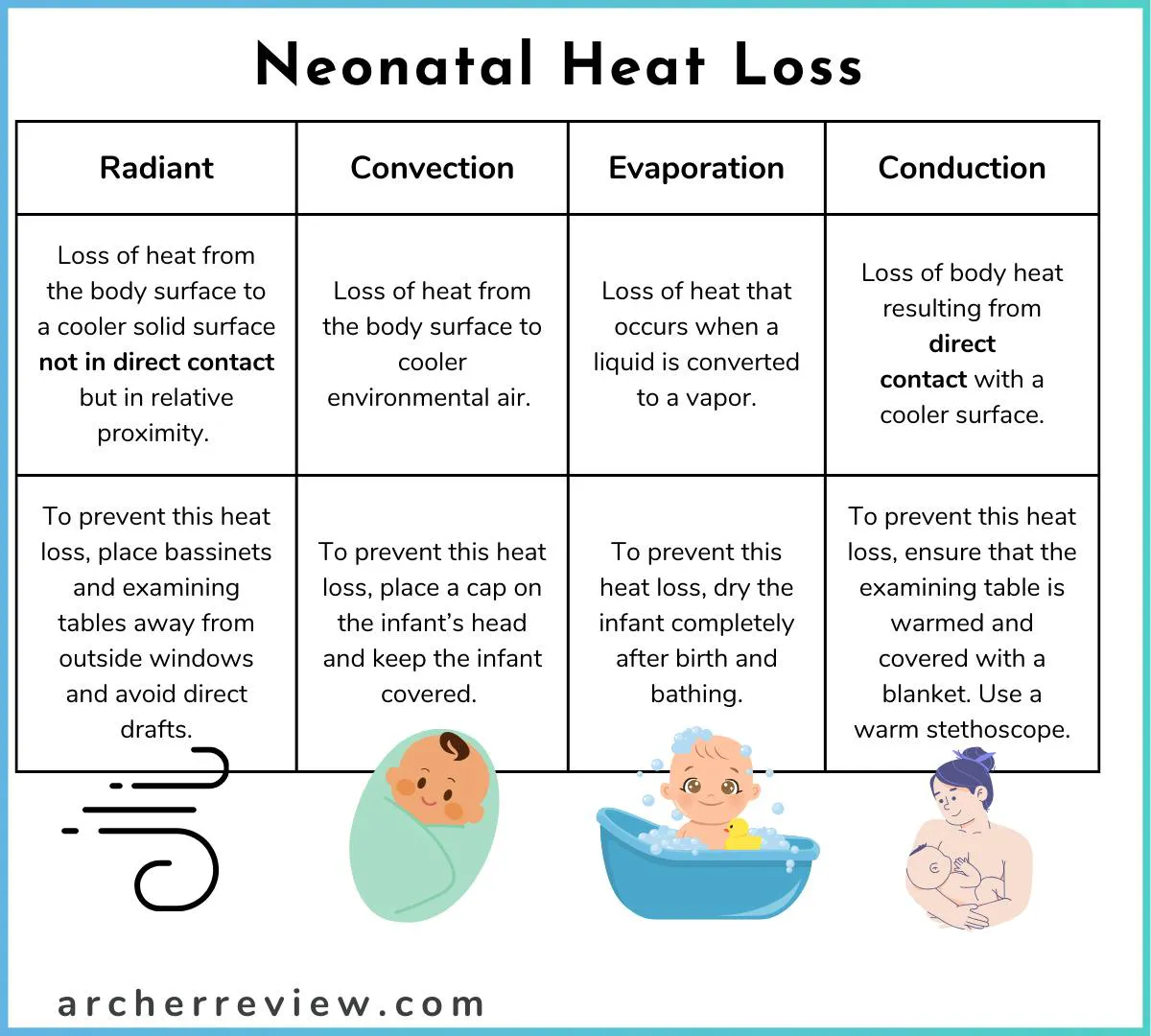
Choice A is correct. Evaporative heat loss occurs when the moisture from the body's surface is lost to the environment. Drying the infant with a towel would help prevent evaporative heat loss, not radiant heat loss.
Choice B is incorrect. Skin-to-skin contact with the mother (or father) is an effective way of reducing conductive heat loss.
Choice C is incorrect. Warming the stethoscope prior to applying it to the infant is an effective way of reducing conductive heat loss. Conductive heat loss occurs through direct contact with a cooler object.
Choice D is incorrect. Keeping the temperature in the newborn care area between 22°C and 26°C (72°F and 78°F) is an effective way to reduce convective heat loss. Convective heat loss occurs from the body's surface to cooler environmental air.
Learning Objective
Understand different types of neonatal heat loss and preventive measures.
Additional Info