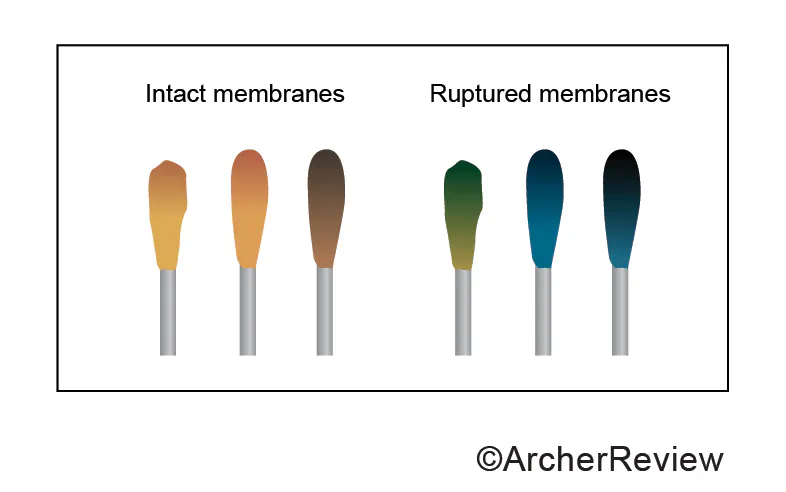
A client at 38 weeks gestation reports to the nurse that she just experienced a gush of fluid coming from her vagina. The nurse confirms that this is amniotic fluid by using which test?
A client at 38 weeks gestation reports to the nurse that she just experienced a gush of fluid coming from her vagina. The nurse confirms that this is amniotic fluid by using which test?
A. Transvaginal ultrasound
[10%]
B. Transabdominal ultrasound
[7%]
C. Nitrazine paper test
[80%]
D. Gram staining
[3%]
Statistics
Subject/Lesson
Subject
Maternal & Newborn Health
Lesson
Labor/Delivery
Client Need
Test Plan
Reduction of Risk Potential
Related Topic
System Specific Assessments
Item Type
Item Type
Application
Explanation
Choice C is correct. Nitrazine paper is used to measure the pH of the fluid to determine if the amniotic membrane has ruptured. Once the fluid comes into contact with nitrazine paper, the pH of the fluid will cause the paper's color to change. The resulting color will correlate to a pH allowing the nurse to decipher whether the fluid is amniotic or vaginal.
Choice A is incorrect. A transvaginal ultrasound would not assist the nurse in identifying if the fluid was amniotic.
Choice B is incorrect. A transabdominal ultrasound cannot determine if the fluid is amniotic.
Choice D is incorrect. Gram staining is performed to detect the presence of bacterial infections. This is not a test to determine if the fluid is amniotic.
Learning Objective
Recognize when a client presents with a possible rupture of membranes, a nitrazine paper is typically used to assess the pH level of the fluid to identify whether the fluid is amniotic.
Related Videos
2 Key Topics
Amniotic Sac Rupture
30.1 Labor Concepts & Delivery Types
Additional Info
✓ Amniotic fluid should be clear, possibly containing flecks of white vernix
✓ Amniotic fluid has a distinctive odor that is not malodorous
✓ The nitrazine/pH test with a color change of blue-green to dark blue (pH > 6.5) suggests a true membrane rupture but is not always conclusive
✓ The fern test is more diagnostic of true rupture of membranes because it is less likely to be affected by vaginal infections, recent intercourse, or other factors