A client presents to the obstetrics floor at 39 weeks gestation with irregular contractions. After you get the client situated in a labor, delivery, and recovery room, you notice the client's health care provider (HCP) enter the room to evaluate the client. Following the evaluation, the HCP exits the room, and shortly thereafter, you enter. During your discussion, the client states the HCP "went to order oxytocin." In anticipation of that order, you understand this client's oxytocin will be administered via which route of administration?
A client presents to the obstetrics floor at 39 weeks gestation with irregular contractions. After you get the client situated in a labor, delivery, and recovery room, you notice the client's health care provider (HCP) enter the room to evaluate the client. Following the evaluation, the HCP exits the room, and shortly thereafter, you enter. During your discussion, the client states the HCP "went to order oxytocin." In anticipation of that order, you understand this client's oxytocin will be administered via which route of administration?
A. Intramuscular administration
[3%]
B. Intravenous administration via mainline infusion using an infusion pump
[35%]
C. Intravenous administration via piggyback using an infusion pump
[61%]
D. Oral administration
[1%]
Statistics
Subject/Lesson
Subject
Maternal & Newborn Health
Lesson
Labor/Delivery
Client Need
Test Plan
Pharmacological and Parenteral Therapies
Related Topic
Medication Administration
Item Type
Item Type
Knowledge/Comprehension
Explanation
Choice C is correct. Oxytocin should always be administered intravenously as a piggyback infusion. Intravenous infusion is the only acceptable method of parenteral administration of oxytocin for the induction or stimulation of labor. Accurate control of the infusion rate is essential and is best accomplished by an infusion pump. The current FDA recommendation is "to piggyback the Pitocin (oxytocin) infusion on a physiologic electrolyte solution, permitting the Pitocin (oxytocin) infusion to be stopped abruptly without interrupting the electrolyte infusion."
Choice A is incorrect. In order to control postpartum uterine bleeding, oxytocin can be administered intramuscularly following delivery of the placenta. For this client, intramuscular administration of oxytocin is not indicated at this time.
Choice B is incorrect. Oxytocin should not be infused as a mainline intravenous medication due to the potency of the medication and the need for accurate dosing.
Choice D is incorrect. Oxytocin is destroyed in the gastrointestinal tract and is therefore unavailable in oral form.
Learning Objective
Recognize that when giving oxytocin to augment uterine activity, the medication must be intravenously infused via piggyback utilizing an infusion pump.
Related Videos
4 Key Topics

Oxytotic Medications
6.13 Obstetric & Labor Medications
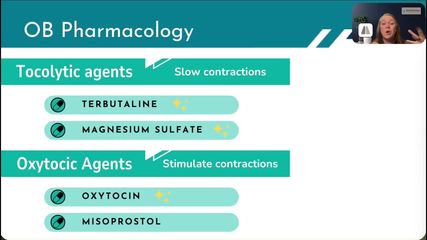
Tocolytics & Oxytotics
30.2 Preterm Labor & Medications
Additional Info
- Oxytocin is also commonly referred to under the brand name Pitocin.
- Oxytocin is given for induction of labor, the augmentation of uterine activity, to prevent or control uterine bleeding after delivery, to induce completion of an incomplete abortion (including miscarriages), and to promote milk ejection during lactation.
- Due to the sensitivity of oxytocin dosing, a calibrated infusion pump must be utilized.
- Oxytocin is piggybacked intravenously using a calibrated infusion pump into the most proximal port of the mainline intravenous (IV) line.
- IV bags, tubing, and infusion pumps must be labeled in a standard fashion, consistent with hospital policy.
