The nurse is caring for a client in labor and discovers the client has a completely prolapsed umbilical cord.
Which of the following actions should the nurse take?
The nurse is caring for a client in labor and discovers the client has a completely prolapsed umbilical cord.
Which of the following actions should the nurse take?
A. encourage the client to push at the next contraction
[3%]
B. administer nasal cannula oxygen at 2 liters/minute
[16%]
C. position the client knee to chest
[77%]
D. obtain a prescription for oxytocin
[3%]
Statistics
Subject/Lesson
Subject
Maternal & Newborn Health
Lesson
Labor/Delivery
Client Need
Test Plan
Health Promotion and Maintenance
Related Topic
Ante/Intra/Postpartum and Newborn Care
Item Type
Item Type
Application
Explanation
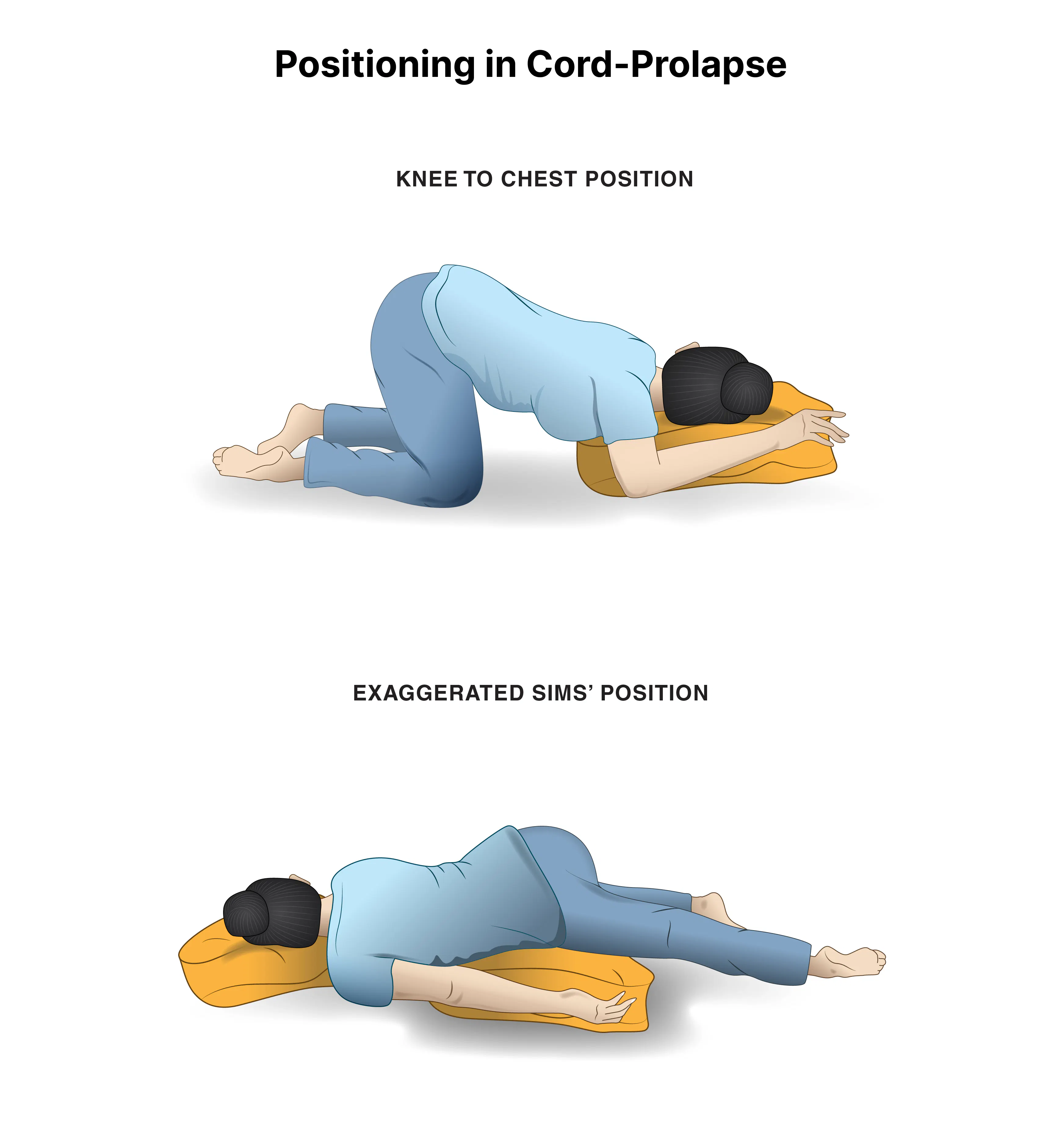
Choice C is correct. A prolapsed umbilical cord is a serious finding that may lead to fetal hypoxia. The nurse must act quickly if this is suspected. Nursing and medical care will overlap, but one of the earliest interventions is to reposition the client either knee to chest, Trendelenburg, or with a left side-lying position with hips elevated using a pillow under the left hip (exaggerated sims position). The goal of repositioning is to position the woman's hips higher than her head to shift the fetal presenting part toward her diaphragm.
Choice A is incorrect. The client should not push at the next contraction. Pushing will progress labor, and the goal is to provide immediate care to restore perfusion to the fetus. Most cases of prolapsed umbilical cord result in an emergent cesarean section.
Choice B is incorrect. Administering oxygen is an early priority, but giving 2 liters via nasal cannula is insufficient. The clinical standard is administering oxygen 8-10 liters via a face mask.
Choice D is incorrect. Obtaining a prescription for oxytocin would be inappropriate. This is because the more uterine contractions, the more fetal perfusion will be demanded, which cannot be supplied because of the prolapse in the umbilical cord.
Related Videos
4 Key Topics

Disease Specific Positioning
9.14 Disease-Specific Positioning
Prolapsed Umbilical Cord
30.4 Intrapartum Complications
Additional Info
✓ A prolapsed umbilical cord is a medical emergency
✓ The prolapse may be hidden or complete
✓ This condition should be suspected if the fetal heart monitor shows sustained bradycardia, variable decelerations or prolonged deceleration
✓ The nurse should reposition the client with the intent to position the woman’s hips higher than her head to shift the fetal presenting part
✓ Acceptable positions include knee-chest, Trendelenburg, or hips elevated with pillows, with side-lying position maintained
✓ The nurse should shout for help, pause oxytocin infusion, and provide oxygen via face mask at 8-10 liters/minute
✓ Provide and maintain vaginal elevation of the presenting part using a gloved hand
✓ An emergency cesarean section is likely
