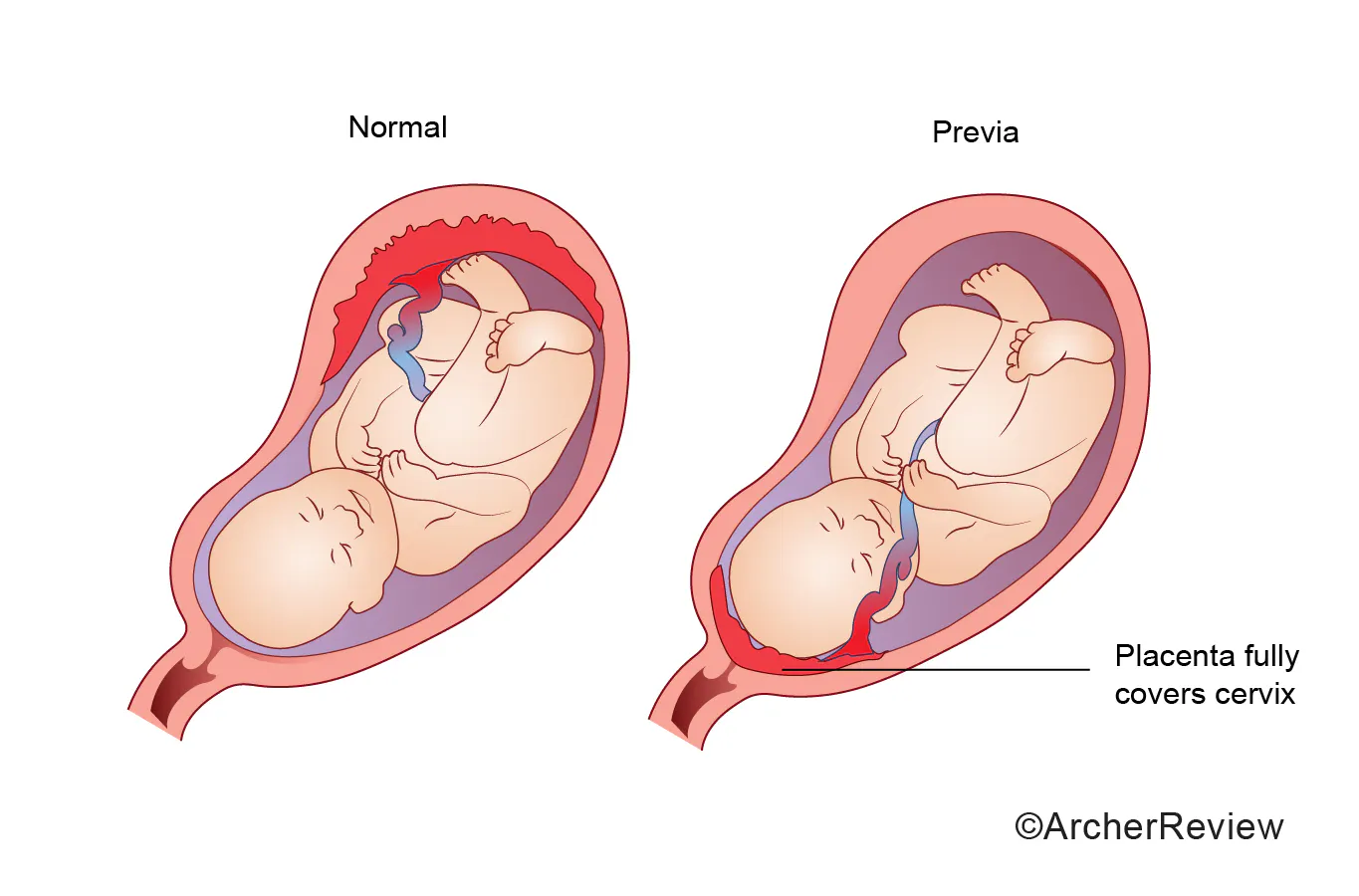
The nurse is caring for a client with placenta previa. Which of the following orders by the primary healthcare provider (PHCP) should the nurse question?
The nurse is caring for a client with placenta previa. Which of the following orders by the primary healthcare provider (PHCP) should the nurse question?
A. Manual cervical exam
[65%]
B. Transabdominal ultrasound
[5%]
C. Nonstress test
[4%]
D. Transvaginal ultrasound
[26%]
Statistics
Subject/Lesson
Subject
Maternal & Newborn Health
Lesson
Antepartum
Client Need
Test Plan
Reduction of Risk Potential
Related Topic
Potential for Complications of Diagnostic Tests/Treatments/Procedures
Item Type
Item Type
Knowledge/Comprehension
Explanation
Choice A is correct. Manual cervical exams should be questioned if a client has placenta previa. The reasoning is that palpation of the placenta previa through a partially dilated cervix may cause severe hemorrhage.
Choice B is incorrect. A transabdominal ultrasound is a non-invasive imaging technique that uses sound waves to create an image of the pelvic area. This method is safe in cases of placenta previa as it does not involve any manipulation of the cervix. It allows healthcare providers to assess the location of the placenta without posing a risk of increased bleeding.
Choice C is incorrect. A nonstress test is a fetal monitoring test that measures the fetal heart rate in response to fetal movement. It is a non-invasive test and does not involve any procedures that could disrupt the placenta or cause bleeding.
Choice D is incorrect. Similar to transabdominal ultrasound, transvaginal ultrasound is a non-invasive imaging technique. Transvaginal ultrasound is the most accurate way to assess placenta previa. The angle between the transvaginal probe and the cervical canal is such that the probe does not enter the cervical canal.
Related Videos
2 Key Topics
Placenta Previa
30.4 Intrapartum Complications
Additional Info