The nurse is reviewing a client's contraction stress test results.
Which action should the nurse take based on the results?

The nurse is reviewing a client's contraction stress test results.
Which action should the nurse take based on the results?
A. obtain an order for a biophysical screening
[41%]
B. document the results as within normal limits
[42%]
C. perform Leopold maneuvers
[11%]
D. obtain a urine specimen and assess for proteinuria
[6%]
Statistics
Subject/Lesson
Subject
Maternal & Newborn Health
Lesson
Antepartum
Client Need
Test Plan
Health Promotion and Maintenance
Related Topic
Ante/Intra/Postpartum and Newborn Care
Item Type
Item Type
Analysis
Explanation
Choice A is correct. The results show that the client has a positive CST. This is not a reassuring finding and occurs when late decelerations are present with a minimum of 50% of the contractions. Positive CSTs are linked to an increased incidence of fetal growth restriction, late decelerations in labor, meconium-stained fluid, low 5-minute Apgar scores, and stillbirth. After this non-reassuring finding, the nurse should arrange for a biophysical profile (BPP) as fetal characteristics are evaluated simultaneously over 30 minutes. Fetal movement, fetal tone, fetal breathing movement, and amniotic fluid amount. The BPP is necessary to determine the fetuses' well-being after a non-reassuring CST.
Choice B is incorrect. It would be inappropriate for the nurse to document the result within normal limits. A positive CST requires follow-up. A positive CST indicates that late decelerations occurred in at least 50% of the contractions.
Choice C is incorrect. Performing Leopold maneuvers is not appropriate based on this finding. These maneuvers provide valuable information about the location and presentation of the fetus and do not provide vital information such as fetal heart rate, fetal breathing movements, and fetal tone.
Choice D is incorrect. Obtaining a urine specimen and assessing it for any proteinuria is not appropriate. The CST provides valuable insight into how the fetus will tolerate labor, and additional information on the fetus's well-being is necessary through a BPP.
Related Videos
2 Key Topics
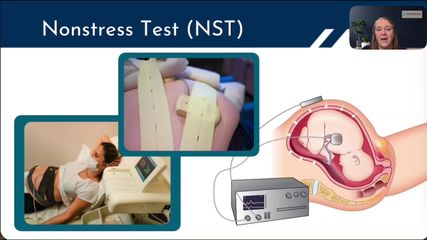
Contraction Stress Test
29.3 Fetal Assessment Tests
Additional Info
✓ The results for a CST are interpreted as follows –
- Positive (abnormal) indicates that late decelerations were present in the FHR in more than 50% of the contractions.
- Negative (normal) indicates that no late or variable decelerations were evident during the contractions.
✓ A contraction stress test is indicated for clients with high-risk pregnancies. This test is completed in the third trimester.
✓ Relative contraindications to a CST include placenta previa and clients at risk for preterm delivery as this test may hasten delivery or at least cause rupture of the membranes.
