The nurse in the emergency department (ED) has a client with suspected septic shock. The priority intervention for this client is to
The nurse in the emergency department (ED) has a client with suspected septic shock. The priority intervention for this client is to
A. establish a peripheral vascular access device.
[88%]
B. obtain the prescribed consult with infectious disease.
[1%]
C. provide frequent updates regarding the client’s care.
[0%]
D. perform a physical assessment for the potential source of infection.
[10%]
Statistics
Subject/Lesson
Subject
Leadership & Management
Lesson
Prioritization
Client Need
Test Plan
Management of Care
Related Topic
Establishing Priorities
Item Type
Item Type
Analysis
Explanation
Choice A is correct. Shock is a medical emergency and indicates a significant loss in bodily perfusion. In clients with septic shock, a common feature is severe hypovolemia, necessitating rapid fluid resuscitation. Additionally, intravenous broad-spectrum antibiotic therapy should start within one hour of presentation. The nurse must act quickly to establish peripheral vascular access, which will be vital to obtaining the necessary laboratory specimens (blood cultures, lactic acid) and delivering fluid resuscitation along with broad-spectrum antibiotics. Two large bore IV access should be established within five minutes of presentation, one for fluid resuscitation and the other for antibiotic delivery. If peripheral intravenous access can not be obtained, the nurse should attempt to get intraosseous access.
Choice B is incorrect. Obtaining a consult with infectious disease is a crucial intervention so that this specialist may determine the appropriate medical management. However, staying with the client and restoring circulating volume is vital when a client is in shock.
Choice C is incorrect. Frequent updates regarding the client’s care would be a psychosocial need. This does not prioritize the client’s physical instability.
Choice D is incorrect. The source of the infection is essential, but performing a physical assessment would take away time from the necessary intervention of establishing vascular access to deliver life-saving treatment.
Learning Objective
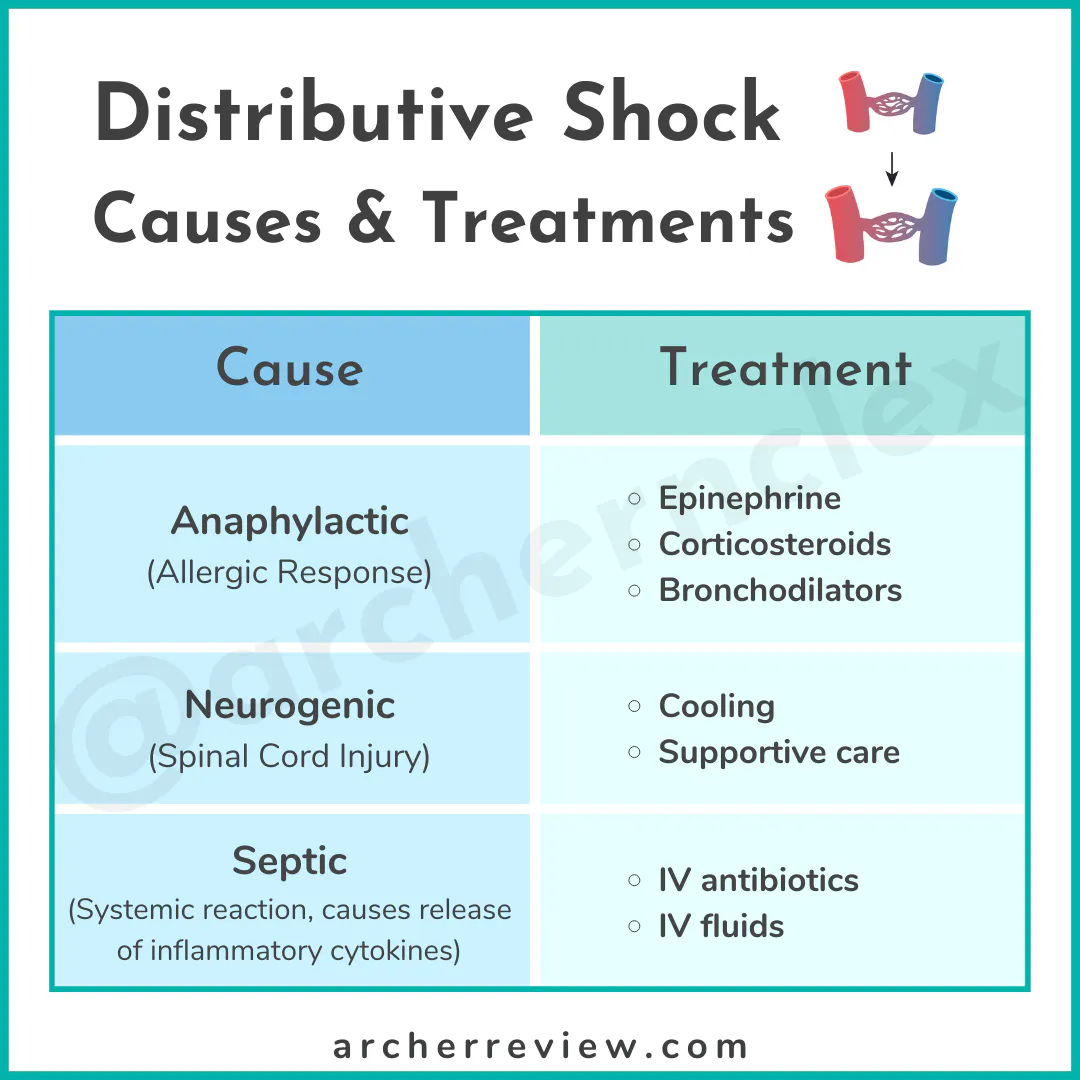
Recognize that septic shock is a distributive shock requiring immediate intravenous fluids administration, obtaining blood cultures, and infusing parenteral antibiotics. Getting quick and adequate IV access is a critical necessity.
Related Videos
4 Key Topics
Sepsis
23.3 Infection Control & Infectious Diseases

Distributive Shock
27.5 Shock
Additional Info
 Source : Source: Archer Review
Treatment goals for a client with septic shock include the following:
✓ Optimal perfusion as demonstrated by a MAP ≥ 65 mmHg.
✓ Normal respiratory rate, pulse, temperature, pulse oximetry, mentation, and urine output.
✓ Clearance of lactic acid. A falling lactic acid indicates a favorable response to fluids and oxygenation.
✓ Lactic acid is produced when tissue is not being perfused.
✓ A serum lactic acid level of 2 mmol/L or greater may indicate the severity of sepsis.
