Client is a 68-year-old male admitted for evaluation of chronic lower extremity symptoms.
Item 1 of 1
- History and Physical
Client is a 68-year-old male admitted for evaluation of chronic lower extremity symptoms. The client reports intermittent pain in the legs with walking that improves with rest. On assessment, lower extremities appear thin, shiny, and hairless. Bilateral 2+ pitting edema is noted in the lower legs. Pedal pulses are weak bilaterally. The client describes numbness and tingling in the feet. Skin on the lower legs appears brownish and thickened. Capillary refill time is less than 2 seconds. No redness, warmth, or purulent drainage is noted.
The nurse is reviewing the client’s intake assessment.
Click to highlight the findings that are associated with peripheral arterial disease (PAD).
The nurse is reviewing the client’s intake assessment.
Click to highlight the findings that are associated with peripheral arterial disease (PAD).
Client is a 68-year-old male admitted for evaluation of chronic lower extremity symptoms. The client reports
intermittent pain in the legs with walking that improves with rest.
On assessment,
lower extremities appear thin, shiny, and hairless.
Bilateral 2+ pitting edema is noted in the lower legs.
Pedal pulses are weak bilaterally.
The client describes
numbness and tingling in the feet.
Skin on the lower legs appears brownish and thickened.
Capillary refill time is less than 2 seconds.
No redness, warmth, or purulent drainage is noted.
Statistics
Subject/Lesson
Subject
Adult Health
Lesson
Cardiovascular
Client Need
Test Plan
Reduction of Risk Potential
Related Topic
Potential for Alterations in Body Systems
Item Type
Item Type
RecognizeCues
Explanation
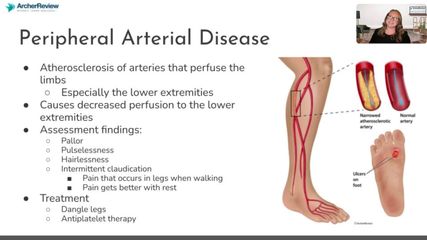
Findings associated with peripheral arterial disease (PAD) include intermittent pain in the legs with walking that improves with rest (known as intermittent claudication), lower extremities appearing thin, shiny, and hairless (due to chronic poor perfusion), pedal pulses weak bilaterally (indicating impaired arterial blood flow), and numbness and tingling in the feet (a sign of ischemia affecting nerve tissue). These findings are consistent with arterial insufficiency, where reduced blood supply to the extremities leads to impaired tissue health, decreased exercise tolerance, and sensory changes. PAD reflects a chronic, progressive narrowing of the arteries, often secondary to atherosclerosis.
The other findings are not characteristic of PAD. Bilateral 2+ pitting edema and brownish, thickened skin on the lower legs are hallmarks of chronic venous insufficiency, where blood pooling and poor venous return lead to fluid accumulation and skin changes. These findings point toward venous rather than arterial disease. Capillary refill time less than 2 seconds is a normal finding, suggesting adequate peripheral perfusion; in significant PAD, one would expect delayed capillary refill greater than 2 seconds due to impaired arterial flow. Therefore, these findings should not be selected when identifying signs specific to peripheral arterial disease.
NCLEX Strategy Spotlights
Related Videos
2 Key Topics
Peripheral Arterial Disease
