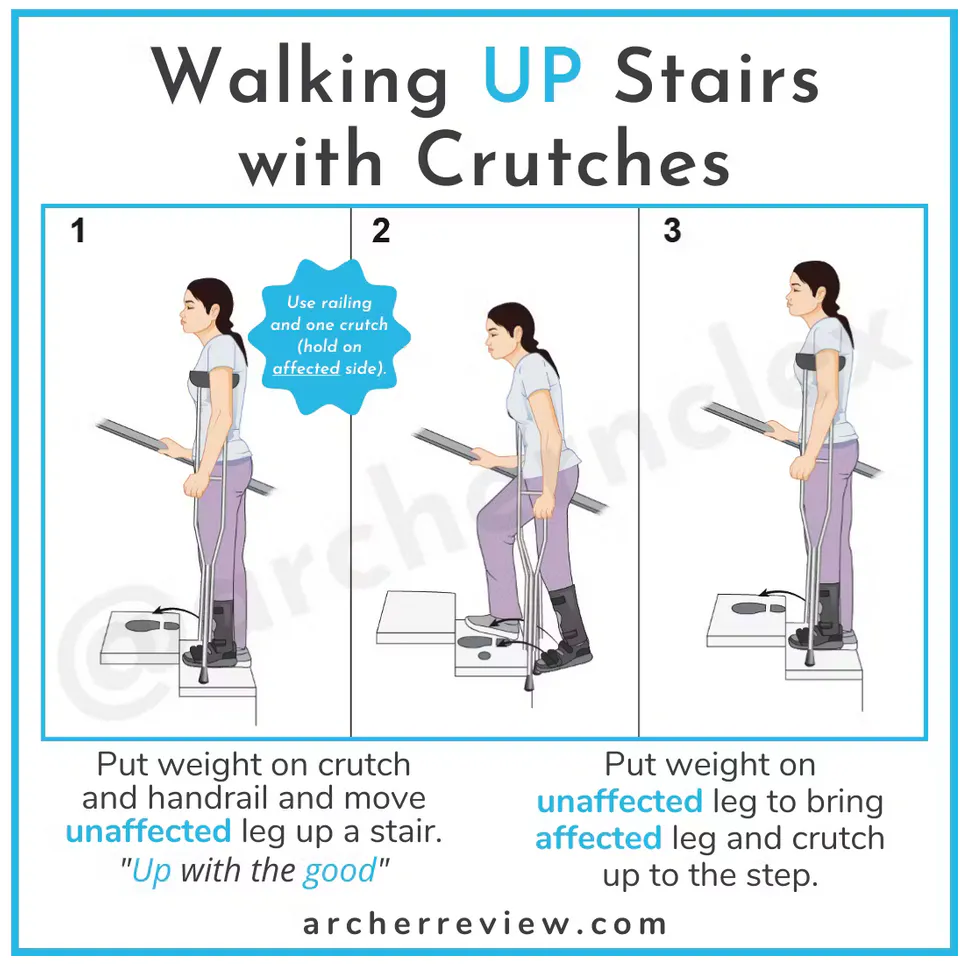
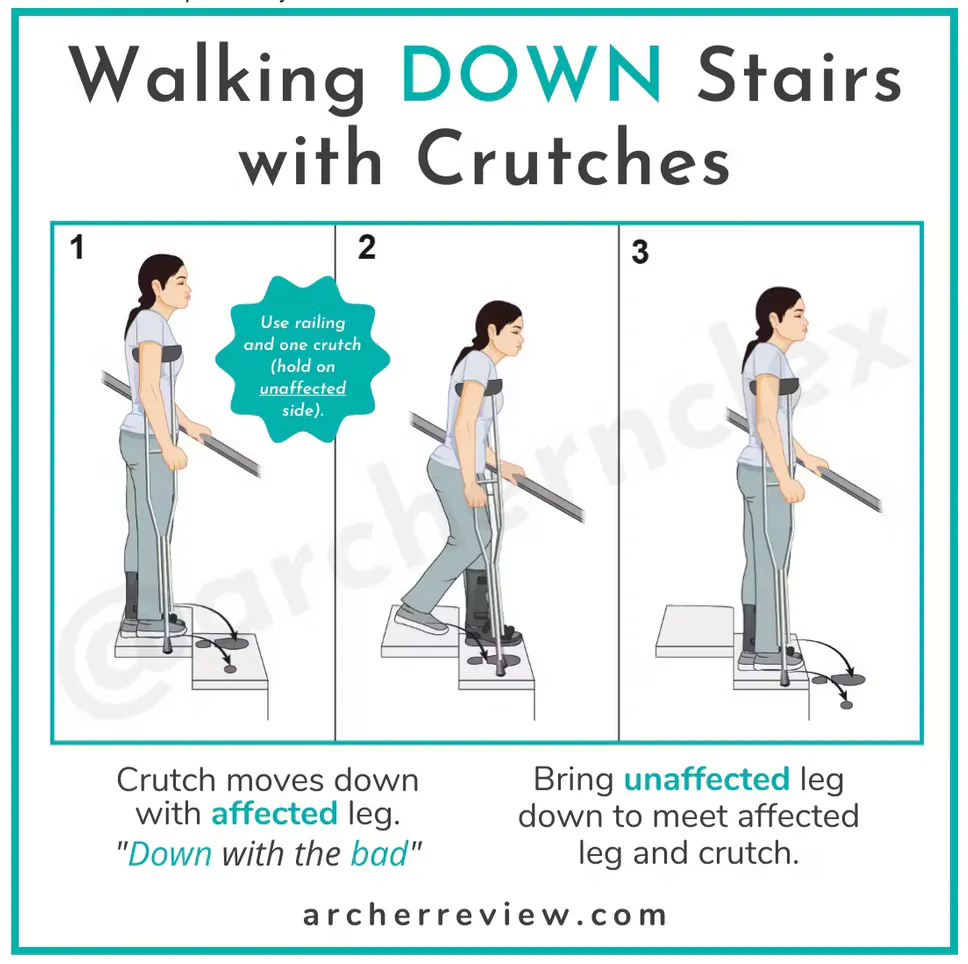
The nurse is teaching a client how to ambulate using crutches.
Which of the following information should the nurse include?
The nurse is teaching a client how to ambulate using crutches.
Which of the following information should the nurse include?
A. "Keep the crutches 4 in (10 cm) in front of your feet while standing."
[9%]
B. "When ascending stairs, lead with your unaffected (stronger) leg."
[67%]
C. "Before sitting down in a chair, move both crutches to the unaffected (stronger) side of the body."
[15%]
D. "Your shoulders should support your body weight while ambulating with crutches."
[9%]
Statistics
Subject/Lesson
Subject
Fundamentals
Lesson
Basic Care & Comfort
Client Need
Test Plan
Basic Care and Comfort
Related Topic
Assistive Devices
Item Type
Item Type
Application
Explanation
Choice B is correct. When using crutches on stairs, the client needs to hold the handrail for support with one hand while placing both crutches on the side away from the handrail. This technique provides stability and prevents falls when ascending and descending stairs. When ascending stairs with crutches, the client should lead with the stronger leg, not the weaker one, to ensure stability and support. The client should place both crutches on the side away from the handrail and use the handrail for support with one hand while ascending.
Choice A is incorrect. The client should keep their crutches 6 in (15 cm) in front of their feet while standing. This provides adequate support.
Choice C is incorrect. Before the client sits down, the client should be instructed to -
- Back up against the chair.
- Put the legs against the front seat of the chair.
- Hold the crutches on the affected (weaker) and use the other hand to hold the arm of the chair.
- Use the unaffected (stronger) leg to lower down in the chair.
- Use the armrests for support if needed.
Choice D is incorrect. The hands and arms should be used to support the body weight. The shoulders supporting the body weight indicate poor posture and put the client at risk for injury.
Related Videos
2 Key Topics
Stairs with Crutches
9.7 Assistive Devices
Additional Info