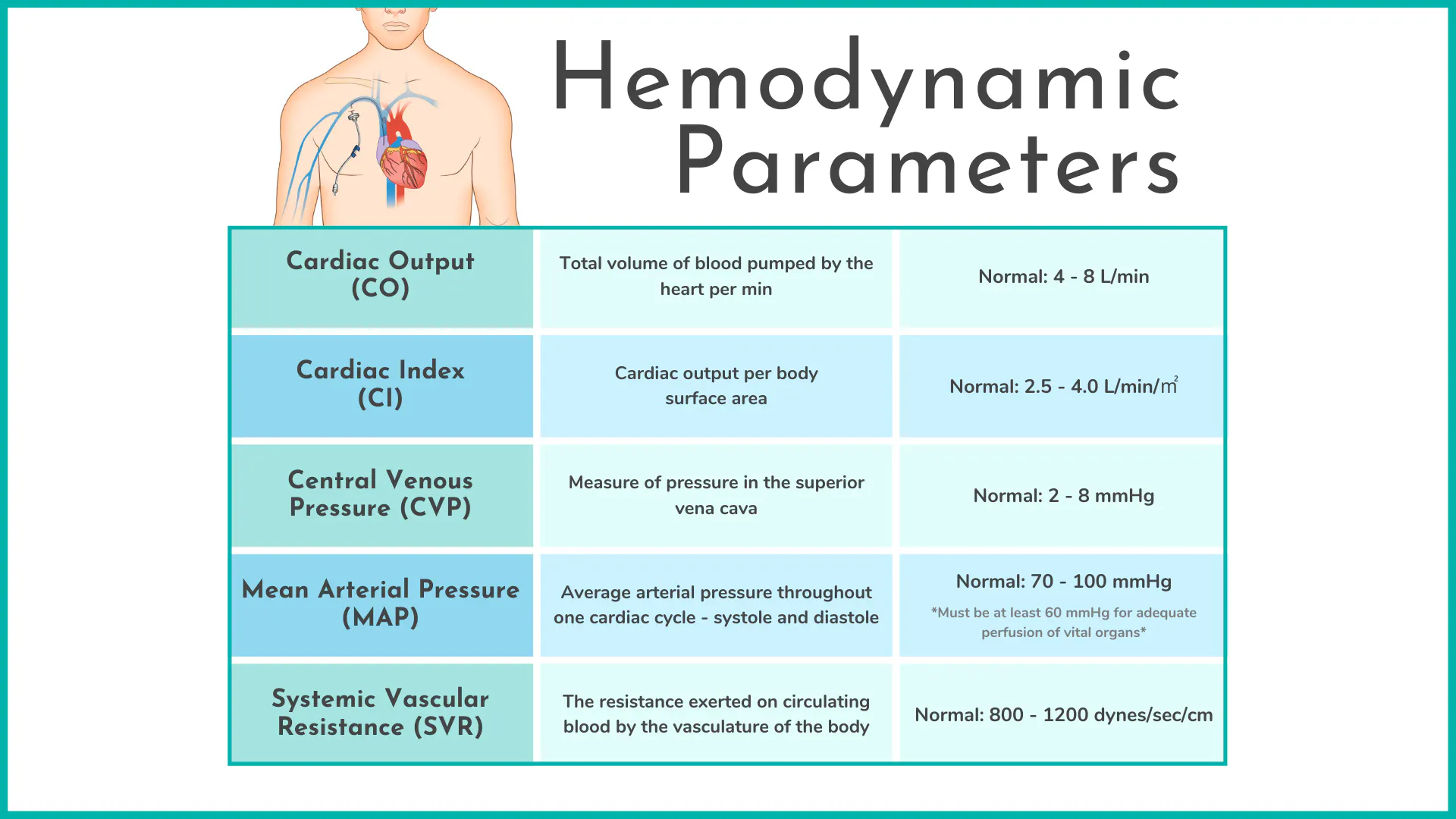
The nurse is caring for a client receiving hemodynamic monitoring. After reviewing the client's central venous pressure, the nurse should take which action based on the client's 0100 CVP reading? Normal CVP is 2-8 mmHg. See the image below.
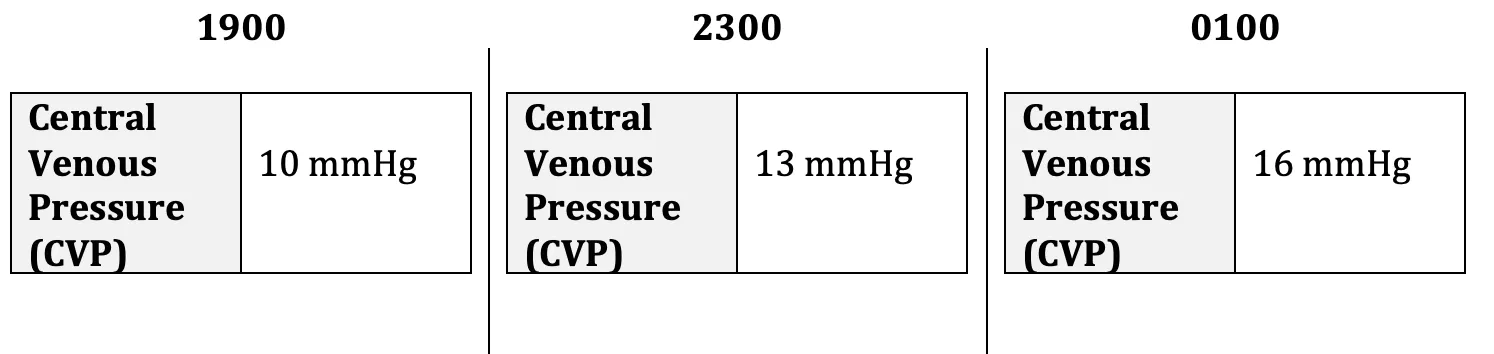
The nurse is caring for a client receiving hemodynamic monitoring. After reviewing the client's central venous pressure, the nurse should take which action based on the client's 0100 CVP reading? Normal CVP is 2-8 mmHg. See the image below.
A. Assess the client for fluid volume overload
[77%]
B. Obtain a prescription for saline fluid bolus
[4%]
C. Document the findings and continue to monitor
[13%]
D. Place the client in a side-lying position.
[6%]
Statistics
Subject/Lesson
Subject
Critical Care
Lesson
Critical Care Concepts
Client Need
Test Plan
Physiological Adaptation
Related Topic
Hemodynamics
Item Type
Item Type
Analysis
Explanation
Choice A is correct. The normal central venous pressure (CVP) is 2 to 8 mmHg. CVP measures the amount of fluid that returns to the right atrium (or preload). This client's CVP has been trending upward, and the nurse should assess the client for hypervolemia, specifically, manifestations of right-sided heart failure.
Choice B is incorrect. This might exacerbate fluid overload and is not the initial action without further assessment. Administering additional fluids without knowing the cause of the elevated CVP could worsen the client's condition, especially if fluid volume overload is present.
Choice C is incorrect. The nurse's initial focus should be on assessing and addressing potential issues related to an elevated CVP. Documentation can follow after the assessment and appropriate interventions.
Choice D is incorrect. The primary concern is to assess for and address fluid volume overload. Placing the client in a side-lying position is not the initial action based on the elevated CVP reading at 0100.
Related Videos
6 Key Topics
Cardiac Output
27.3 Critical Care Cardiovascular System
Central Venous Catheters & Arterial Lines
27.3 Critical Care Cardiovascular System

Imaging
12.2 Diagnostic Testing & Monitoring
Additional Info
✓ CVP measurement can be obtained through a central venous catheter. The normal value is 2 to 8 mmHg.
✓ A low CVP may be caused by venous dilation and low fluid volume.
✓ A high CVP may be caused by hypervolemia, tension pneumothorax, or right-sided heart failure.