The nurse is triaging clients in the emergency department (ED).
Which client should the nurse recommend to the primary healthcare provider (PHCP) to be assigned to the intensive care unit (ICU)?
The nurse is triaging clients in the emergency department (ED).
Which client should the nurse recommend to the primary healthcare provider (PHCP) to be assigned to the intensive care unit (ICU)?
A. 28-year-old admitted with S. pneumoniae meningitis and has a Glasgow Coma Scale of 13.
[50%]
B. 59-year-old admitted with decompensated heart failure receiving oxygen therapy and hospice services.
[16%]
C. 33-year-old admitted with cholecystitis and is receiving patient-controlled analgesia.
[6%]
D. 67-year-old admitted with intractable pain and vomiting secondary to metastatic ovarian cancer.
[28%]
Statistics
Subject/Lesson
Subject
Critical Care
Lesson
Critical Care Concepts
Client Need
Test Plan
Pharmacological and Parenteral Therapies
Related Topic
Expected Actions/Outcomes
Item Type
Item Type
Analysis
Explanation
Choice A is correct. S. pneumoniae meningitis is a life-threatening central nervous system infection. Delayed diagnosis and delayed administration of antibiotics may lead to permanent neurological deficits and increased mortality/ morbidity. Neurological decline, including seizures, may occur in a client experiencing bacterial meningitis. Coupled with the potential for bacteremia leading to sepsis (pneumococcal sepsis), this client requires intensive care. This client requires aggressive and prompt administration of antibiotics following a diagnostic lumbar puncture.
Choices B, C, and D are incorrect.
- Decompensated heart failure is a serious illness. However, considering this client is receiving hospice care, critical care admission is highly unlikely. The major tenet of hospice care is symptom control and not life-prolonging therapy, which may be achieved on a medical floor or at home (choice B).
- Cholecystitis with no evidence of septic shock may be treated on the medical floor as this is not a critical illness as it pertains to acuity (choice C).
- For the client with metastatic ovarian cancer experiencing persistent pain and vomiting, optimal pain control, anti-emetics, and fluid repletion are the principal goals of care. These objectives can be achieved in an oncology unit. If the client develops shock despite fluid repletion, then only they need ICU care for possible pressor support (choice D).
Learning Objective
Recognize bacterial meningitis as a condition requiring prompt treatment and ICU care.
Related Videos
5 Key Topics

Meningitis
16.5 Central Nervous System Disorders
Glasgow Coma Scale- Critical Care
27.2 Critical Care Neurovascular System
Additional Info
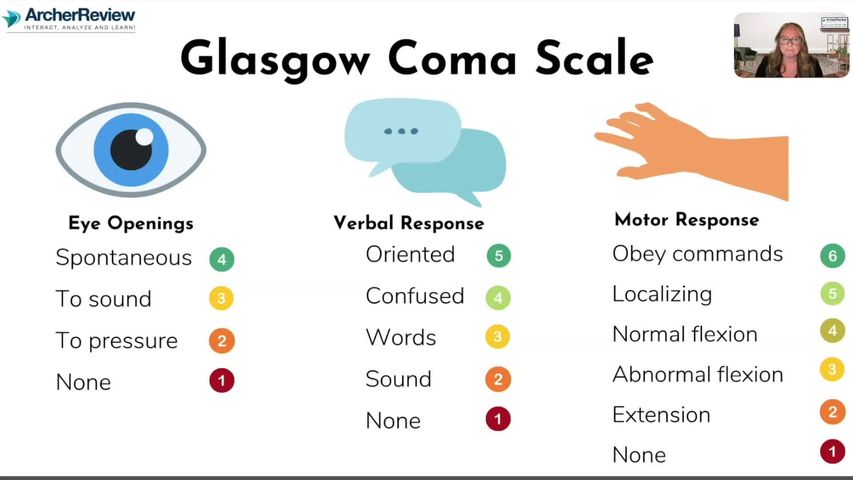
- Neurological functioning is best assessed with scales such as the Glasgow Coma Scale. The highest score is 15, as it measures the best eye, verbal, and motor responses.
- Untreated meningitis is life-threatening. Delayed treatment can cause permanent neurological deficits. Mortality rates were reduced for clients with bacterial meningitis with the prompt administration of antibiotics and steroids as well as admission to the intensive care unit. Intensive/critical care services include the ability to hemodynamically monitor a client, titrate vasoactive medications, and provide highly skilled nursing care.
