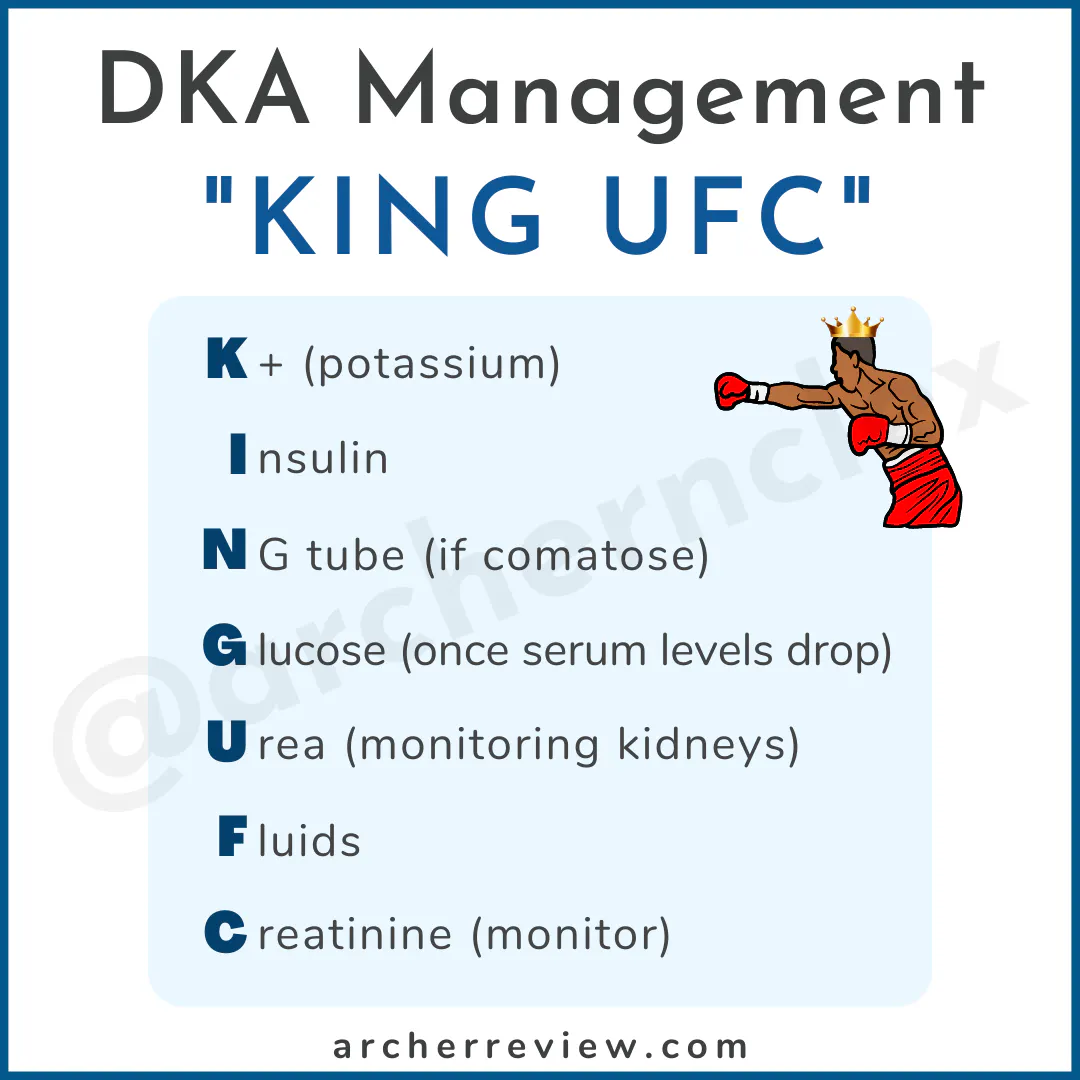
The nurse is planning a staff development conference about diabetic ketoacidosis (DKA).
Which of the following information should the nurse include?
The nurse is planning a staff development conference about diabetic ketoacidosis (DKA).
Which of the following information should the nurse include?
A. The goal is to lower blood glucose by 50 to 75 mg/dL/hr (2.775 to 4.165 mmol/L/hr).
[39%]
B. Dextrose 5% in water (D5W) should be available to treat symptoms of hypoglycemia.
[39%]
C. Hypovolemia caused by DKA may be treated with 3% saline.
[12%]
D. The urine output would increase once regular insulin is initiated.
[9%]
Statistics
Subject/Lesson
Subject
Critical Care
Lesson
Critical Care Concepts
Client Need
Test Plan
Physiological Adaptation
Related Topic
Illness Management
Item Type
Item Type
Knowledge/Comprehension
Explanation
Choice A is correct. DKA presents with hyperglycemia (serum glucose >250 mg/dL, >13.875 mmol/L), acidosis, hyperkalemia, and ketonuria. DKA treatment aims to lower blood glucose by 50 to 75 mg/dL per hour (2.775 to 4.165 mmol/L/hr ) This is accomplished by the prescribed regular insulin, which is given intravenously. If the blood glucose does not decrease by at least 50 - 75 mg/dL in the first hour, insulin infusion should be increased. Insulin infusion should be continued until acidosis resolves. Serum glucose should be maintained between 150 and 200 mg/dL (8.325 mmol/L and 11.10 mmol/L) until the DKA resolves. Once the blood glucose is lowered to 200 mg/dL(11.1 mmol/L), isotonic saline should be switched to D5 1/2 NS (dextrose 5% in 1/2 NS) to prevent hypoglycemia while the insulin infusion continues until the resolution of acidosis.
Choice B is incorrect. Dextrose 50% should be available in the event of severe hypoglycemia. Dextrose 5% is not sufficient to treat hypoglycemia.
Choice C is incorrect. The treatment goal for the hypovolemia caused by DKA is isotonic saline, not hypertonic saline.
Choice D is incorrect. Urine output would decrease with the infusion of regular insulin as correcting the hyperglycemia would treat the polyuria, a hyperglycemia symptom.
Learning Objective
Recognize that DKA treatment is aimed at correcting acidosis. Insulin is continued until acidosis corrects while carefully monitoring for hypoglycemia and hypokalemia.
Related Videos
2 Key Topics
Diabetes Mellitus Type I
19.10 Diabetes Mellitus & Glycemic Control
Additional Info
✓ DKA is a common complication associated with type one diabetes mellitus.
✓ DKA may cause both hyperglycemia and hypovolemia.
✓ Treatment for hyperglycemia includes the initiation of a prescribed regular insulin bolus at 0.1 unit/kg followed by a continuous infusion at 0.1 unit/kg/hr. This treatment will also target the acidosis found with DKA.
✓ Treatment for hypovolemia includes the initiation of isotonic saline infusions.
✓ Close monitoring of their blood glucose and potassium is essential for the client receiving regular insulin. The most common complications of regular insulin therapy are hypoglycemia and hypokalemia.