The nurse in the emergency department is caring for a child with nuchal rigidity, fever, photophobia, and rash. The nurse should initially
The nurse in the emergency department is caring for a child with nuchal rigidity, fever, photophobia, and rash. The nurse should initially
A. provide the client a tepid sponge bath.
[3%]
B. initiate droplet precautions.
[74%]
C. prepare the client for a lumbar puncture.
[16%]
D. prepare the client for a computed tomography scan of the brain.
[6%]
Statistics
Subject/Lesson
Subject
Critical Care
Lesson
Critical Care Concepts
Client Need
Test Plan
Safety & Infection Control
Related Topic
Standard Precautions/Transmission- Based Precautions/Surgical Asepsis
Item Type
Item Type
Analysis
Explanation
Choice B is correct. Meningitis should be suspected based on this client's symptoms of fever, photophobia, and nuchal rigidity. Until the etiology is clear, the client must be placed in respiratory isolation using droplet precautions to prevent the spread of the disease to other individuals. Suspected bacterial meningitis cases warrant placing the client on droplet isolation. All transmission-based precautions must be implemented based on clinical suspicion and immediately on presentation of the client to a health care facility.
Choice A is incorrect. The child's temperature needs to be reduced; however, this is not the nurse's priority. Additionally, tepid sponging alone will not cause a sustained reduction in the fever of febrile clients. When used, tepid sponging is often most effective when combined with pharmacological interventions (e.g., antipyretics) to adequately address the client's fever.
Choice C is incorrect. A lumbar puncture is performed to obtain cerebrospinal fluid (CSF) for analysis, the mainstay of diagnosis. However, the priority nursing action is to place the client in respiratory isolation using droplet precautions upon suspicion of meningitis and arrange for diagnostic procedures once the client has been placed in isolation.
Choice D is incorrect. A computed tomography scan of the brain may be ordered to rule out other pathology and determine if the client has swelling of the brain. This is not the priority compared to protecting the safety of staff and other clients.
Learning Objective
Recognize the signs of meningitis and place the clients with suspected bacterial meningitis on droplet isolation.
Related Videos
4 Key Topics

Meningitis
16.5 Central Nervous System Disorders
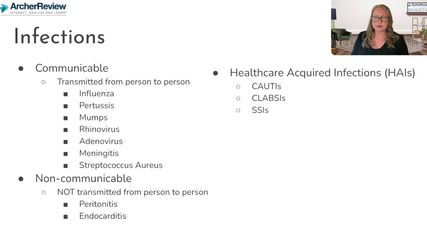
Transmission based precautions- Immune System
23.3 Infection Control & Infectious Diseases
Additional Info
✓ If meningitis is suspected, the client should be treated for acute bacterial meningitis until it is ruled out, even if the cause is suspected to be viral.
✓ Antibiotics are the mainstay of therapy for acute bacterial meningitis.
✓ In addition to antibiotics, treatment includes measures to decrease brain and cranial nerve inflammation and intracranial pressure (ICP).
✓ Most clients are admitted to an intensive care unit (ICU).
✓ Keeping clients in isolation (via droplet precautions) for a minimum of the first 24 hours of therapy can help prevent the spread of meningitis.
✓ Routine vaccination for H. influenza, S. pneumoniae, and N. meningitidis and chemoprophylaxis against N. meningitidis help prevent meningitis.
✓ Viral meningitis begins with symptoms typical of a viral illness, followed by headache, fever, and nuchal rigidity, but is rarely as severe as acute bacterial meningitis.
✓ Treat clients for acute bacterial meningitis until that diagnosis is ruled out.
✓ As soon as acute bacterial meningitis is suspected, blood cultures and lumbar puncture (for cerebrospinal fluid analysis) are performed.
