The nurse is caring for a client with a subarachnoid hemorrhage.
Which electrolyte abnormality may occur as a complication?
The nurse is caring for a client with a subarachnoid hemorrhage.
Which electrolyte abnormality may occur as a complication?
A. hyperkalemia
[23%]
B. hypocalcemia
[11%]
C. hyponatremia
[60%]
D. hypermagnesemia
[6%]
Statistics
Subject/Lesson
Subject
Critical Care
Lesson
Critical Care Concepts
Client Need
Test Plan
Reduction of Risk Potential
Related Topic
Potential for Complications from Surgical Procedures and Health Alterations
Item Type
Item Type
Knowledge/Comprehension
Explanation
Choice C is correct. After experiencing a subarachnoid hemorrhage (SAH), the client is at risk for hyponatremia. Hyponatremia results from the central salt-wasting syndrome of inappropriate secretion of antidiuretic hormone (SIADH). It usually occurs during the same period as vasospasm, several days after the initial hemorrhage.
Choice A is incorrect. Hyperkalemia is not a complication associated with SAH. Hyperkalemia is a clinical manifestation associated with Addison's disease.
Choice B is incorrect. Hypocalcemia is not a complication associated with SAH. Hypocalcemia is a clinical manifestation associated with Cushing's syndrome and hypoparathyroidism.
Choice D is incorrect. Hypermagnesemia is not a complication associated with SAH.
Related Videos
2 Key Topics
Stroke
16.5 Central Nervous System Disorders
Additional Info
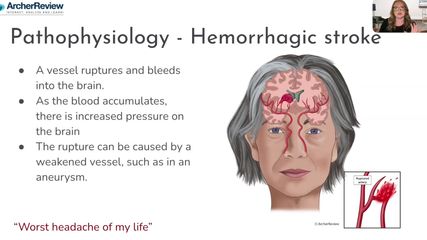
✓ A SAH is due to bleeding in the subarachnoid space.
✓ Causes of an SAH include rupture of a cerebral aneurysm rupture, arteriovenous malformations (AVMs), trauma, and intracranial artery dissections.
✓ Manifestations associated with an SAH include abrupt onset of pain, described as the "worst headache of my life." A brief loss of consciousness, nausea, vomiting, focal neurologic deficits, photophobia, and a stiff neck.
