The nurse is caring for a client who is two hours postoperative after having a water-seal chest tube placed for a hemothorax. The nurse observes that the drainage in the collection chamber has decreased in the previous hour from 50 mL of bloody drainage to 25 mL. The nurse should assess
The nurse is caring for a client who is two hours postoperative after having a water-seal chest tube placed for a hemothorax. The nurse observes that the drainage in the collection chamber has decreased in the previous hour from 50 mL of bloody drainage to 25 mL. The nurse should assess
A. for tidaling in the water seal chamber.
[10%]
B. the tubing for any possible kinks.
[73%]
C. the system for an air leak.
[7%]
D. for bubbling in the suction control chamber.
[9%]
Statistics
Subject/Lesson
Subject
Critical Care
Lesson
Critical Care Concepts
Client Need
Test Plan
Reduction of Risk Potential
Related Topic
Potential for Complications of Diagnostic Tests/Treatments/Procedures
Item Type
Item Type
Application
Explanation
Choice B is correct. The nurse should assess the tubing for any kinks for a client with hemothorax and who has had less than 100 to 300 mL of bloody drainage during the first 2 hours postoperatively. The tubing directly empties into the drainage collection chamber, and considering that it is too early for the hemothorax to resolve, it is likely an obstruction in the tubing. Another intervention the nurse can take is moving the client to allow the fluid to drain into the system. Chest tube drainage should be free of any kinks.
Choice A is incorrect. Assessing for tidaling in the water seal would not be helpful because the issue is in the drainage collection chamber.
Choice C is incorrect. Assessing for an air leak is irrelevant to problems in the water seal chamber. This client's issue is that the drainage in the suction control chamber is decreasing, so the problem would be the tubing and drainage collection chamber. An air leak would not cause drainage to decrease. This client's issue is the drainage decreasing, so assessing the suction control chamber for bubbling would not be relevant.
Choice D is incorrect. The client's chest tube is to water seal, and the suction control chamber should not be bubbling.
Related Videos
4 Key Topics
Chest Tubes- Respiratory System
17.4 Chest Tubes

Chest Tubes
4.2 Thoracic Drainage
Additional Info
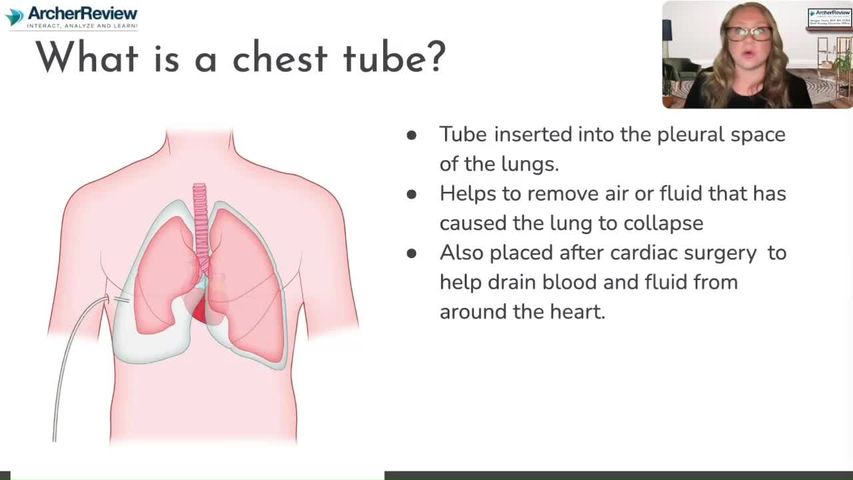
✓ A chest tube is a primary treatment for a client with a pneumothorax or hemothorax.
✓ The nurse is responsible for assessing the patency of the system by assessing each chamber.
✓ The nurse should always ensure client safety by having the appropriate emergency equipment at the bedside.
✓ This equipment includes occlusive sterile gauze, a bottle of sterile water, and clamps.
